Early Medieval Europe / CAROLINGIAN ART / OTTONIAN ART
 Call Kai
 Learn
 Practice Test
 Spaced Repetition
 Match
 Flashcards
 Knowt Play
1/11

There's no tags or description
Looks like no tags are added yet.
12 Terms
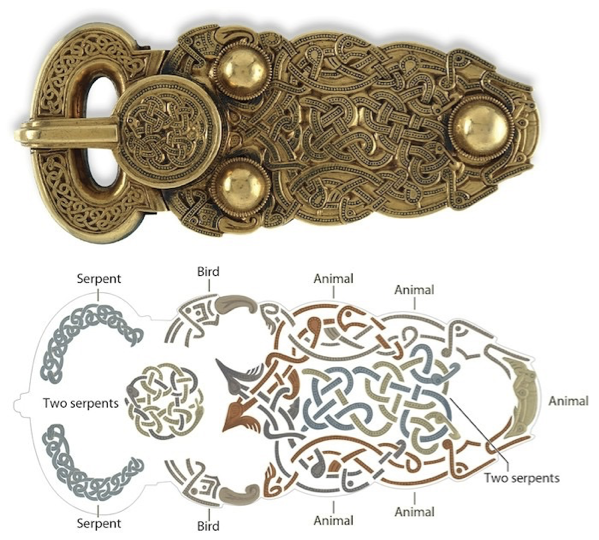
Gold belt buckle from the Sutton Hoo Ship Burial, England, c. 625, in the British
Museum, London
found in ship burial (common for elites in england at the time)
animal interlace - snakes biting their own tails, birds, other unknown animals
over under, knotted pattern
value of gold shows how rich and powerful the elite buried there was
shows complex metalworking techniques that arose in middle ages

Shoulder clasp from the Sutton Hoo Ship Burial c. 625, in the British
Museum, London; gold and garnet
Garnet cloisonne - gold strips were soldered to make compartments and then inlaid with garnet gemstones and blue glass
geometric pattern surrounded by serpent interlace
value of gold shows how rich and powerful the elite buried there was
shows complex metalworking techniques that arose in middle ages

Iron mask from the Sutton Hoo Ship Burial c. 625, in the British
Museum, London
found broken into hundreds of fragments, had to be reconstructed
armor - would have offered battlefield protection while signifying royalty
appears as human face with eye sockets, breathing holes, and gilded mustache
very rare find - buried with elite owner to signify status, bravery, and societal significance

The Book of Durrow, c. 660, produced in an unknown
Northumbrian monastery, now in Dublin, Trinity College Library,
tempera on parchment.
-Page with the Man, Symbol of the Evangelist Matthew
cloak resembles a cloisonne brooch
bordered by abstract interlace pattern
stiff cloak, matthew depicted frontally but with profile feet
medieval abstraction with roman christian imagery

The Lindisfarne Gospels, made at Lindisfarne in Northumbria, ca. 700,
probably written and decorated by Eadfrith, before he became bishop of
Lindisfarne, now in the British Library, London, tempera on vellum
-Carpet page with a cross
incredibly intricate serpentine interlace - snakes curl over and devour one another
chaos is held in check by geometric enclosure and inscribed cross
feeling of motion
-Portrait of the Evangelist Matthew
matthew sits in his study writing in a codex, clothed in drapery with curved lines to represent folds
largely in profile but with a twisted perspective
probably modeled after a Mediterranean depiction of matthew
writing is a combination of greek and latin
head (moses) looks at matthew from behind curtain
his closed book (old testemant) contrasts with matthew’s open book (new testament)
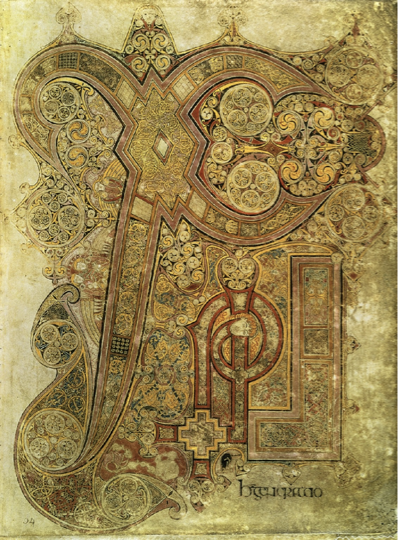
Chi Rho Iota page, from the Book of Kells, ca. 800, ink and pigment on
vellum from 100 calves, Trinity College Library, Dublin
first three letters of christ’s name
abstract geometric pattern brings beauty to gods words
flat, line-heavy early middle ages style
male head grows from letters and three angels are present

Palace chapel of Charlemagne, Aachen (Aix-la-Chapelle),
Germany, 792-805, Odo of Metz architect
modeled off the church of san vitale, sought to evoke images of byzantine glory
early geometric, vaulted medieval building
embodies strength
charlemagne had private view of altar from his thrown

Gospel book of Charlemagne ("Coronation Gospels"), ca. 800-810,
Kunsthistorisches Museum, Vienna: Portrait of the Evangelist
Matthew
Charlemagne was very learned and invested in the liberal arts, renewed bible making efforts
matthew is seated writes in codex, working on new testament
new style used to depict matthew compared to early middle ages
color and shading used to distinguish shapes, not line work
many parallels to roman style, which makes sense because charlemagne was trying to reestablish the image of the christian roman empire
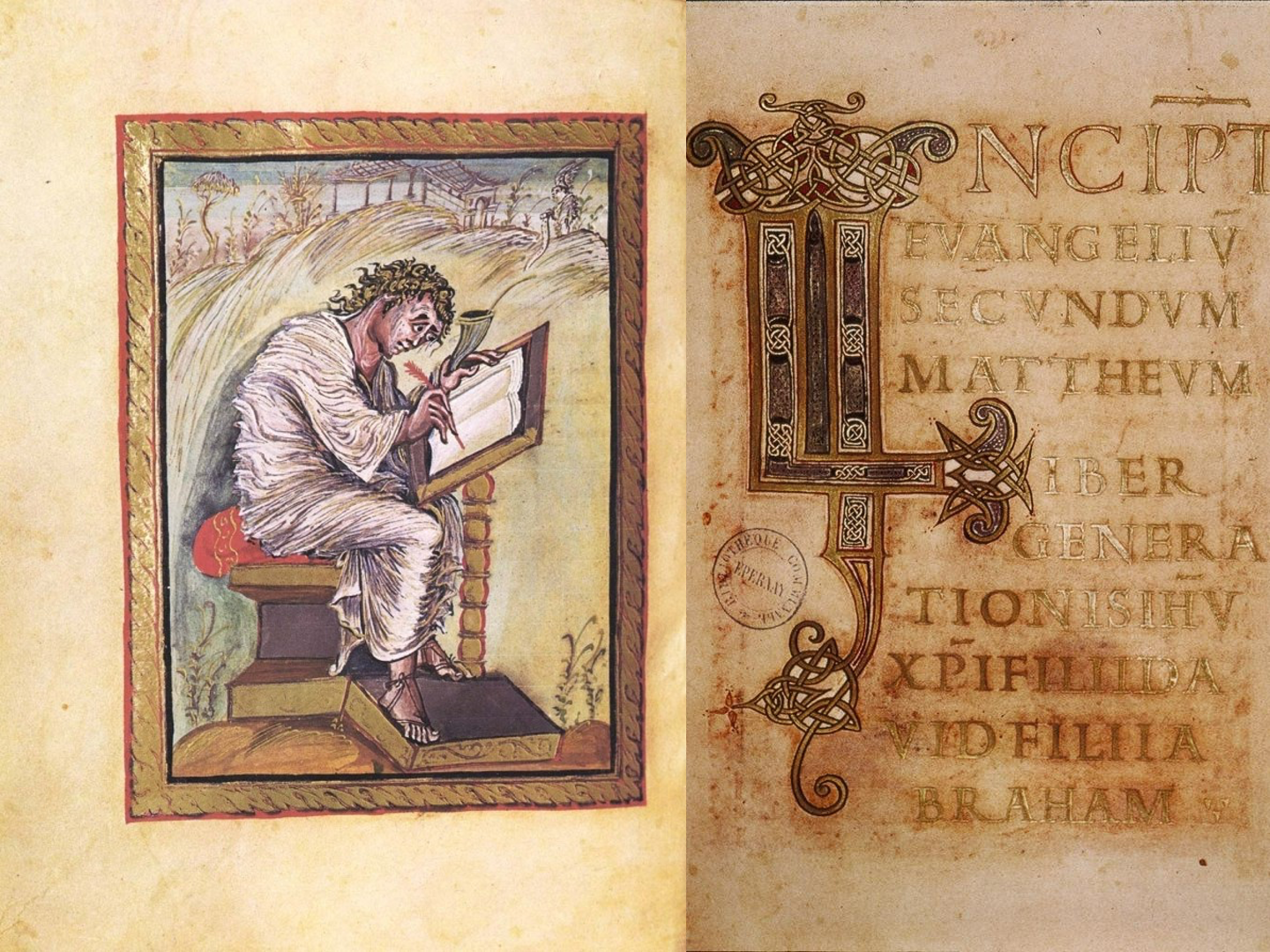
Gospel book of Archbishop Ebbo of Reims ("Ebbo Gospels"),
made at Hautvilliers, near Reims c. 816-40: Portrait of the
Evangelist Matthew
matthew writes frantically while folds of fabric vibrate
holds inkhorn in left hand and pen in right hand
twisted profile, shading, highlights, and dress reminds of roman style
however also has line work that blends in european style
it mixes the styles

Lindau Gospels, cover with Crucifixion, gold, precious stones, and
pearls, ca. 870, Pierpont Morgan Library, New York
cover was luxury item commissioned by Carolingians
showed wealth of owner and glorified the word of god
christ nailed to cross is central focus
youthful, beardless, and unsuffering
shown alongside angels and virgin mary and saint john

Bronze doors for St Michael’s, Hildesheim, Germany, 1015
(Bishop Bernward) “Temptation; Accusation; Annunciation”
St. Michael’s is a basilica plan church
the door contains old testament scenes foreshadowing new testament scenes
may have been inspired by santa sabina
bronze metalwork sculpture
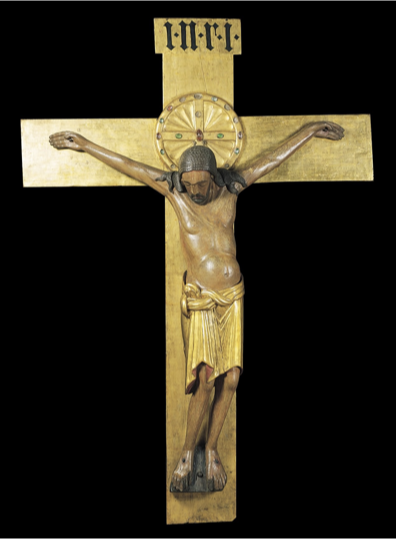
The Gero Crucifix, c. 970, wood, 6’ 2” tall, commissioned by
Archbishop Gero, Cologne Cathedral
differs from youthful depictions of christ without suffering
portrays christ as experiencing intense suffering
very emotional work
blood streaks down forehead
halo may foretell ressurection
strongest depiction of agony in early middle ages