Gamebird test 2
 Call Kai
 Learn
 Practice Test
 Spaced Repetition
 Match
 Flashcards
 Knowt Play
1/133

There's no tags or description
Looks like no tags are added yet.
134 Terms
what are key events in an organisms life, can include juvenile development, age of maturity, mating systems, clutch size, parental investment, senescence and death?
life history
what is when life history events occur, examples include pair formation, courtship, body molt, wing molt, migration, nesting, etc?
annual cycle

what is the top annual cycle?
passerines

what is the bottom annual cycle?
dabbling ducks

what does the dark red signify?
wintering

what does the bright red signify?
molt

what does purple signify?
migration

what does green signify?
breeding
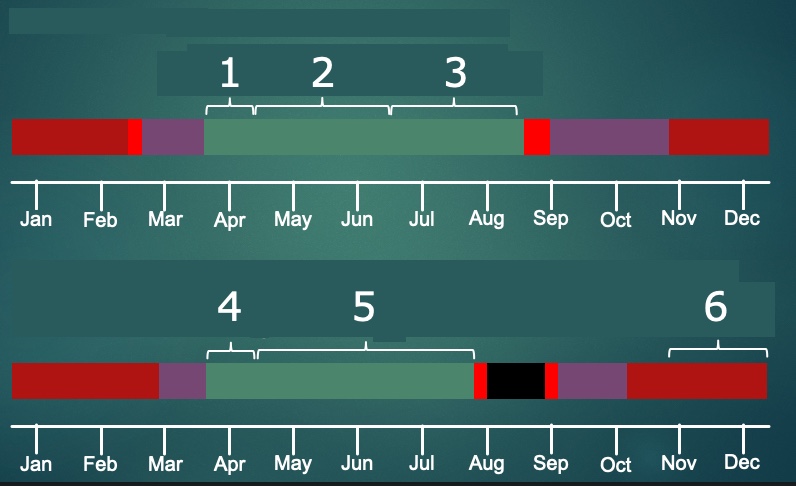
what does black signify?
pre migration

what is 1?
pair formation

what is 2?
nesting

what is 3?
post fledging

what is 4?
pre breeding

what is 5?
nesting and brood rearing

what is 6?
pair formation
what is some differences between passeriformes and anseriformes?
passeriformes has condensed breeding season, molt to breeding plumage in spring, and spend all winter in non breeding plumage, anseriformes pair bonds on wintering grounds, molt to breeding plumage in fall, spend short time in non breeding plumage
what is the consequence of pair bonding on wintering grounds?
promotes monogamy
what is the consequence of molting to breeding plumage during fall?
males stand out in hunting season
what is the consequence of having a short time in non breeding plumage?
nutrition important to molt quickly
what are the three functions of feathers?
thermoregulation, aerodynamics, communication and camoflauge
what are the major types of feathers?
contour, semiplumes, down, bristles, filoplume
what are the two sources of plumage color?
pigments, structural colors
what is the process of shedding feathers and the replacement of those with a new generation of feathers?
molting
what are the two main dangers with molting?
lose 25% of lean body mass, flightless period
roughly how many days is the flightless period for swans?
35-40
roughly how many days is the flightless period for geese?
30
roughly how many days is the flightless period for ducks? (molt for females later than males)
30
what are the 5 major plumages?
natal, juvenal, basic, alternate, supplemental
what was the First attempt to standardize molt and plumage and Defined the Basic and Alternate Plumages and molts to achieve those?
Humphry parkes
what was the big change was to set the juvenile plumage as the first basic plumage; which helps to solve evolutionary differences in molt and to establish homologous molt strategies across taxa?
Howell modified
what Relies on a calendar to age birds based on a date relative to January 1?
calendar based system
what means All individuals hatched within the calendar year?
hatch year
what means Any bird outside the hatching calendar year?
after hatch year
what means Birds after January 1st of the following hatch calendar year?
second year
what means all birds older than the 2nd year?
after second year

memorize this (I dont have any good way to put this in a card)
ok
what Since 2010 new terminology is being proposed to age birds based on plumage and molt and not calendar year terms. The WRP adopts terminology established by Howell, and replaces calendar cycle terms with molt and plumage terms?
Wolfe-ryder-powell system
what are the 4 primary molting strategies in birds?
simple basic, complex basic, simple alternate, complex alternate
what means Birds have formative but no alternate plumage includes Whistling-Ducks, Swans, Geese, wild turkey, Northern Bobwhite, Scaled Quail?
complex basic
what means No pre-alternate molt in first cycle includes Scoters, Ptarmigan?
simple alternate
Birds have formative and alternate plumages attain breeding plumage through Prebasic Molt includes All Anas, Aythya, most sea ducks, most grouse (sage grouse, ruffed grouse)?
complex alternate
what is undetermined as yet wither CAS or SAS. Attain breeding plumage through prealternate molt?
ruddy duck
what Occurs once per year and entails change of entire plumage, Flight feathers are first to be replaced, followed by a body molt ( = delayed molt), Results in breeding plumage (now termed Basic Plumage)?
pre basic molt
what Replaces certain body feathers in bird from juvenal plumage? (is an insertive molt)
pre formative molt
what in Both sexes molt important body feathers into a more cryptic plumage state (now termed Alternate Plumage)? (is an insertive molt)
pre alternate molt
what includes Formative and Alternate plumages in molt cycles?
complex alternate strategy
what happened to birds reproductive organs when in the non breeding season?
regress to non functional state
the photoperiod stimulates the release of what, which causes the testes to growth 300-400 times their size?
gonadotropins
what are extremely rare in birds, but are in waterfowl?
intromittent organs
how did the intromittent organs probably evolve in waterfowl?
extra pair copulations and water
the ovary also largely increases in size during the breeding season, which ovary is functional in birds?
left
because there is rapid follicle development, how fast does each ovum mature?
6-8 days
which way does the male copulatory organ corkscrew?
counter clockwise
which way does the female copulatory organ corkscrew?
clockwise
where do many forced copulations end in waterfowl?
blind pouches
what Evolved as a strategy for males to increase genetic benefits, Can have severe consequences for the female, especially if in water (drowning), Importance of vaginal morphology, sperm competition, timing of mating, Most frequent mate (pair-bonded male) typically fertilizes the eggs, EPC rate can reach 50% of matings, but success rate still < 5%?
extra pair copulations
what is some information about waterfowl eggs?
precocial development, enough yolk for hatchlings to survive 5 days, each egg 5-25% of female body weight, 40% yolk
what strategist has rapid body growth, high reproduction rate, early reproduction, and sometimes single reproduction?
r
what strategist has slower body growth, lower reproduction rate, delayed reproduction, and multiple reproductions?
K
what are some examples of waterfowl r selection?
blue winged teal, northern pintail
what are some examples of waterfowl K selection?
common eider, Canada goose
what are Arctic-nesting geese and eiders use endogenous (stored) reserves for both egg laying and incubation?
capital breeders
temperate-nesting ducks use some endogenous reserves for egg production but also rely heavily on exogenous protein and minerals?
income breeders
when does incubation usually begin for ducks?
penultimate day of laying
usually how many breaks do species take from incubation per day?
2
usually how long does incubation last?
24-26 days
what hypothesis says females can only cover so many eggs, and is it true or not?
incubation hypothesis, unsure
what hypothesis says female can only care for so many young, and is true or not?
brood rearing hypothesis, no
what hypothesis says that females can only lay so many eggs (nutrient limitation), and is it true or not?
egg production hypothesis, yes
what hypothesis says early-laid eggs decline in viability, incubation must start AND extending the window of predation risk is bad?
viability predation hypothesis, yes
what kind of nests rely on old growth forests, relies on woodpeckers, includes wood ducks, bufflehead, goldeneyes, and mergansers are secondary obligate, and whistling ducks are facultative?
cavity nesting
what has been shown to happen when there are too many nest boxes in one area?
increased rates of brood parasitism
what nesting is generally nesting on semi permanent water bodies, survival is higher due to less predation, includes canvasbacks, redheads, ring necked ducks, ruddy ducks?
overwater nesting
what nesting depends on pairing and migration chronology and also egg laying energetics, includes most dabbling ducks?
upland nesting
what nesters are Mallards and Northern Pintail? (April)
early
what nesters are Blue-winged Teal and Northern Shovelers? (early may)
mid nesters
what nesters are Gadwall, American Wigeon, Lesser Scaup are even later? (late may)
late nesters
what are the benefits of early nesting?
more resources, more space, can renest
in what do Ducklings and hen all communicate to synchronize, typically in the morning, most within an hour of each other, leave nest within 24 hrs?
hatching
what is the average survival rate of nests, and how much is needed to sustain populations?
10-30%, 15%
how does nest survival increase?
nest age, earlier in season
how do skunks find nests?
accidentally
how do foxes find nests?
methodically
when should males abandon nests?
High probability of remating, Two parents are not required for brood-rearing, Cost of male attendance is high
when should a female abandon nest?
Female presence does not enhance offspring survival, Costs to female (survival) outweigh the benefit of staying
what care does Dendrocygninae, Anserini, Cygnini have?
intense parental care
what care does Anatinae have?
female care of young
what stage of brood development is downy young?
Class I
what stage of brood development is partly feathered young?
Class II
what stage of brood development is partly feathered young(no down visible in this period)?
Class III
what is brood amalgamation called?
creching
what percentage of mortalities occur within the first 10 days? (higher survival in wet years, earlier in season, and wetlands)
70-90%
what is one of the most studied aspects of waterfowl biology because of its strong influence on populations?
nesting ecology
what is it called when male and female gametes differ in size and shape?
Anisogamy
what are females limited by in reproduction?
number of gametes and energy to put in them, access to resources
what are males limited by in reproduction?
limited by number of mates, access to mates
what says that Selection for traits of females that increase access to resources, Selection for traits of males that increase access to mates?
Bateman’s principle
what means one mate?
monogamy
what means one male mated to more than one female?
polygyny
what means a female mated to more than one male at a time?
polyandry