Boolean logic
 Call Kai
 Learn
Learn Practice Test
 Spaced Repetition
 Match
Match Flashcards
 Knowt Play
1/31

There's no tags or description
Looks like no tags are added yet.
Name | Mastery | Learn | Test | Matching | Spaced | Call with Kai | Chat |
|---|
No analytics yet
Send a link to your students to track their progress
32 Terms
What are the main features of boolean logic?
It is a branch of mathematics
created by George Boole
The values are binary so either True or False
4 Main logic operators(in order of operation):
NOT
AND
OR
XOR
What is the algebraic and alternative symbols of AND?
Algebraic: ^ e.g. A ^ B
Alternative: . e.g A . B
What is the algebraic and alternative symbols of OR?
Algebraic: v e.g A v B
Alternative: + e.g. A + B
What is the algebraic symbol of XOR?
Algebraic: ⊕ e.g A ⊕ B
What is the algebraic and alternative symbols of NOT?
Algebraic: ¬ e.g ¬A
Alternative: Ā e.g Ā
What are the four algebraic operation names?
NOT = negation
AND = conjunction
OR = disjunction
XOR = exclusive disjunction
What is the difference between ¬(A ^ B) and ¬A ^ ¬B
The first one requires you to work out A ^ B first as it is in brackets then invert the 0 and 1.
The second one requires you to work out NOT A and NOT B first then add them.
What can you use to simplify boolean expressions?
Karnough maps
What are the 6 rules of K maps
Grouping should be a power of 2
no diagonal groups
they should be as large as possible
henceforth meaning fewest number of groups
overlapping allowed
wrapping around allowed
What is an adder and half adder?
Half adder - basic digital circuit used two add two singe bit numbers - has two outputs and two inputs - sum and carry. (carry is the 1 carried over)
Adder - extension of the half adder to add three bits. - two outputs - three inputs
Why do CPU’s not have half adders at the start?
Because that would require two molds to make full and half adders, so its cheaper just to make one.
What is the logic gate for a half adder?
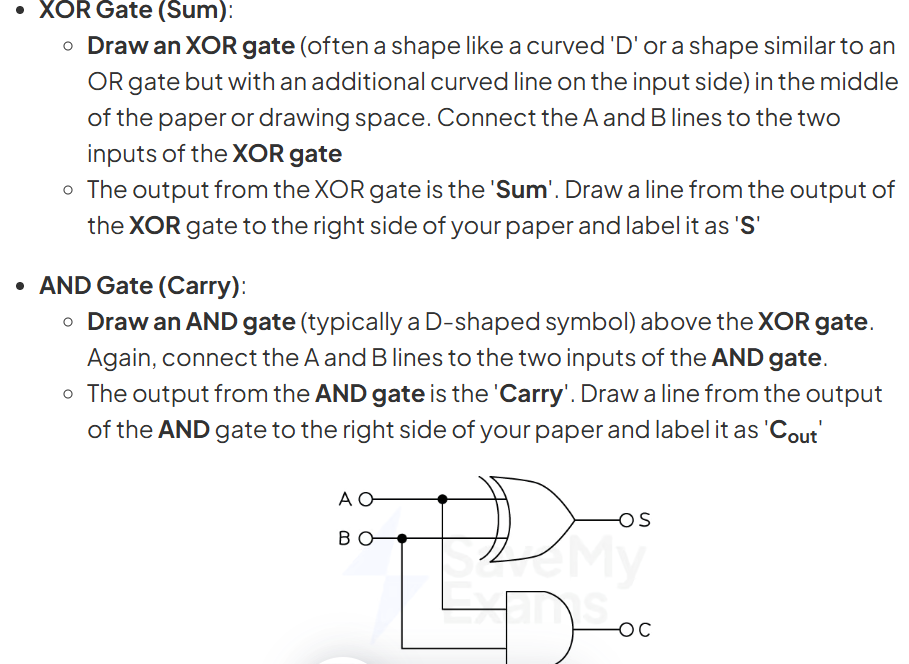
What is the truth table for a half adder?

What is the logic gate for a full adder

What is a half adder and its features?
It is the basic digital circuit used in computation to perform the addition of two single bit numbers.
therefore it has two inputs and two outputs
its two outputs are the carry out - which is the carry in binary addition and the sum which is the outputted number in the addition.
What is a full adder and it’s features?
it is an extension of the half adder where it adds three bits because the half adder can’t take the count into account.
therefore three inputs and two outputs
the extra input is Cin because it is the count.
you can connect these together to add together more bits.
What is a flip flop and its purpose?
A flip flop is a bi stable circuit with two stable states, used to store one bit of data as it loops
t has D and CLK inputs, and Q and NOT(Q) outputs
It is positive edge triggered: it changes only on the rising edge of the clock
If D = 1 at the rising edge, Q = 1 and NOT(Q) = 0
If D = 0 at the rising edge, Q = 0 and NOT(Q) = 1
Q holds its value until the next rising edge
It is used in memory units, shift registers, counters, latches, and synchronous circuits
Explain the different inputs and outputs in a D type flip flop
D input = data input which is what is wanted to be stored
CLK input = clock input - which controls when the data waiting is copied
Q - the main output of the stored bit
NOT Q = the opposite of Q. (When Q is 1 - NOT Q - 0) Visa versa.
What is the difference between twos compliment and sign and magnitude?
twos compliment has the MSB as a value.
e.g. in 8 bit binary if the MSB was 1 it could be -128
sign and magnitude has the MSB representing positive and negative.
e.g. the MSB being 1 means the number is negative and 0 = positive.
How to convert an integer to 2’s compliment?
e.g. 12
write out the number normally = 0000 1100
flip the signs = 1111 0011 - this is known as 1’s compliment
add one to the LSB = 1111 0100
that’s it
How to subtract numbers in binary?
e.g. 50 - 100
write out 50 in binary = 00110010
write out 100 in twos compliment - 10011100
then add them together - 11001110 (NOTE if there is an overflow then ignore it and don’t use that bit in the final answer)
the answer is also in twos compliment too.
What is the problem with sign and magnitude?
there are two different ways to represent 0:
1000
0000
this makes addition and subtraction difficult and can cause errors
this is why twos compliment is used
how do fractional signed numbers work in binary?
They are always in twos compliment and standard form
a decimal point is used to separate integers from fraction
it goes down in halves
e.g.
2^-1 2^-2 2^-3
½ ¼ 1/8
How do accuracy and precision change when representing a certain number of bits in fractional binary?

What are the two main benefits of normalization?
making sure there is only one possible combination of representing the number
Making sure you can keep it to the highest degree of accuracy possible.
What do positive and negative normalized floating point numbers start with?
Positive = 0.1
negative = 1.0
How to normalize a decimal number?
e.g. 6.5
write out the value in binary
Move the decimal point over to the first instance where it is normalized (shown in the image)
in the image it has been moved three places to the left (become bigger) so the exponent must be three
And therefore the mantissa will be the new value starting from the digit to the left of the decimal place

How does the mantissa effect precision?
Higher mantissa = higher precision and lower range
higher exponent = higher range and lower precision
What is the mantissa?
he part of a floating-point binary number that stores the significant digits and the sign of the value
What is the exponent?
the part of a floating-point binary number that scales the value by moving the binary point
What is normalization?
adjusts the mantissa and exponent so that the number has a unique and most precise format
What is truncation?
the process of shortening a number by discarding all digits beyond a specific point or available storage limit, without performing any rounding