Module 1 - Viscous behaviour and texture analysis
 Call Kai
 Learn
Learn Practice Test
 Spaced Repetition
 Match
Match Flashcards
 Knowt Play
1/29

There's no tags or description
Looks like no tags are added yet.
Name | Mastery | Learn | Test | Matching | Spaced | Call with Kai | Chat |
|---|
No analytics yet
Send a link to your students to track their progress
30 Terms
Content of module 1 - Viscous behaviour and Texture analysis
Introduction to rheology
Viscous behaviour
Texture analysis
Introduction to rheology - Definition rheology
study of the relationship between the deformation of a material and the corresponding forces as a function of the time during which the material is subjected to these forces
amount of deformation depends on
timescale
intensity of acting force
Introduction to rheology - deformation
= change in sample dimensions under an acting force
Introduction to rheology - flow
= continuous deformation under the acting force
Introduction to rheology - rheological behaviour
Type of rheological behaviour | Type of deformation | interaction forces |
ideally viscous | irreversible deformation |
|
viscoelastic | partial deformation behaviour |
|
ideally elastic | reversible deformation |
|
Introduction to rheology - deformation behaviour
Compression
Extension
Shear = force applied parallel of the top plane

Introduction to rheology - deformation behaviour: compression (1)
all side compression → volume of sample will decrease in function of the compression force
Introduction to rheology - deformation behaviour: compression (1) of ideal elastic products
P=−KϵV
P = compression stress
K = compression modulus
ϵ=VΔV
Introduction to rheology - deformation behaviour: extension (2)
forces clamped on 2 sides —> move in opposite way
σL=AF
ϵL=LΔL
ϵL = extension strain
Introduction to rheology - deformation behaviour: shear deformation (3)
A = surface area (m²)
F = shear force (N)
shear stress = τ=AF
shear deformation = shear strain = γ=hdu=tan(α)

→ instrument = rheometry
Introduction to rheology - deformation behaviour: shear deformation (3) of elastic solid

→ deformation is reversible = elastic
Introduction to rheology - deformation behaviour: shear deformation (3) of liquid

→ deformation is irreversible
strain rate = shear rate = \gamma^{\cdot}=\frac{d\gamma}{\differentialD t}\left\lbrack\frac{1}{s}\right\rbrack
Introduction to rheology - test classified according to deformation

Viscous behaviour
Fluids
studied under shear in a viscometer or rheometer
deformation behaviour = flow behaviour
Viscous behaviour - General content
Terminology: shear stress, shear rate, shear viscosity
Newtonian behaviour
Rotational tests
flow curve
time-dependent behaviour
Viscous behaviour - Terminology (1)
shear stress = τ=AF[m2N]=[Pa]
shear strain = shear deformation = γ=hdu[−] → !! not constant
strain rate = shear rate =\frac{d\gamma}{\differentialD t}=\frac{dv}{dh}\left\lbrack\frac{1}{s}\right\rbrack
shear viscosity = η=γ⋅τ[Pa⋅s]
η: temperature dependant

Viscous behaviour - Newtonian behaviour (2)
Deformation is irreversible
ex. water, solvents, oils
General: deformation energy → frictional heating → fluid heating + environment heating → deformation energy is lost → deformation is irreversible
Viscous behaviour - Rotational tests (3) - Flow curve: newtonian behaviour


viscosity fluid 1 < viscosity fluid 2
tau 1 < tau 2 → more force is needed at fluid 2 to get the fluid flowing at a certain shear rate
Viscous behaviour - Rotational tests (3) - Flow curve: non-newtonian behaviour
T-dependant !!
η ^*= apparent shear viscosity

shear-thinning
shear stress ↑ → viscosity ↓
reasons: disintegration, orientation, deformation
shear-thickening
shear stress ↑ → viscosity ↑
reasons: particles come more and more into contact with one another → increased flow resistance
Viscous behaviour - Rotational tests (3) - Flow curve: yield point
τy = yield point = minimal shear stress inducing sufficient deformation for the material to flow
below yield point
elastic behaviour
acts like solid
beyond yield point
sample flows
irreverisble deformation

Methods to find yield stress
dynamic yield stress = τy = intersection at γ⋅=0

static yield stress
increasing shear stress from 0 shear till it starts to flow → τy = crossover point of low deformation and high deformation region

Dependant on
time
sample manipulation
test conditions
Viscous behaviour - Rotational tests (3) - Flow curve: rheological models

Viscous behaviour - Rotational tests (3) - Flow curve:time-dependent behaviour
First method
possible responses of a fluid put under constant shear rate
no change in shear stress and viscosity → time independent (ex. oil)
decreasing shear stress and viscosity over time → thixothropic (ex. ketchup)
increasing shear stress and viscosity over time → rheopectic (ex. starch solution)

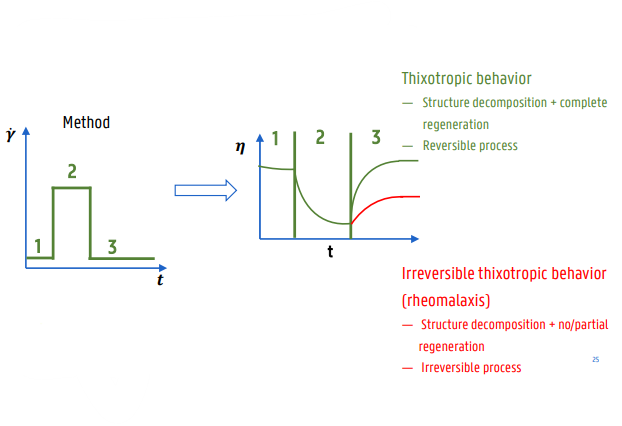
rheomalaxis
weak particle gel network → easily irreversibly damaged → loss initial structure
Alternative method
time-dependent → hysteresis
thixothropic → curve will shift to lower shear stress
rheopectic → curve will shift to higher shear stress

Texture analysis
Large deformation
Compression or extension
Recording force during deformation
Texture parameters can be derived
Texture profile analysis
Texture analysis - different tests
puncture test
compression-extrusion test
cutting shear test
compression
texture profile analysis
tensile/extension test
Texture analysis - different tests: puncture test (1)
action: push a probe into the sample
preset: penetration depth and speed are constant
result: force as a function of time
Measured force depends on
food texture
size and shape of the probe
penetration depth
penetration speed
Graph
initial rapid rise = deformation under load
at sudden change of slope → penetration starts
irreversible damage
bio-yield point
Texture analysis - different tests: compression-extrusion test (2)

Steps
food is packed closely
liquid is pressed out
food ruptures and flows up through annulus
Texture analysis - different tests: cutting shear test (3)
cutting action divides the product in 2 pieces
Texture analysis - different tests: compression test (4)
sample is compressed between 2 plates
Texture analysis - different tests: texture profile analysis (5)
two subsequent compressions imitate two bites (‘of consumer’)
Parameters
Fracturability
load suddenly drops
does not occur for all foods
Hardness
maximum force recorded during first and second cycle
Adhesiveness
adhesion of probe to sample when moving upwards
Cohesiveness
= area 2/area 1
measures how the sample stays cohesive during compression
Springiness
distance 2/distance 1
to determine how much sample recovers in height after the first compression
Gumminess = hardness*cohesiveness
Chewiness = gumminess*springiness
Texture analysis - different tests: tensile/extension-test (6)
sample is stretched out by hook