Clinical Trials Midterm
 Call Kai
 Learn
 Practice Test
 Spaced Repetition
 Match
 Flashcards
 Knowt Play
1/123

Earn XP
Description and Tags
STAT 509 Terms to Know
124 Terms
Clinical trials
The evaluation of intervention (treatment) on disease in a controlled experimental setting. Prospective studies designed to evaluate interventions and therapies to prevent or treat a condition in a particular population of patients. Most involve random assignment to treatment groups.
Examples:
comparison of AZT versus no treatment on the length of survival in patients with AIDS
Evaluating hormonal therapy on reduction of breast cancer
Epidemiology
A systematic study of disease etiology (causes and origins of disease) using observational data.
Examples:
Secondhand smoking and lung cancer
Air pollution and respiratory illness
Diet & heart disease
Value
Evaluate an intervention that has the potential to be of social or scientific value - ethical conduct of clinical research
Scientific validity
Using methods that will produce reliable results - essential to ethical conduct of clinical research
Fair selection of participants
Participant selection that avoids placing the vulnerable at undue risk and avoids preferential access of attractive interventions to the privileged - ethical conduct of clinical research
Favorable benefit/risk balance
Minimize risks and maximize potential benefits, with an estimate that benefits will likely outweigh risks - ethical conduct of clinical research
Independent review
Review of design by individuals not directly affiliated with the research - ethical conduct of clinical research
Informed consent
Provide information about purpose of research, procedures, and potential risks and benefits to enable participants to make voluntary decisions in a way that respects participant autonomy - ethical conduct of clinical research
Respect for enrolled participants (beneficence)
Protect the rights and wellbeing of participants - ethical conduct of clinical trials
Equipoise
In a situation where there is reasonable certainty that a certain treatment arm is more effective than the other, patients are entitled to be moved to the more effective therapy.
Conflicts of interest
Bias in design, conduct, data analysis, interpretation, and reporting of findings. To avoid, there should be full financial disclosure, analysis should be conducted and/or validated by groups outside industry sponsor, and clinical trial results must be accepted by the clinical community.
Monitoring
Interim statistical analyses that involve independent boards of scientists overseeing trial results, making decisions about continuation or modification, and ensuring safety monitoring
Privacy & confidentiality
Clinical research provisions that affect how investigators identify, contact, and obtain informed consent, how study data are maintained and provided to others, and the sharing of biospecimen type data
Data integrity
Concern about falsification of data and entry of ineligible or phantom participants in clinical trials
Publication bias
Positive or exciting findings are more likely to be published than null results
Cross-sectional study
Data are obtained from a random sample at one point in time. This gives a snapshot of a population.
Prevalence
The proportion of individuals with a disease at one time point.
Relative risk (risk ratio)
Compares the risk of exposed and unexposed subjects.
ψ = P(D|E) / P(D|Ē) = (n11/n1+) / ((n21/n2+)
NOTE: cannot estimate in retrospective studies
Odds Ratio
Compares the odds of contracting a disease.
θ = P(D|E)/{1-P(D|E)} / P(D|Ē)/{1-P(D|Ē)} = n11n12 / n21n22
cohort (incidence) study
A longitudinal prospective study in which a cohort of individuals are identified who are free of a particular disease under study and data are collected on certain risk factors. These individuals are then followed over some specified period of time to determine whether they get disease or not. Incidence and risk factors are then examined.
Retrospective/Case-control study
Individuals with disease (cases) and individuals without disease (controls) are identified. Using records or questionnaires the investigators go back in time and ascertain exposure status and risk factors.
Cannot directly estimate relative risk in these studies, but can estimate the odds ratio.
Pros:
efficient for rare diseases
fast results, low cost
limited attrition of patients
Cons:
recall bias (relies on memory), other bias in obtaining exposure info
Selection bias
Pre-clinical study
Goal: “scale up” previous results to provide first idea of behavior in humans
Advantage: ethical issues involved in human experimentation circumvented
In vitro study
Laboratory investigations using biological material but not actual organisms; look for biologic activity of the drug
In vivo studies
Pre-clinical studies that perform testing on animals
Phase I trial
Determine safe starting doses for humans based on data from animal studies or similar drugs already developed
first studies conducted in humans, usually with a small group of healthy volunteers
Small sample sizes
Main goals:
To explore toxic effects of drugs and determine a tolerated dose for future experimentation
To explore pharmacology of the drug and investigate its interaction with other food, drugs, and alcohol
Phase II trial (preliminary efficacy)
First studies in diseased patients (for non-cancer drugs)
Larger sample size
Drugs which show little promise are screened out at this phase
Multiple doses are usually studied
Main goals:
To determine whether there is sufficient evidence of benefit to warrant further study
To extend the safety information of the treatment
Side effects and toxicity
Feasibility of treatment, logistics of administration & cost
Dose finding (lowest dose level with good efficacy)
Phase III trial (confirmatory studies)
Large studies in a more heterogeneous population; sample size must be large enough & diverse enough
Typically at least 2 required before approval
Studies form the basis for approval by regulatory agencies
Last phase pre-approval
Main goals:
To confirm efficacy observed in phase II
To establish safety in a wider variety of patients and for longer term
Black box warning
The label on a box telling the patient it might cause a variety of conditions that researchers couldn’t control for or mitigate during clinical safety trials.
Package insert (PI)
A slip inside the drug which contains the clinical trial information and warnings for the drug for patient knowledge consumption
Phase IV trial (post-marketing)
observational studies of approved and marketed drugs
rare but serious side effects may be detected
Monitoring systems are in place for reporting side effects of marketed drugs (eg. Timed visits and symptom recording, regulatory level data collection)
Early Feasibility Study (EFS)
Medical device development pathway
Feasibility & device performance
Procedural & device-related safety
Device success and functionality
Regulated by the IDE
Often includes fewer than 20 participants
Followed by confirmatory pivotal study
Dose-finding studies
Studies which determine the maximum dose that can be given without serious problems
Clinical pharmacology studies
Determine the pharmacokinetics (PK) of the drug to aid in setting dosage schedules, understanding how “problems” are related to amount of drug present
Pharmacokinetics
What the body does to the drug, including the half-life of the drug in the body, how the drug changes while in the body, how the body breaks down the drug, etc.
Drug-drug interaction studies
Determine how other commonly used drugs affect important PK parameters; investigate the effect of a commonly used drug on some important PK parameters of the new dug.
Cross-over design (when washout is possible): Some study subjects randomly assigned to A+B then A or vice versa.
Parallel design (when washout is hard to achieve): study subjects are randomly assigned to A+B or A. Compare important PK parameters of A under A+B to the PK parameters under A
Drug-food interaction studies
Determine how food affects important PK parameters of the new drug
endpoints based on PK
Design and analysis are similar to the drug-drug interaction study
Alcohol/benzo interaction studies
Determine how alcohol/benzo affects pharmacodynamics (PD) parameters, specifically reaction time, short-term memory, ability to keep body balanced, etc.
crossover or parallel design
Longitudinal data for each endpoint
Mixed models for each endpoint
Multivariate mixed models for multiple endpoints
Pharmacodynamics
What the drug does to the body, i.e. how the body changes based on the drug’s introduction
Toxicity
Problems that may arise in direct response to administration of the drug (i.e. side effects)
which are relevant depends on the intervention, nature of likely subjects, clinical judgment (defined by the investigators)
what degree is “acceptable” must be established
Dose Limiting Toxicity (DLT)
Describes side effects of a drug or other treatment that are serious enough to prevent an increase in dose or level of that treatment
Maximum Tolerated Dose (MTD)
The “highest possible while still tolerable” dose
involves some level of toxicity we are willing to tolerate because of the drug’s potential benefit
Eg. “the dose that results in toxicity of grade III or worse in no more than one out of three patients”
Standard (3+3) design
Method of determining the MTD. Select a sequence of increasing doses. start with the lowest dose level and administer the drug to 3 subjects.
If 0/3 DLTs, assign 3 new patients to the next higher dose
If 1/3 DLTs, assign 3 new patients at this dose
If 1/6 DLTs, assign 3 new patients to the next higher dose
If ≥ 2/6 DLTs, STOP
If 2/3 DLTs, STOP (or assign 3 new patients to the preceding dose level unless there are already 6 patients at that level)
Advantages:
easy to understand & implement
No prespecified sample size
Disadvantages
often produces imprecise estimates of true MTD
Targets toxicity rates 20-25% of the time
Doesn’t handle missing toxicity info well
A+B Designs
A generalization of the 3+3 design. Subjects are treated in cohorts of size A starting with the lowest dose. Suppose that the most recent cohort was a cohort of A subjects that has been treated at dose dj where j=1…K-1. Then:
If XA(dj) ≤ cL the next cohort of A subjects is assigned to dose dj+1
If cL≤ XA(dj) ≤ cU the cohort of B students is assigned to dose dj+1 otherwise the trial is stopped.
If XA(dj) ≥ cU then the trial is stopped.
The dose that is one level below the dose where a high number of responses are observed is the estimated MTD.
The Pharmacokinetics Process (ADME)
Absorption, distribution, metabolism, excretion - the processes that detail a drugs movement and processing in the body
Characterize properties such as food interaction drug-drug interactions, and organ impairment effects
these studies guide further research, proper dosing, and enhance drug success in clinical studies and real-world usage
Absorption
The process where a drug travels from administration site to bloodstream, involving bioavailability, the fraction reaching the site of action post-administration
Factors: chemical properties of the drug, drug formulation, route and site of administration, interactions with food or other drugs, patient variabilities
Distribution
The process of a drug traveling into different organs and tissues from the blood.
measured by volume of distribution (VD) = (Amt of drug in body) / (Plasma concentration)
Protein binding affects drug availability, with unbound drug needed for effect
Factors: fluid status, blood flow, chemical characteristics of the drug, protein binding
CL = (rate of drug elimination) / (Drug concentration)
Metabolism
The process of chemically altering the molecules of a drug, which creates new compounds - associated with the liver
Occurs in various stages, primarily in the liver
Factors: genetic factors, age, and drug interactions
Excretion
The process of eliminating drugs not metabolized - primarily done by kidney
Common route: renal excretion
Other factors: health conditions, intrinsic drug properties, genetic variation, age
Key measure: half-life (t½) → time it takes for drug concentration to decrease by 50%
Cross-over design
Use when washout is possible.
Some study subjects are randomly assigned to A+B and then to A. Other subjects are given A and then A+B. Compare the important PK parameters of A under A+B to the PK parameters under A.
Analyze via linear mixed model for formal statistical inference.
Parallel design
Use when washout is hard to achieve.
Study subjects are randomly assigned to A+B or A. Compare important PK parameters of A under A+B to the PK parameters under A.
surrogate endpoint
Can be measured sooner than an official endpoint, uses fewer patients sooner with a lower cost. This enables go/no-go decisions before the first clinical outcomes are available. May be difficult to establish. It is sometimes possible that the new drug may affect surrogate markers but have no effect on the final clinical endpoint & vice versa.
Not frequently used in Phase III trials, often used when it is impractical to use a clinical endpoint due to low event rates.
Examples:
Lowering blood pressure or cholesterol for patients with heart disease
Increasing CD4 & T-cell counts or decreasing viral load for patients with HIV
Gehan’s two-stage design
Helps with discarding ineffective treatments early. Focuses on detecting activity and does not explicitly control for error. Not commonly used today.
Stage 1: Give new treatment n0 patients. If none respond, declare ineffective.
Stage 2: If at least one patient responds in stage I, add n-n0 patients and count the total number of patients responding to the new treatment. Calculate point estimate of π and construct a CI.
n0 = log(α0) / log(1-π0)
1.96√(π0)(1-π0)/n = estimated margin
“Is there enough evidence of treatment activity to justify further study?”
Simon’s two-stage design
Provides an early stop point that enables go/no go decisions. Explicitly controls Type I error and power.
Investigators must decide on values π0 and π1, with π0 < π1 for the probability of response so that
π ≤ π0 → we want to declare the drug ineffective with high probability
π ≥ π1 → want to consider drug for further investigation with high probability
Region of parameter space π0 < π < π1 is the indifference region
Optimal design is the one with the smallest expected sample size when π = π0 (when the new drug is ineffective)
“Can we statistically distinguish between unacceptable response rate (π0) and promising response rate (π1) while allowing early stopping for futility?”
Mantel-Haenszel test (MH odds ratio)
Provides a pooled odds ratio across the strata of a 2×2 table representing dichotomous counts.
Assumes a consistent odds ratio across strata while accounting for varying rates within each stratum. By calculating the odds ratio within each stratum and then combining these estimates, it derives the common odds ratio across all strata.

JT (Jonckheere-Terptsra) trend test
Based on a sum of Mann-Whitney-Wilcoxon test statistics. Values near zero support H0, large positive values of JT support an increasing trend and large negative values of JT support a decreasing trend.
Considerations in clinical trials
The trial needs to be done
The disease must have a high incidence and/or a serious course and a poor prognosis
Existing treatment must be unavailable or somehow lacking
The intervention must have promise of efficacy (preclinical & phase I + II evidence)
The trial question posed must be appropriate and unambiguous
The trial architecture is valid (random allocation, blinding)
Inclusion/exclusion criteria in clinical trials need to balance efficiency and generalizability
The trial protocol is feasible
The trial administration is effective
Superiority test
Testing whether the new treatment is superior to the standard treatment
H0: ∆ ≤ 0
H1: ∆ > 0
Noninferiority test
Testing whether the new treatment is not worse than the standard treatment (one-sided inquiry)
H0: ∆ ≤ -M (inferiority)
H1: ∆ > -M (non-inferiority)
Objective endpoints
Considered the gold standard for clinical trials, distinct stopping points for a study. Eg. death, heart attacks, strokes
Subjective endpoints
Usually patient-reported or perception-based measures; most important to patient quality of life & wellbeing.
Composite endpoints
Combinations of endpoint events, typically time to first event among composites. Most often used because of sample size considerations.
Eg. time to first heart attack or death
Randomized clinical trial (RCT)
Comparative studies with an intervention group and a control group to evaluate the effects of an intervention. The assignment of the participant to a group is determined by the formal procedure of randomization.
Main goal: to obtain a true assessment of the treatment effect and to carry out valid hypothesis tests.
Advantages of randomized design:
Removes potential of bias in allocation
Tends to produce comparable groups
Guarantees validity of statistical tests of significant
Random error
Refers to the variability within the human population, resulting in relatively significant random fluctuations.
Bias
Refers to deviations that are not due to chance alone
Selection bias
Selecting a sample that is not representative of the population.
Procedural selection bias
Occurs when treatment assignments are influenced by patients or investigators.
Post-entry exclusion bias
Occurs when the exclusion criteria for subjects are modified after examination of some or all of the data.
Assessment bias
The potential for inaccuracies or distortions in patient or physician assessments of a patient’s status, particularly in subjective measurements like pain or symptoms.
Statistical biases
The difference between the parameter to be estimated and the mathematical expectation of the estimator. Can result from methods of analysis or estimation.
randomization, blinding, concurrent controls, objective assessments, follow-up, no post-hoc exclusion
Key design features for controlling bias in clinical trials
non-randomized concurrent control
Participants allocated into treatment and control arms by a nonrandom process
comparison of survival results of patients treated at two institutions
patients offered two treatments and choose
Patient as own control (cross-over design)
Special case of randomized control trial, with each participant to serve as their own control (reduces between-patient variability)
wash-out period may be required between periods
fewer patients needed
carryover effects, period effects, sequence effects, only certain types of outcomes
Analysis may be more difficult
Historical controls
All participants in the trial receive a new intervention and the results are compared to the outcome in a previous study control group.
easier to recruit, sample size can be larger
Particularly vulnerable to bias from time trends
Trends in prevalence of various disease
Need do separate treatment effect from time trend
Shifts in diagnostic criteria due to improved tech can cause major changes in frequency of degrees and prognosis
Not very common because conditions don’t carry over and we don’t know that previous thresholds are the ideal standard
Hierarchical models
Statistical framework used to analyze nested or clustered data.
We conduct N studies from a population of studies, and for each study i we sample ni individuals at random from the i-th study group and count the number of responses Xi. n1 … nN are random variables from some distribution. They can be summarized by iid random vectors where πi is a true response rate for the i-th study population.
Allocation concealment
Treatment allocation should be concealed until the time of randomization, i.e. neither the patient nor the investigator should know the next treatment assignment.
Critical to preventing procedure selection bias
Also referred to as blinded randomization
Blinding
Not knowing which treatment is given after randomization, such as drug vs. placebo. Provides a measure of assurance that the study outcome is being objectively measured. The randomization sequence should only be available to a few individuals in a trial.
Practical considerations: ethical, possible, trial design features, feasible
Enrollment
Registering a patient into a study. Prior steps include informed consent and checking study eligibility criteria. Patients will get a subject ID number during this step.
Sharp null
Under H0 it is assumed that there is absolutely no difference in the effectiveness of treatment A and B.
Fixed allocation
Randomization probabilities are prespecified and constant (not altered as the study progresses)
Simple randomization
Permuted block randomization
Stratified randomization
Adaptive allocation
Randomization probabilities respond to assignments or outcomes.
Baseline covariate adaptive randomization
Response adaptive randomization
More complex method because it doesn’t predetermine randomization, and future treatment assignments depend on information about participants already enrolled such as baseline characteristics or outcomes
Simple randomization
Each participant that enters the trial is assigned treatment A or B with probability π or 1-π respectively, independent of everyone else. If n patients are randomized with this scheme, the number of patients assigned Treatment A is a random quantity that follows a binomial distribution Bin(n,π)
Advantages:
easy to implement
Impossible for investigators to guess what next treatment assignment will be
Properties of many statistical inferential procedures are established under simple randomization (iid) assumption
Disadvantage
possibility exists of severe treatment imbalance (less efficient, loss of credibility in trial results)
Permuted block randomization
Fixed block size:
Choose a block size & generate all possible combinations with the number of treatments. Each block of a given size randomly picks up one combination with equal probability, and those patients within the block are assigned treatments specified by the combination.
However, clinician may be able to guess what treatment the next patient is going to receive, which could cause potential bias. This can be solved by varying block size.

staggered entry
Patients enter a study sequentially over time as they become available and eligible for a study.
Utilize in stepped wedge design
Stratified randomization
Use blocked randomization within strata formed by different combinations of prognostic factors. Patients are randomized using block sizes equal to b within each stratum. Stratification is crucial for small to moderately sized trials, but should always be included, especially accounting for site.
Advantages:
makes the treatment groups appear similar
facilitates within stratum (subgroup) analysis
May result in more precise estimates of treatment difference
Disadvantages:
Too many prognostic factors to form strata, with very few patients in some strata
More difficult to implement and prone to error
Prognostic factors
Different characteristics of the patients other than treatment which may affect their response to the treatment, such as age, gender, race, white blood count, etc.
Baseline covariate adaptive randomization
Attempt to balance the allocation of patients to treatment overall and/or by prognostic factors.
The next treatment assignment is given that maximizes the imbalance on key prognostic factors between treatment groups - age, sex, race, etc.
typical methods: urn randomization, minimization or dynamic allocation
Frequently used in mental health trials
Maintains better balance than stratified randomization
Often used for small studies (N<100-200) in which baseline imbalances on important prognostic factors could raise concerns about the validity of the trial
Disadvantages
complex to implement
Criticized for being deterministic (not true randomization procedure)
Efron biased coin design
As soon as the treatments become sufficiently imbalanced favoring one treatment, then the randomization is chosen to favor the other treatment in an attempt to balance more quickly while still incorporating randomization so that the physician can never be certain of the next treatment assigned.
Choose an integer D and a probability ϕ ≤ 0.5. nA and nB denote the number of patients on treatment A or B ar any point in time in the study respectively. The next patient to enter the study will be randomized to treatment A or B with probability πA or 1-πA where:
πA = .5 if |nA - nB| ≤ D
πA = ϕ if nA - nB > D
πA = 1 - ϕ if nB - nA > D
Essentially, if imbalance ≤ D: equal chance. Otherwise favor the underrepresented arm with ϕ ≤ 0.5.
Urn Model
Start with 2m balls in an urn; m labeled A and m labeled B. When the first patient enters the study you choose a ball at random from the urn and assign that treatment.
If you choose an A ball, you replace it in the urn and add an additional B ball
If you choose a B ball then you replace it and add an additional A ball
As soon as imbalance occurs in favor of one treatment, chances become greater to get the other treatment in an attempt to balance more quickly.
Criticism:
design-based inference is difficult to implement
complexity of implementing these methods may not be worthwhile
Pocock and Simon Minimization
A deterministic scheme for allocating treatment with the goal of balancing many prognostic factors by treatment.
The next patient that enters the study is assigned either treatment A or according to whichever makes the subsequent measure of marginal discrepancy smallest. In case of a tie, the next patient is randomized with probability .5 to either treatment.
Response Adaptive Randomization
Responses of past participants in the study are used to determine the treatment allocation for the next patient.
motivation: more patients receive the better treatment
Method requires a response that can be determined quickly
Disadvantages:
Information on response may not be available immediately
May take a greater number of patients to get the desired answer
May interfere with the ethical principle of equipoise
Results may not be easily interpretable from design
Play-the-Winner Rule
Type of response adaptive randomization.
First patient is randomized to either treatment A or B with equal probability.
Next patient is assigned same as previous if the previous patient’s response was a success. If previous patient’s response is a failure, then the patient receives the other treatment. The process calls for staying with the winner until a failure occurs and then switching.
Response Adaptive Urn Model
Type of response adaptive model.
First patient is assigned to either treatment by equal probability.
A success on treatment A → add 1 A ball into the urn
A failure on treatment A → add 1 B ball into the urn.
Then, the next patient is assigned to whichever ball is drawn at random from this urn.
ECMO trial
Promising treatment for a neonatal population suffering from respiratory insufficiency. Utilized play-the-winner rule because outcome of each case was known soon after randomization, anticipated most treatment patients would survive and most control would die (modest participant count), and it was reasonable for the scientific dilemma.
10 patients randomized to treatment and all survived, while only one was randomized to control and died.
unblinded
All patients and the clinical trial research staff know the treatment assignment
Single blind
Only patients are masked to treatment assignment; the investigator and clinical trial research staff know the treatment assignment
Double blind
Neither the patient nor the investigator/research staff knows the treatment assignment
Triple blind
Neither the patient, investigator/research staff nor the person evaluating the response to treatment knows the treatment assignment.
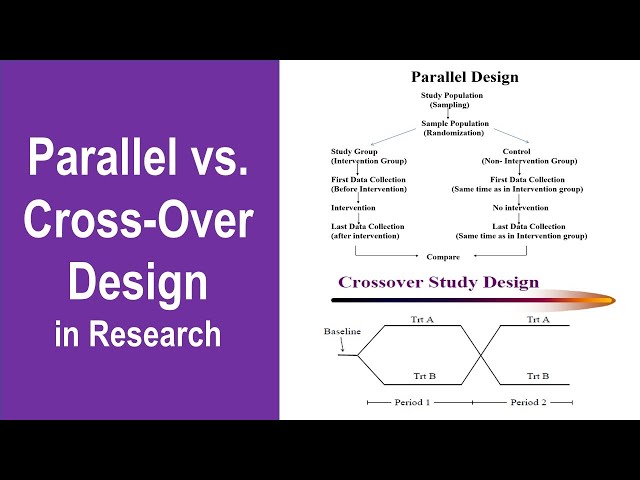
Parallel group design
The most typical clinical trial design.
Treatment and control groups treated simultaneously
Each subject is randomly assigned to one group
Relatively simple and easy to implement
Run-in period
Occurs before phase III or pivotal design. In many parallel-group trials, a pre-randomization lead-in time period is often used before the actual treatment is administered.
Reasons for use:
screening - identify eligible participants
baseline data collection - lets studies show which data needs to be collected or not
Washout - clear prior treatments
compliance assessment
training to standardize behaviors or procedures
Potential issues
increases length of study (problem when larger)
Incrases costs
May not be proper for patients with acute conditions
ethical objections to using placebo run-ins
cross-over design
Special case of a randomized control trial where each participant serves as their own control and receives all treatments in different time periods with a washout period in between.
repeated measurements design
wash-out period - based on the half life of the drug
Useful for chronic disease & outcomes that can be measured relatively quickly
The treatments only alleviate the disease condition
More efficient treatment comparison than a parallel design
simplest case: 2×2 crossover, treatment A vs B, randomized to AB or BA
Limitations
Carryover effects, period effects, sequence effects
Outcome needs to be ascertained relatively quickly
Analysis may be more difficult
