The Sporadic Sick Cow: Cardiac Disease
 Call Kai
 Learn
 Practice Test
 Spaced Repetition
 Match
 Flashcards
 Knowt Play
1/12

There's no tags or description
Looks like no tags are added yet.
13 Terms
Describe key aspects of the bovine clinical exam.
It is not just listening to the heart, you are looking at the CARDIOVASCULAR SYSTEM
• Thoracic pain-withers test /abducted elbows/stance
• Oedema - typically submandicular or presternal oedema
• MM colour- pale/cyanosis
• Jugular distension, pulsation or positive re-fill test
Something backlogging jugular or heart cannot cope, also looking for pulsation in context of where the cow’s head is
Pulsation - If head down, pulsation throughout jugular, if up, only at thoracic inlet, does not dictate a particular cardiac disease but tells you cow HAS cardiac disease
Positive re-fill - if takes >5-10 secs, tricuspid valve is incompetent
• Respiratory distress
• Exercise intolerance
• Increased HR, arrhythmias
• Pulse quality
• Non- specific signs too-
pyrexia, other disease processes, could be due to infection mediating a cardiac problem

Summarize forward vs. backward failure of the right side of the heart.
Summarize forward vs. backward failure of the left side of the heart.
**Left side - clinical signs considering bovine lungs are minimal compared to SA

Describe the basic principles of clinical signs associated with heart disease.
• Congestive/backward heart failure:
Right or left sided
Right - jugular signs, systemic oedema, nutmeg liver (Due to chronic congestion), pale tense kidneys
Left - pulmonary oedema (rare presentation in ruminants)
• MAY HAVE BOTH!
Describe the features or murmurs or abnormal cardiac sounds.
• 'Normal'
• Murmurs - esp when unwell
Difficult to establish what is significant when they have another underlying condition
• Gallop/split sound
• 'Not normal'
• Murmur
• Splash/tinkle
• No heart sounds (!!! eek)
Cranial thoracic mass - which may displace the heart
• Sinus arrhythmia (BSE)
• Palpable thrill
Describe the main features of traumatic pericarditis.
Do wither’s test twice - if ducks the second time (No evidence of cranial thoracic pain), if does NOT duck (Anticipates the pain = evidence of cranial thoracic pain)
Penetration of the reticulum by metal pieces into the pericardium - introducing bacteria, gives muffled heart, splashing sounds, experiencing pyrexia, may eventually cause cardiac tamponade (Forward and backward failure)
Abscessation (Chronic) and secondary cardiac tamponade (Acute)
• Dx - CS +/- ultrasound (Easy)
Neutrophilia + increased globulins
Cows generally become ill during transition period (In months following calving), possibly due to free space in the abdomen or immune-suppression (Unknown)
• Tx
• Rarely successful
• Broad spectrum abs- Rumenotomy ('guddle' for the wire)
• Magnet
• Prognosis - poor
• Prevention-remove sources of wire/nails
• Prophylactic magnets
• Metal detector on forage harvester

Describe the main features of Endocarditis.
Bacteria from a bacteraemia or septicaemia settling on valve leaflets causing granulomatous infection
Tricuspid (why?) primarily, but can also be mitral
May have a history of past infection e.g. metritis, sore foot etc. (myasis in sheep)
Secondary septic infarcts - pulmonary or systemic
Remember this is 2 diseases at the same time: abscessation (chronic) and secondary cardiac failure (slightly less chronic)
• CS - Murmur (variable)
Pyrexia (initially/intermittent)
Cardio-Vascular signs (Right side congestive/backward)
Abduction of the elbows (thoracic pain)
(+/-Withers positive)
DX
Clinical exam (Ultrasound scan, mixed results, may see nothing or something insignificant)
Bloods - increased globulins, neutrophilia
TX
rarely successful, broad spectrum abs + NSAID's
Prevention - prevent immunosuppression and primary illnesses with prompt, aggressive tx of any infections
Describe the main features of High Altitude or Brisket Disease.
Analogous to Cor Pulmonale, disease in the lungs causes secondary cardiac disease, reduced partial pressure of O2 in the atmosphere reduces perfusion and oxygenation, creating a mismatch that results in right-sided hypertrophy/HF signs
• Common above 2500m (but can occur at lower altitudes)
• Predisposed by: age, pregnancy,
cold weather, rapid weight gain- increased metabolic work'
intercurrent pulmonary diseases,
and exposure to endotoxins, swainsonine, monocrotaline,
and ionophores
Mainly beef-due to farming systems
Describe the main features of VSD in cattle.
• CS - Systolic murmur (PMI Right - why?)
+/- stunting
+/- CV signs
+/- Exercise intolerance
Look for other deformities
DX - Diagonal murmur, caudal LHS, cranial RHS
(Colour flow Doppler)
Tx - none
Prognosis - Can be ok or can be terminal (context)
Note: These will be born normal size unless there are other issues- think why?
Describe the main features of ASD in cattle.
Persistent Foramen Ovale
• i.e Atrial septal defect
• Usually no signs/no murmur, difficult to diagnose in life, cannot usually auscultate the murmur
Left to right shunt (relative pressures)
• Probably well tolerated
May have no clinical signs in life
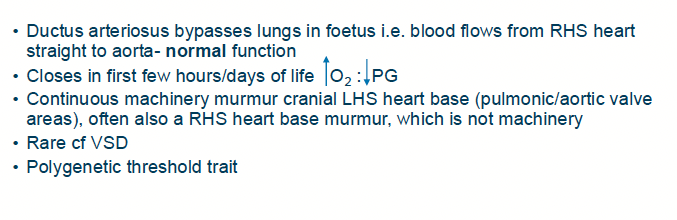
Describe the main features of PDAs in cattle.
Describe the main features of Tetralogy of Fallot in Cattle.
Hypertrophy of right ventricle is secondary to abnormalities cattle are born with

Describe the main features of Cardiomyopathies in cattle.

Describe the main features of Arrhythmias in cattle.
• Normal sheep/ bovine rhythm is regularly regular (at a clinical level though relaxed sheep can have a sinus arrhythmia)
• Primary arrhythmias are uncommon as a cause of disease
• Secondary arrhythmias are not unusual
Hypocalcaemia
Hypomagnesaemia
Endotoxin
Intestinal disease (acid/base imbalance)
Abdominal pain
• Atrial fibrillation is probably the most significant