UNIT 5 BIOLOGY EXAM
 Call Kai
 Learn
Learn Practice Test
 Spaced Repetition
 Match
Match Flashcards
 Knowt Play
1/20

There's no tags or description
Looks like no tags are added yet.
Name | Mastery | Learn | Test | Matching | Spaced | Call with Kai | Chat |
|---|
No analytics yet
Send a link to your students to track their progress
21 Terms
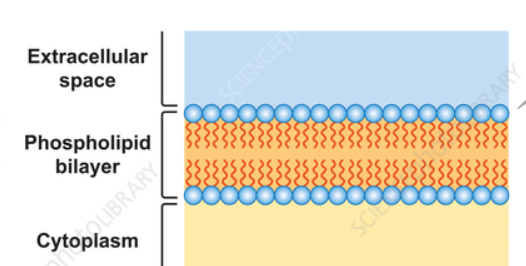
Describe the parts of the phospholipid bilayer
HYDROPHILIC phosphate head which is POLAR
HYDROPHOBIC fatty acid tails which is NON-POLAR
What does it mean by the terms “polar” and “non-polar”?, give examples of the parts of the phospholipid bilayer that are polar and non-polar.
Polar = attracted to water, such as the hydrophilic phosphate heads
Non-polar = repelled by water, such as the hydrophobic fatty acid tails
State the two main features of the fluid mosaic model
Fluid Part- Phospholipids and proteins can move laterally (side to side)
Mosaic Part- Refers to how the phospholipid bilayer is embedded with different proteins
State the three roles of cholesterol in cell surface membranes
Cholesterol adds mechanical stability
Cholesterol increases rigidity
Cholesterol prevents the loss of ions

Describe what a glycoprotein is and state the two main roles of glycoproteins in cell surface membranes
Glycoproteins are carbohydrates covalently bonded to proteins,
Function 1 - they act as receptors for hormones
Function 2 - acts as antigens which allows cells to recognise each other as “self”
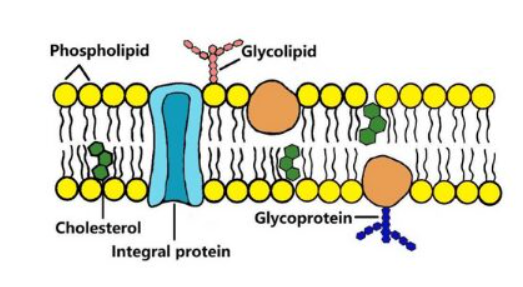
Describe what a glycolipid is and state the two main roles of glycolipids in cell surface membranes
Glycolipids are carbohydrates covalently bonded to a phospholipid
Function 1 - act as receptors for hormones
Function 2 - acts as antigens which allows cells to recognise each other as “self”

Describe what a channel protein is and explain its role in the phospholipid bilayer
Intrinsic (go across the whole bilayer) proteins that have a channel lined with hydrophilic amino acids
They allow the transport of ions and polar molecules DOWN their concentration gradient.
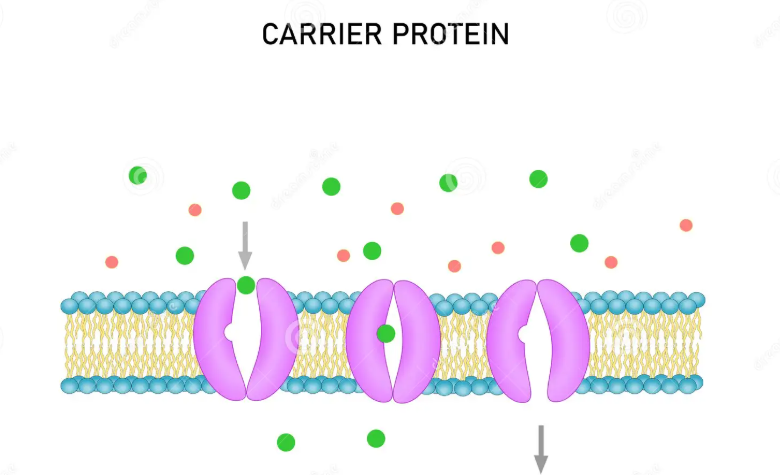
Describe what a carrier protein is and explain its role in the phospholipid bilayer
Intrinsic proteins that have a pocket lined with hydrophilic amino acids.
They allow the transport of ions and polar molecules DOWN and AGAINST their concentration gradient, by changing shape
Describe what extrinsic proteins are and state the two main roles of extrinsic proteins in cell surface membranes
Unlike intrinsic proteins, extrinsic proteins are only found on one side of the cell membrane
Their functions include: Membrane bound enzymes & acting as antigens
Give one similarity and one difference between a channel protein and a carrier protein
Carrier Proteins:
Changes shape & moves substances against their conc gradient
Both:
Transport ions
Go through the whole phospholipid bilayer
What is a Red blood cell, Phagocyte & Squamous endothelium of blood capillary
Red blood cell - Main cellular component of blood and moves around at extremely high speeds & pressures
Phagocyte - A type of white blood cell that regularly changes shape and can fit through small pores in capillaries
SE - Makes up blood vessels called capillaries & are continuous hit by red blood cells which move at high speeds
Why do phagocytes have a low percentage cholesterol?
Why do red blood cells need more cholesterol than phagocytes?
Why do SE have a very high amount of cholesterol in their membrane?
They have to be flexible to move through small pores & capillaries, and carry out phagocytosis
They move at high speeds and pressure through the circulatory system, so need rigidity to keep their biconcave shape
They are continuously hit by RBC that move at high speed and pressure so need a lot of mechanical stability to prevent damage.
What is simple diffusion?
Both simple and facilitated diffusion is a passive process, what does this mean?
Net movement of small non polar particles from an area of a high conc to low conc, down their conc gradient. This is a passive process where these substances move between phospholipids.
Diffusion does not require any metabolic energy
What is facilitated diffusion?
What is a polar molecule?
Net movement of polar particles from a high to low conc, down their conc gradient. This is a passive process where these substances move between channel or carrier proteins.
Covalent molecules with an unequal distribution of electrons.
Describe one difference between facilitated diffusion and simple diffusion
Both are passive processes (doesn’t require additional energy)
Both move substances down their conc gradient, from a high to low conc
FD moves polar substances + ions through intrinsic protein, whereas SD moves small non polar, lipid soluble substances between phospholipids.
Explain why small, uncharged, lipid soluble molecules can go through without the use of a protein
They are non-polar and so are hydrophobic
Therefore, they will not be repelled by the hydrophobic fatty acid centre of the bilayer
Describe what is meant by the phrase ‘lipid soluble’ and explain why the lipid soluble molecules can go through without the use of a protein
It means dissolves in lipids
Therefore, lipid soluble molecules are non-polar and so are hydrophobic and will not be repelled by the hydrophobic fatty acid tail
Give an example of a lipid soluble molecule
Name two intrinsic proteins involved in facilitated diffusion
Oxygen and steroid hormones
Channel and carrier proteins
Channel proteins transport molecules such as ions ( e.g. Na+). Channel proteins work in a specific way, explain what this means
It only changes shape for one chemical/ion
Explain how carrier proteins work
Carrier proteins are specific, so they have a binding site for only on type of ion lined with hydrophilic amino acids.
When the ion binds, the carrier protein changes shape, and transports the ions to the other side
State the chemical formula of glucose and suggest why it is unable to fit through gaps between phospholipids in the phospholipid bilayer- (simple diffusion)
Glucose = C6 H12 O6 (24 atoms)
It is unable to fit through gaps between phospholipids in the phospholipid bilayer because it is too large and it is polar