Untitled
0.0(0)
Studied by 1 person Note
 Call Kai
 Learn
 Practice Test
 Spaced Repetition
 Match
 Flashcards
 Knowt Play
Card Sorting
1/51

52 Terms
1
New cards
What is the symbol for proton?
p+ (Positive)
2
New cards
Where is the proton located
Nucleus of an atom
3
New cards
What is a protons electrostatic charge?
Positive
4
New cards
What is the mass of a proton?
1 amu (atomic mass unit)
1.66 x 10(-24)g
1.66 x 10(-24)g
5
New cards
What is the symbol for neutron?
n (with an exponent of 0)
6
New cards
Where is the neutron located in an atom?
nucleus
7
New cards
What is the mass of a neutron?
1 amu (atomic mass unit)
8
New cards
What is the charge of a neutron?
neutral (no charge)
9
New cards
What is the symbol for electron?
e- (negative)
10
New cards
Where is the electron located?
- outside the nucleus
- shells
- orbits
- energy levels
- large cloud around the nucleus that fill the SPACE of an atom
- shells
- orbits
- energy levels
- large cloud around the nucleus that fill the SPACE of an atom
11
New cards
What is the charge of an electron?
negative
12
New cards
What is the mass of an electron?
no mass (1/1840th AMU)
13
New cards
Where are the # of protons located on the periodic table
Atomic #
14
New cards
How do you find the neutrons on the periodic table?
Atomic Mass - Mass #
15
New cards
How do you find the electrons on the periodic table?
Atomic #
16
New cards
John Dalton Model and features
- Small spheres with different shapes and colors
- invisible
- Atoms of an element are all identical in properties
-different elements contain differing properties
- different ratios combine to make new substances
- invisible
- Atoms of an element are all identical in properties
-different elements contain differing properties
- different ratios combine to make new substances
17
New cards
JJ Thomson model of the atom
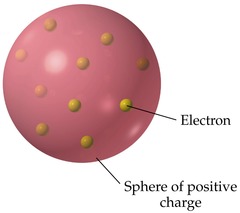
18
New cards
JJ Thomson Model Features
- Smaller subatomic particles in different combinations make different elements
- A sphere with a positive charge
- Negative particles embedded inside (electrons)
- A sphere with a positive charge
- Negative particles embedded inside (electrons)
19
New cards
Ernest Rutherford Model
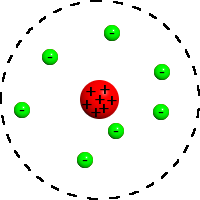
20
New cards
Ernest Rutherford Features
- Dense positively charged core (nucleus)
- Atom is mainly empty space
- Nucleus is 1/10,000 the size of an atom
- Atom is mainly empty space
- Nucleus is 1/10,000 the size of an atom
21
New cards
Niels Bohr Model
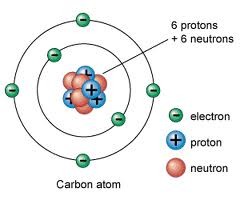
22
New cards
Features of Niels Bohr Model
- Electrons surround the nucleus in specific energy levels
- Electrons release light colours of different energy levels
- Electrons can not fall below the lowest energy level
- Electrons release light colours of different energy levels
- Electrons can not fall below the lowest energy level
23
New cards
Schrodinger ( Quantum Mechanical Model)
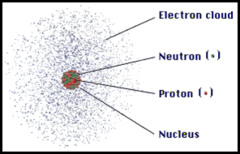
24
New cards
Features of Schrodinger Quantum Mechanical Model
- A cloud of negative charges electrons occupy a whole space at different energy levels
- A nucleus containing both protons and neutrons
- The nucleus has a positive charge as the neutrons have no charge
- A nucleus containing both protons and neutrons
- The nucleus has a positive charge as the neutrons have no charge
25
New cards
What is the difference between mass number and average atomic mass?
- The atomic mass is the total number of protons and neutrons in the nucleus of an atom.
- Whereas the average atomic mass is used to calculate a weighted average of each isotope, to give the overall average atomic mass
- Whereas the average atomic mass is used to calculate a weighted average of each isotope, to give the overall average atomic mass
26
New cards
All isotopes of an element will have the same _______________ properties
chemical
27
New cards
What to remember for calculating average atomic mass
- Round at End
- Answer either tenth or hundreth
- Make sure when u convert percent to a decimal its in the same decimal place
- Answer either tenth or hundreth
- Make sure when u convert percent to a decimal its in the same decimal place
28
New cards
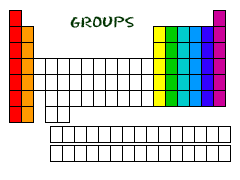
where the family/groups on the periodic table
29
New cards
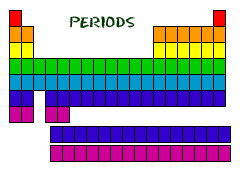
where are the periods on the periodic table
horizontal rows
30
New cards
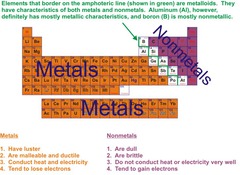
Where are metals on the periodic table?
left of staircase
31
New cards
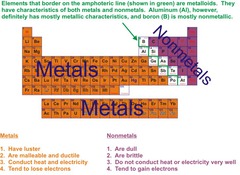
Where or non metals on the periodic table
right of staircase
32
New cards
Where are metalloids located on the periodic table?
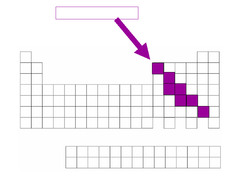
33
New cards
Where are the alkaline earth metals?
Group 2
34
New cards
where are the alkaline metals
group 1
35
New cards
where are the noble gases
group 8/18
36
New cards
Where are the halogens located?
group 7/17
37
New cards
Process of ion formation
Ions are formed when atoms lose or gain electrons in order to fulfill the octet rule and have full outer valence electron shells.
8 is great!
8 is great!
38
New cards
metals form __________
cations (+)
39
New cards
non-metals form ___________
anions (-)
40
New cards
what does isoelectronic mean?
Ions that share the same amount of electrons as a noble gas
41
New cards
The neutral atoms of all the isotopes of the same element have
the same number of electrons
42
New cards
most reactive group on periodic table
alkali metals (group 1)
43
New cards
least reactive group on periodic table
noble gases (group 18/8)
44
New cards
most reactive non metal
Fluorine (F)
45
New cards
most reactive metal
Francium (Fr)
46
New cards
What is a physical change?
A physical change that does not change the chemical makeup of a substance but only the appearance of the substance.
47
New cards
the subatomic particles found at the centre of an atom are
protons and neutrons
48
New cards
the charge of the centre of an atom is
positive
49
New cards
elements in the same groups have
same amount of valence electrons
50
New cards
Elements in the same period have
same number of electron shells/energy levels
51
New cards
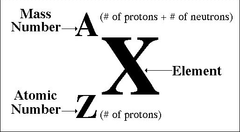
what does a nuclear notation look like?
or (element name)-(mass)
52
New cards
Chemical Change
change to a substance that always results in the formation of a different substance or substances