intro to lenses and refractive error
 Call Kai
 Learn
 Practice Test
 Spaced Repetition
 Match
 Flashcards
 Knowt Play
1/67

There's no tags or description
Looks like no tags are added yet.
68 Terms
what are the wavelengths in the visible light segment of EM spectrum?
400-700 nm
what do the wavelengths of 400-700 nm denote?
requirement for vision to occur
what behaviors does light exhibit?
behaviors of waves and particles
-- dependent on the circumstances of the experiment
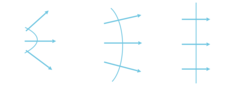
what is a wavefront?
series of concentric circles (waves) that travel AWAY from the source it created

what allows a wavefront to travel (initiation)?
energy sources
-- light (lightbulb or sun), sound, physical force
what indicates the direction the wavefront is traveling?
rays

what are the position of rays in comparison to the wavefront?
perpendicular intersection

what does the vergence of a wavefront indicate?
how curved the water front is

what does a steeper vergence mean
more curved/smaller circle
-- closer to the source
what does a flatter vergence mean
less curved/larger circle
-- travels away from the source
-- the energy from the source is dissipating
what is divergence
light rays travelling away from a source
--- wavefront gets larger and flatter

what is convergence
light rays headed towards a focal point
-- wavefront gets smaller and steeper

diverging light

converging light

how do diverging wavefronts change as they travel further from the source?
larger and flatter

at what distance are diverging wavefronts flat and the waves are parallel to each other
infinite
what is refraction>
change in direction of propagation of any wave as a result of its traveling at different speeds at different points along the wave front
how and why does a lens refract light?
1. change in the speed of light is traveling causes it to change direction
2. when light goes from air into a different substance of higher density it slows down and changes direction
3. extend to which it changes direction depends on the angle the light ray makes w the surface of the substance and the curvature of the surface
4. the curvature determines the dioptric power of the lens which then determines where the light will focus
what is the refractive index
when light goes from air into a different substance of higher density
what is the angle of incidence
the angle the light ray makes with teh surface of the substance
what is the focal point
where the light focuses
--- must be on the retina
-- attributes to why the image of an object appears clear
what is a convex lens
feels thicker in the middle than at the edges

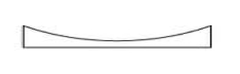
what is a concave lens
feels thinner in the middle than in the edges

why is it important to know about vergence>
lenses have power to change the vergence of light
-- prescribing lenses to a patient involves using lenses to chnge the vergence of the light so that light rays focus where they need to
when we are looking at something, what are we technically looking at?
an image of that object
what produces an image?
light from an object that enters the eye
---- where the light rays come to a focus
what does the eye have the ability to do
focus light that comes in from the object
-- why> bc the eye has power
where does the power of the eye come from? how do they affect light coming in?
cornea and natural lens
--- both are convex, so converge any light that enters the eye
what happens if the power of the eye is appropriate given the length of the eye?
light focuses on the retina
-- patient sees clearly; no corrective gl or cl
-- emmetropic eye

in a myopic eye, where do light rays focus? why?
front of the retina
--- eye is TOO POWERFUL (too much corneal/natural lens power)
---eye is too long
^^^ either or both
-------- required corrective lenses bc nearsighted!
what will a myopic patient complain about in regards to vision
blurred vision at distance
-- they are nearsighted
what varies depending on the degree of myopia
far point or punctum remotum
-- far point gets closer to the eye as myopia increases
in a hyperopic eye, where do light rays focus? why?
behind the retina
---eye is TOO WEAK (not enough cornea/natural lens power)
---eye is too short
^^ either or both
--------needs corrective lenses
in terms of vision, what would a hyperopic patient complain about
blurred vision at near
-- farsighted
what varies depending on the degree of hyperopia
near point or punctum proximum
---- near point gets further from the eye as hyperopia increases
what power do lenses have
plus (+) or minus (-)
what are the units of measurement of a spectacle lens
diopters (D)
how do plus lenses change the vergence of light? what does it do to the focal point
plus lenses are conves -- makes light more convergent
---- pulls focal point forward
how do minus lenses change the vergence of light? what does it do to the focal point
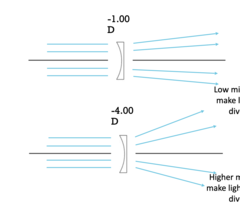
minus lenses are concave -- make light more divergent
--- pushes focal point further back
how do higher and lower plus lenses converge light?
lower
--make light more convergent, flatter radius of curvature, focal point farther
higher
--make light even more convergent bc steeper radius of curvature, focal point closer

how do higher and lower minus lenses converge light?
lower- make light more divergent
higher- make light even more divergent
what are properties of minus lenses?
-concave
-thick edges and thin centers
-the stronger power in the lens, the steeper the radius of curvature, the thicker the edges, the thinner the center
- minimize objects it makes more clear
without minus lenses in a myopic eye, what happens?
--entering light is being overconverged by the cornea/natural lens
--eye is too long so the focal point is in front of retina
what are the properties of plus lenses?
-convex
-thin edges and thick centers
-magnify objects
-magnifies the size of the object it makes more clear
without plus lenses in a hyperopic eye, what happens?
--the eye is not converged enough by the cornea/natural lens
--eye is too short causing the focal point to be behind the retina
what is refractive error?
an error in the way the light refracts, or is displaced as it enters the eye
what kind of refractive error is pure myopia and hyperopia?
spherical refractive errors
--eye is spherical/round
--corrected with spherical lenses
when does astigmatism occur
when the eye is not spherical in shape, but oval
what are astigmatic refractive error corrected
cylindrical lenses
when can astigmatism occur
alone or within the context of myopic or hyperopic refractive error
in spherical eyes, what are the errors in focus due to?
--due to myopia or hyperopia
how are the corneas/natural lenses oriented in spherical eyes
-symmetric
-same curvature in all meridians
-light entering eye focuses at a point either in front or behind the retina
in spherical refractive errors, how do you see the image? because of this, what must the corrective lenses have?
all parts of the image appear equally blurred bc all meridians are equal
--corrective lenses must have equal power in all meridians (can be rotated and still correct properly)
what are characteristics of an astigmatic cornea?
stretched along an axis (0-180 degrees)
-- one meridian has the flattest curve
-----90 degrees away from the flattest curve meridian is the steepest curvature
-------all other meridians have curvatures somewhere in between
in an astigmatic eye, does light entering form a point? what is formed instead?
-- it doesnt
----- 2 line images either in front of, behind, or straddling the retina
if you have astigmatic refractive error, how do you see an image? how do you correct this?
image is not equally blurred (some meridians are clearer than others)
--- requires astigmatic lens to correct
what do astigmatic (cyl) lenses don't have? what must it reflect?
dont have equal power in all meridians
-- must reflect the corresponding differences in power across teh ocular surface (90 degrees apart)
==lenses cannot be rotates or else it will not correct refractive error
what are the characteristics of astigmatic (cyl) lenses
-has a flat and steep meridian
--flat/steep meridians of lens must coincide with flat/steep meridians of the cornea to properly correct astigmatic ref. error
what does OD mean?
right eye
-oculus dextrus
what does OS mean?
left eye
-oculus sinister
what does OU mean?
both eyes
-oculus uterque
what is sphere in spectacle rx
myopic or hyperopic component
what is cylinder in spectacle rx
astigmatic component
what is axis in spectacle rx
orientation of astigmatic component
-- axis of the correcting cyl is described by its flat meridian
what is add in spectacle rx
additional power needed in the reading segment of a bifocal or multifocal lens
how is a spectacle rx written?
OD -2.00-1.00x180
OS -0.75-1.25x085
-- first number = sphere / second = cyl / third = axis
-----always indicate power (+) or (-) / cyl is always - / diopters are the units to measure power / always write in 3 digits
what does the cylindrical component of a spectacle rx do? spherical component?
- cylindrical: superimposes/collapses line images
- spherical: puts collapsed line images onto the retina after they collapsed
what is the purpose of a spectacle rx
refract/displace the light in such a way that all of the images are moved to the retina