Chapter 10 Enzyme Kinetics, Inhibition, and Control
 Call Kai
 Learn
 Practice Test
 Spaced Repetition
 Match
 Flashcards
 Knowt Play
1/78

There's no tags or description
Looks like no tags are added yet.
79 Terms
1st order reaction
A→P
rate: v = k[A]
units: M/s
2nd order reaction
2A→P
v=k[A]2 in M/s
A+B→P
v=k[A][B] in M/s
Pseudo 1st order
A+B→P when [B] » [A]
appears first order with respect to substrate A
when [A] » [B}
appears first order with respect to B
elementary kinetics
simple, 1 step
descriptions of each elementary reaction collectively constitute the mechanistic description of the overall process
reaction order indicates
the number of molecules participating in an elementary reaction
At constant T, the rate of an elementary rxn is proportional to
frequency at which reacting molecules collide
plot of first-order rate equation
ln [A] = -kt + ln[A]o

half life of first order rate equation
t1/2= 0.693/k
plot of second order rate equation
1/[A] = kt + 1/[A]o

half life of second-order rate
t1/2= 1/k[A]o
General chemical equation for a simple enzyme-catalyzed reaction
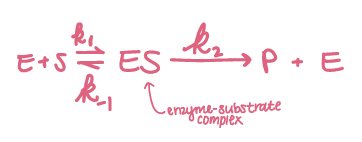
steady state assumption
rate of ES formation equals rate of ES breakdown
keeps [ES] effectively constant
NOT equilibrium
substrate concentration drops and product concentration rises, but [ES] and free [E] remain ~constant

What happens to reaction kinetics when [S] is much larger than [E]?
when substrate concentration is much greater than total enzyme concentration, the enzyme becomes completely saturated with substrate
makes the reaction zero-order with respect to substrate b/c [S] is no longer limiting the rate
what is the rate limiting step when all enzyme is bound as ES? What is the formula for Vmax?
when all enzyme is bound as ES, the breakdown of ES into product via k2 is rate limiting
vmax = k2[E]T
pseudo-first-order process dependent on total enzyme concentration
Michaelis-Menten Equation
tells you how fast an enzyme will work based on the substrate you feed it
when you plot velocity vs substrate concentration, it curves upward into a rectangular parabola, flattening at Vmax due to saturation

What is KM?
Michaelis constant
the exact [S] needed to reach ½ of Vmax
A low KM means the enzyme reaches max speed with _____ substrate
little substrate
enzyme has high affinity, grabs substrate tightly
A high KM means the enzyme reaches max speed with ____ substrate
high substrate concentration
enzyme has low affinity, it holds loosely
KM is unique for every specific enzyme-substrate pair, but it changes is you…
alter temperature or pH
catalytic constant
kcat
turnover number!
represents the maximum number of reaction processes that each active site can catalyze per unit of time when enzyme is fully saturate
an intrinsic constant for a given enzyme
catalytic efficiency
kcat/KM
measure of efficiency and specificity at low [S]
Low [S] Behavior
[S] « KM → little ES complex forms → almost all E is in free form
under these conditions, vo = (kcat/KM) [E]T[S]
Lineweaver-Burk Plot
linearizes kinetic data

X-intercept Lineweaver-Burk plot
-1/KM
Why does high [S] matter for reliability?
high [S] gives reliable data and accurate KM values
Low [S] creates tiny vo readings; when converted into reciprocals for a Lineweaver-Burk plot, tiny experimental errors get heavily magnified
what is considered catalytically perfect?
kcat/KM = x 108-109 M-1s-1
can steady state kinetics determine reaction mechanism?
No, but it can be used to eliminate proposed mechanisms
Steady state kinetics are incapable of revealing enzyme intermediates
reactions involving 2 substrates and yielding 2 products account for
~60% of known biochemical reactions
most are transfer reactions
also redox reactions in which reducing equivalents are transferred between 2 substrates
Redox examples of bisubstrate reactions
Hydrolysis of peptide bond by trypsin = transfer of peptide carbonyl group from peptide N to H2O
Hydride ion is formally transferred from ethanol to NAD+ using alcohol dehydrogenase
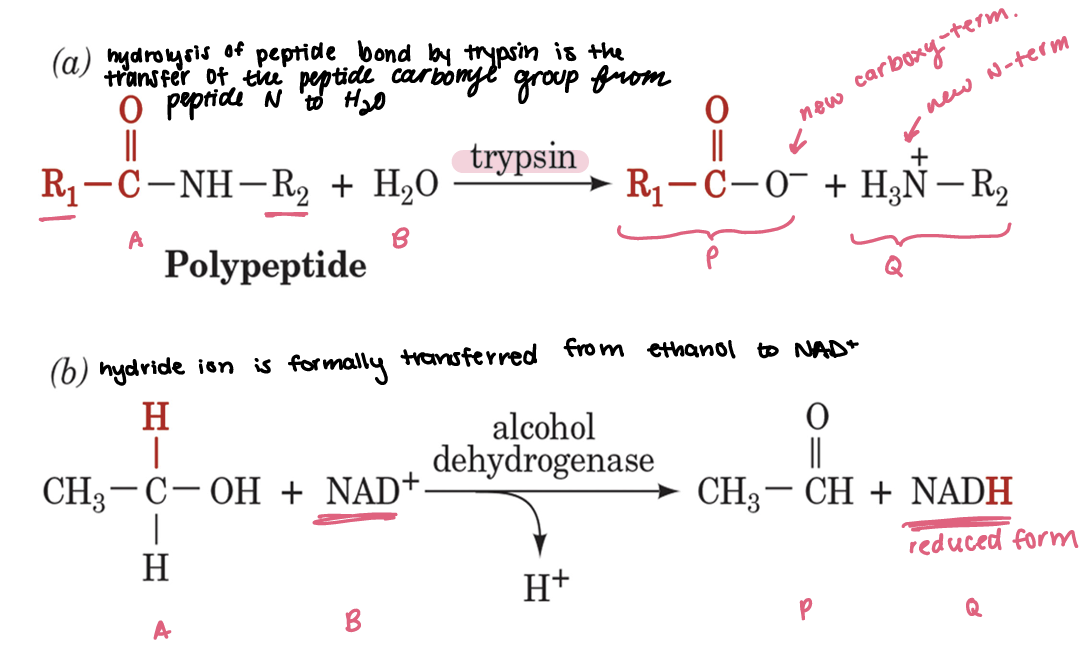
sequential reactions can be
ordered: compulsory order of substrate addition to enzyme
random: no preferential order of substrate addition to enzyme
ordered bisubstrate reaction
substrates are designated by the letters A and B in the order that they add to the enzyme
products are designated by P and Q in the order that they leave the enzyme

random bisubstrate reaction
some dehydrogenases and kinases operate randomly
sequential reactions with no preference for the order of substrate addition

ping pong reaction
double-displacement
group transfer reaction in which 1+ products are released before all substrate have been added
chemical X changes hands twice:
it is displaced off substrate A and onto the enzyme
it is then displaced off the enzyme and onto substrate B
enzyme inhibitor
something that decreases enzyme activity
enzyme inactivator
irreversibly inhibits enzyme
permanently blocks
competitive inhibition
inhibitor competes with substrate
reduces the amount of free enzyme available for substrate to bind to
modified MM equation for competitive inhibition
α = 1 + [I]/KI

What is α?
the factor by which you have to increase your substrate concentration to overcome the inhibitor
α = 1 + [I]/KI
In competitive inhibition, I makes KM appear
larger
decreases affinity for S
increases KMapp
takes a much higher substrate concentration to reach 1/2Vmax
KI
equilibrium constant with the inhibitor
a lower KI means a tighter, more powerful inhibitor
How does competitive inhibition impact Vmax
Vmax is unchanged
if you dumb enough substrate in, you can still get to max velocity
Alcohol dehydrogenase breaks down methanol in the body into toxic byproducts. Thus, ethanol is given as…
a competitive inhibitor because it competes for the same active site
saves the patient by blocking the toxic buildup
uncompetitive inhibition
inhibitor competes with ES complex
inhibitor binds directly to the enzyme-substrate complex but not to the free enzyme
makes the E appear inactive
uncompetitive inhibition makes Vmax appear
makes Vmax appear smaller
uncompetitive inhibition makes KM appear
makes KM appear lower
mixed inhibition
inhibitor binds to both enzymes and ES complex
bind to a site distinct from the substrate
mixed (noncompetitive) inhibition does what to Vmax apparent
mixed/noncompetitive inhibition decreases Vmax apparent
modified Michaelis-Menten equation for mixed inhibitor (noncompetitive)
α (affecting KM)
α’ (affecting Vmax)
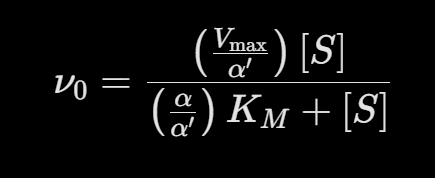
mixed/noncompetitive inhibition does what to KM
may increase or decrease KMapp
Apparent KM in mixed/noncompetitive inhibition goes down when…
inhibitor binds more tightly to the ES complex than to the free enzyme
K’I < KI
KM apparent in mixed/noncompetitive inhibition stays the same when
the inhibitor has equal affinity for both
α = α’ & KI = K’I
Vmax still drops though in pure non-competitive inhibition
Apparent KM in mixed/noncompetitive inhibition goes up when…
inhibitor binds more tightly to the free enzyme (E) than to the ES complex
KI < K’I
On a Lineweaver-Burke plot, uncompetitive enzyme inhibition appears
as parallel lines with the same slope
adding more S does not reverse effect of uncompetitive inhibitor because binding of substrate does not interfere with binding of uncompetitive inhibitor
pure noncompetitive inhibition
binds to both E and ES with equal affinity
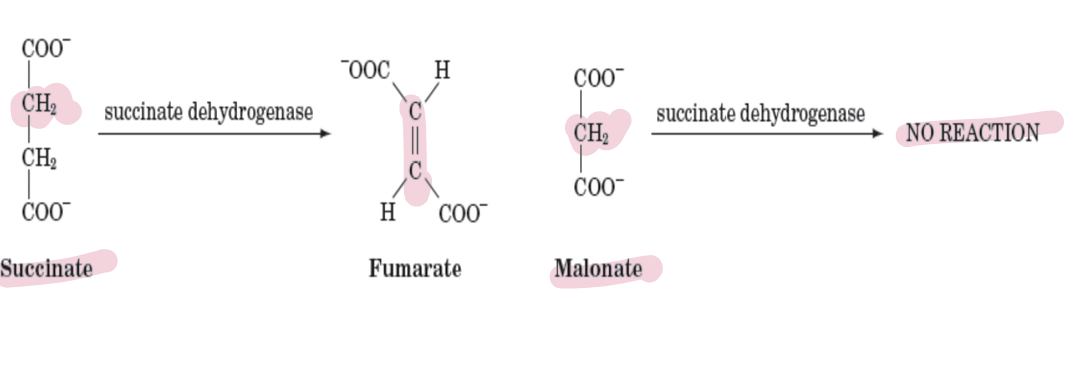
Succinate vs malonate with succinate dehydrogenase
Succinate dehydrogenase = citric acid cycle enzyme that converts succinate to fumarate
competitively inhibited by malonate, which resembles structure of succinate, but cannot be dehydrogenated
Oseltamivir (Tamiflu) is hydrolyzed in the liver to yield oseltamivir carboxylate which is a _____ inhibitor of influenza neuraminidase
competitive inhibitor of influenza neuraminidase
Why are TS analogs typically effective inhibitors?
TS analog = stable substance that geometrically and electronically resembles TS of reaction
typically effective because catalysis often relies on enzyme’s ability to bind to and stabilize its reaction TS
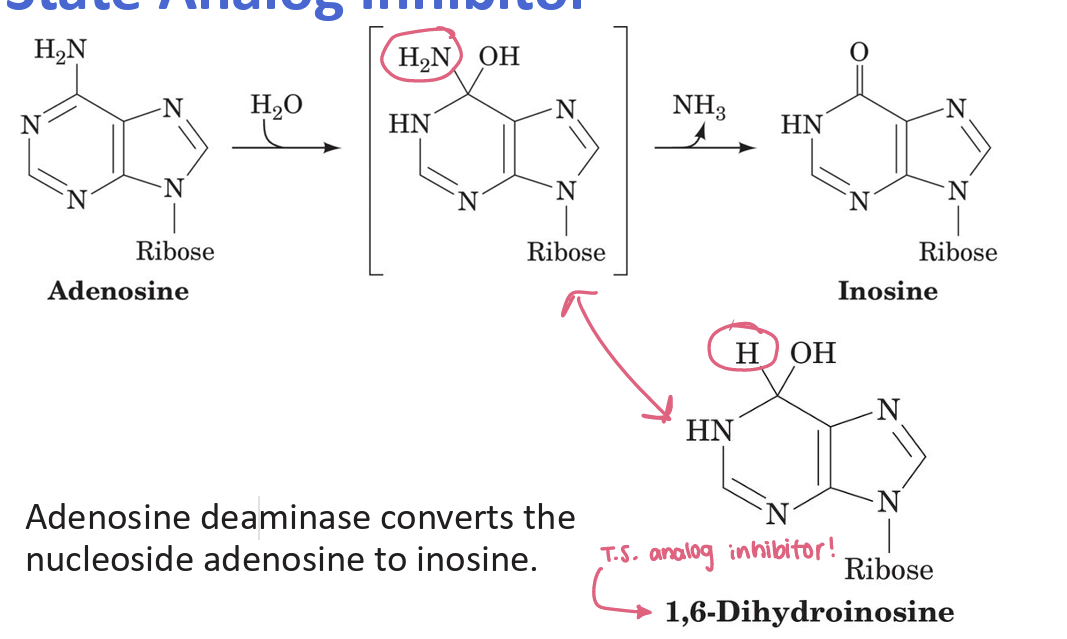
Adenosine deaminase
converts nucleoside adenosine to inosine
inosine is the TS analog inhibitor
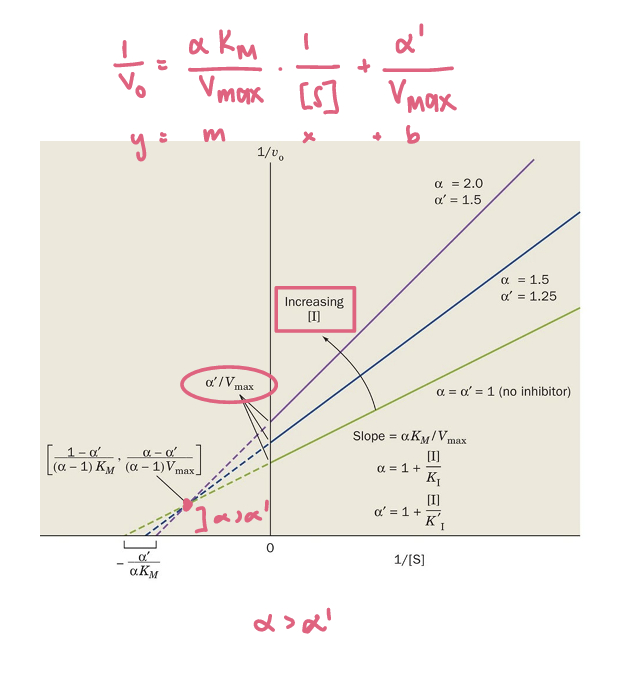
Mixed inhibition: α > α’
inhibitor binds more tightly to free enzyme than ES
KI < K’I
the lines intersect in quadrant II
behavior more similar to competitive inhibitor, KM increases, Vmax drops

Mixed inhibition: α’ > α
inhibitor binds more tightly to the ES complex than free enzyme
K’I < KI
lines intersect in quadrant III
leans towards uncompetitive behavior, meaning the apparent KM actually decreases with dropping Vmax
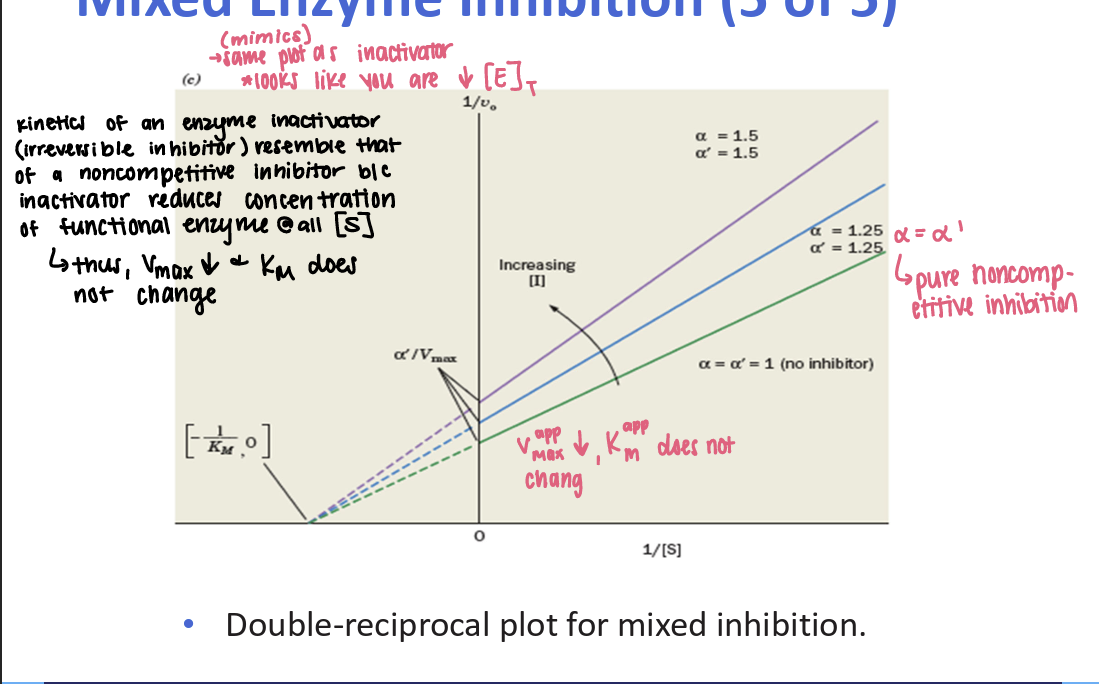
(Pure) Noncompetitive inhibition: α = α’
inhibitor has equal affinity for both free enzyme and ES complex
KI = K’I
lines all converge on x-axis at -1/KM (does not change!)
y-intercepts go up, meaning Vmax apparent drops
Why does pure noncompetitive inhibition mirror irreversible inhibitor/inactivator?
it effectively just reduces the amount of active enzyme floating in beaker
y-intercept in mixed inhibition (Lineweaver Burke)
always moves up as you increase inhibitor concentration because Vmax always drops in mixed inhibition
Enzyme control
need to coordinate activities
can control
enzyme concentration: balance between synthesis and degradation
enzyme activity: allosteric control
Allosteric control
something binds somewhere other than active site, affects binding at another site
ex: feedback inhibition
Aspartate transcarbamoylase (ATCase) catalyzes: carbamoyl phosphate + aspartate → N-carbamoyl aspartate
an example of allostery and feedback inhibition
first step in pyrimidine biosynthesis
ATCase reaction is allosteric thus the graph is
sigmoidal (S-shaped) — demonstrates cooperative binding
Allosteric effectors in ATCase binding
CTP = allosteric inhibitor; binds to the T-state, shifts curve right, makes enzyme less eager to bind aspartate
ATP = allosteric activator; shifts curve to the left, stimulating the enzyme
CTP inhibits ATCase early…
this helps balance cellular nucleotides:
high ATP stimulates ATCase to make more pyrimidines
high CTP inhibits ATCase and shifts cell toward purine synthesis
T-state vs R-state of ATCase
ATCase = large heterododecamer made of catalytic and regulatory subunits (2c3r3)
T-state: tense, low-activity, tightly bound conformation favored when CTP is bound
R-state: relaxed; high-activity conformation favored when substrates or ATP (allosteric activator) are bound — opens up structure
How does PALA help demonstrate ATCase’s conformational change from T→R
PALA = bisubstrate analog that mimics both ATCase’s substrates stuck together
Because it cannot be chemically converted into product, it acts as a powerful, tight-binding competitive inhibitor that locks enzyme into place
PALA binds tightly to the R-state but it does not bind to the T-state
Binding of PALA to enzyme induces a conformational change that swings 2 domains together such that…
their 2 bound substrates can react to form product

2 main models of allostery
symmetry model
sequential model
symmetry model of allosterism
ligand binds more tightly to the R state than to T, ligand binding with promote the T→R shift
this increases the affinity of the unliganded subunits for the ligand
simultaneous transition, all-or-none (all R or all T)
pre-existing T←→R equilibrium shifted by differential ligand binding
sequential model of allosterism
conformational changes occur sequentially as more ligand-binding sites are occupied
localized conformational shift alters the shape and increases ligand affinity of adjacent subunits through domino effect
allows hybrid T and R subunits
ligand-induced shape change propagates locally to neighbors
In eukaryotes, the most common covalent modification is
phosphorylation and dephosphorylation of the hydroxyl group on Ser, Thr, or Tyr residues

Glycogen phosphorylase catalyzes the…
phosphorolysis of glycogen
the rate limiting step of glycogenolysis
Primary way to switch glycogen phosphorylase from inactive (T) to active (R) is by
attaching a phosphate group to a specific amino acid (Ser14)
using phosphorylase kinase to stick P onto glycogen phosphorylase using ATP (pushes to R state)
phosphoprotein phosphatase removes that phosphate group, turning it back off
Glycogen phosphorylase a vs b
Phosphorylase b: less active (dephosphorylated)
naturally prefers T form
it can be nudged into action by AMP (allosteric activator signaling low energy) or shut down by ATP and G6P (allosteric inactivators signaling plenty of energy)
Phosphorylase a: phosphorylated/active
P group and favors R form
flood of glucose can act as an inhibitor, forcing it back to T-form to tell the cell, “there is enough glucose, stop breaking down glycogen!”