ECCB 401 Lab Quiz 4 - Rodentia, Lagomorpha, & Carnivora
 Call Kai
 Learn
 Practice Test
 Spaced Repetition
 Match
 Flashcards
 Knowt Play
1/124

There's no tags or description
Looks like no tags are added yet.
125 Terms
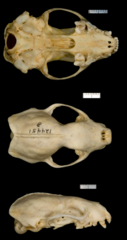
What class, subclass, and infraclass are all these specimens in?
Class: Mammalia
Subclass: Theria
Infraclass: Eutheria
- Superorder: Euarchontoglires
- Group: Glires
- Order: Lagomorpha
- Family: Leporidae
- General Group: Rabbits & Hares (Desert Cotton-Tail)
- Family Geographic Range: All continents except Antarctica, Australia, southern South America and most islands
- Family Diet: Herbivorous, coprophagous
- Order Identification: facial portion of maxilla fenestrated, incisive foramine large, canines absent, large diastama, small peg-like second upper incisor directly behind first, enamel on incisors extends to posterior surface, cheek teeth rootless and hyposodont
- Family Identification: 2 pairs of upper incisors, squamosal and parietals may also have fenestrae, zygomatic arch expanded vertically, bony part of auditory meatus (ear canal that connects the outer ear to the tympanic membrane) tubular and vertical, jugal short
- Way to Remember:

- Superorder: Euarchontoglires
- Group: Glires
- Order: Lagomorpha
- Family: Leporidae
- General Group: Rabbits & Hares (Eastern Cotton-Tail)
- Family Geographic Range: All continents except Antarctica, Australia, southern South America and most islands
- Family Diet: Herbivorous, coprophagous
- Order Identification: facial portion of maxilla fenestrated, incisive foramine large, canines absent, large diastama, small peg-like second upper incisor directly behind first, enamel on incisors extends to posterior surface, cheek teeth rootless and hyposodont
- Family Identification: 2 pairs of upper incisors, squamosal and parietals may also have fenestrae, zygomatic arch expanded vertically, bony part of auditory meatus (ear canal that connects the outer ear to the tympanic membrane) tubular and vertical, jugal short
- Way to Remember:

- Superorder: Euarchontoglires
- Group: Glires
- Order: Lagomorpha
- Family: Leporidae
- General Group: Rabbits & Hares (Black-Tailed Jackrabbit)
- Family Geographic Range: All continents except Antarctica, Australia, southern South America and most islands
- Family Diet: Herbivorous, coprophagous
- Order Identification: facial portion of maxilla fenestrated, incisive foramine large, canines absent, large diastama, small peg-like second upper incisor directly behind first, enamel on incisors extends to posterior surface, cheek teeth rootless and hyposodont
- Family Identification: 2 pairs of upper incisors, squamosal and parietals may also have fenestrae, zygomatic arch expanded vertically, bony part of auditory meatus (ear canal that connects the outer ear to the tympanic membrane) tubular and vertical, jugal short
- Way to Remember:
- Superorder: Euarchontoglires
- Group: Glires
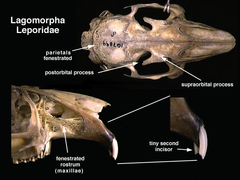
- Order: Lagomorpha
- Family: Leporidae
- General Group: Rabbits & Hares (Swamp Rabbit)
- Family Geographic Range: All continents except Antarctica, Australia, southern South America and most islands
- Family Diet: Herbivorous, coprophagous
- Order Identification: facial portion of maxilla fenestrated, incisive foramine large, canines absent, large diastama, small peg-like second upper incisor directly behind first, enamel on incisors extends to posterior surface, cheek teeth rootless and hyposodont
- Family Identification: 2 pairs of upper incisors, squamosal and parietals may also have fenestrae, zygomatic arch expanded vertically, bony part of auditory meatus (ear canal that connects the outer ear to the tympanic membrane) tubular and vertical, jugal short
- Way to Remember:
- Superorder: Euarchontoglires
- Group: Glires
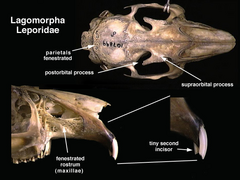
- Order: Lagomorpha
- Family: Leporidae
- General Group: Rabbits & Hares (Eastern Cotton-Tail)
- Family Geographic Range: All continents except Antarctica, Australia, southern South America and most islands
- Family Diet: Herbivorous, coprophagous
- Order Identification: facial portion of maxilla fenestrated, incisive foramine large, canines absent, large diastama, small peg-like second upper incisor directly behind first, enamel on incisors extends to posterior surface, cheek teeth rootless and hyposodont
- Family Identification: 2 pairs of upper incisors, squamosal and parietals may also have fenestrae, zygomatic arch expanded vertically, bony part of auditory meatus (ear canal that connects the outer ear to the tympanic membrane) tubular and vertical, jugal short
- Way to Remember:
- Superorder: Euarchontoglires
- Group: Glires
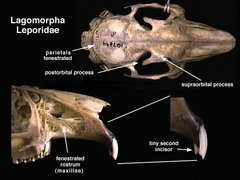
- Order: Lagomorpha
- Family: Ochotonidae
- General Group: Pikas (American Pika)
- Family Geographic Range: Holarctic; discontinuous moutnains of wastern North America, eastern Europe, & all of Asia north of Himalayas
- Family Diet: herbivorous, cophrophagous
- Order Identification: facial portion of maxilla fenestrated, incisive foramine large, canines absent, large diastama, small peg-like second upper incisor directly behind first, enamel on incisors extends to posterior surface, cheek teeth rootless and hyposodont
- Family Identification: 2 pairs upper incisors, lacks supraorbital process, jugal extends posteriorly, squamosal and parietal lack fenestrae
- Way to Remember:

- Superorder: Euarchontoglires
- Group: Glires
- Order: Rodentia
- Suborder: Sciuromorpha
- Family: Aplodontiidae
- General Group: Mountain Beavers
- Family Geographic Range: Pacific NW (northern California to Southern British Columbia)
- Family Diet: Herbivorus
- Order Identification: enamel only anterior, 1 pair of incisors, teeth primitively brahcyodont and rooted, well developed pterygoid region, large parocciptal process, complete zygomatic arch
- Family Identification: flared angular process, parietal ridges well-marked, long lateral tub surrounds auditory meatus, unique pumpkin-shaped molars
- Way to Remember:

- Superorder: Euarchontoglires
- Group: Glires
- Order: Rodentia
- Suborder: Sciuromorpha
- Family: Sciuridae
- General Group: Squirrels (Black Rock Squirrel)
- Family Geographic Range: Cosmopolitan, except Australia, Madagascar, Polar regions, & Southern half of South America
- Family Diet: herbivorous, occasionally eats insects
- Order Identification: enamel only anterior, 1 pair of incisors, teeth primitively brahcyodont and rooted, well developed pterygoid region, large parocciptal process, complete zygomatic arch
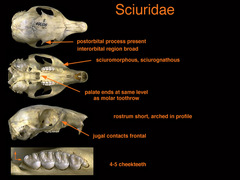
- Family Identification: short rostrum with arched profile, postorbital process well developed, anterior premolar reduced (peglike) or absent, zygomatic arch tilted posteriorly, jugal contacts frontal, 4-5 cheek teeth, palate ends at same level as molar toothrow, sciuromorphous & sciruognathous
- Way to Remember:

- Superorder: Euarchontoglires
- Group: Glires
- Order: Rodentia
- Suborder: Sciuromorpha
- Family: Sciuridae
- General Group: Squirrels (Yellow Pine Chipmunk)
- Family Geographic Range: Cosmopolitan, except Australia, Madagascar, Polar regions, & Southern half of South America
- Family Diet: herbivorous, occasionally eats insects
- Order Identification: enamel only anterior, 1 pair of incisors, teeth primitively brahcyodont and rooted, well developed pterygoid region, large parocciptal process, complete zygomatic arch
- Family Identification: short rostrum with arched profile, postorbital process well developed, anterior premolar reduced (peglike) or absent, zygomatic arch tilted posteriorly, jugal contacts frontal, 4-5 cheek teeth, palate ends at same level as molar toothrow, sciuromorphous & sciruognathous
- Way to Remember:

- Superorder: Euarchontoglires
- Group: Glires
- Order: Rodentia
- Suborder: Sciuromorpha
- Family: Sciuridae
- General Group: Squirrels (Marmot)
- Family Geographic Range: Cosmopolitan, except Australia, Madagascar, Polar regions, & Southern half of South America
- Family Diet: herbivorous, occasionally eats insects
- Order Identification: enamel only anterior, 1 pair of incisors, teeth primitively brahcyodont and rooted, well developed pterygoid region, large parocciptal process, complete zygomatic arch
- Family Identification: short rostrum with arched profile, postorbital process well developed, anterior premolar reduced (peglike) or absent, zygomatic arch tilted posteriorly, jugal contacts frontal, 4-5 cheek teeth, palate ends at same level as molar toothrow, sciuromorphous & sciruognathous
- Way to Remember:

- Superorder: Euarchontoglires
- Group: Glires
- Order: Rodentia
- Suborder: Sciuromorpha
- Family: Sciuridae
- General Group: Squirrels (Arizona Black-Tailed Praire Dog)
- Family Geographic Range: Cosmopolitan, except Australia, Madagascar, Polar regions, & Southern half of South America
- Family Diet: herbivorous, occasionally eats insects
- Order Identification: enamel only anterior, 1 pair of incisors, teeth primitively brahcyodont and rooted, well developed pterygoid region, large parocciptal process, complete zygomatic arch
- Family Identification: short rostrum with arched profile, postorbital process well developed, anterior premolar reduced (peglike) or absent, zygomatic arch tilted posteriorly, jugal contacts frontal, 4-5 cheek teeth, palate ends at same level as molar toothrow, sciuromorphous & sciruognathous
- Way to Remember:

- Superorder: Euarchontoglires
- Group: Glires
- Order: Rodentia
- Suborder: Sciuromorpha
- Family: Sciuridae
- General Group: Squirrels (Fox Squirrel)
- Family Geographic Range: Cosmopolitan, except Australia, Madagascar, Polar regions, & Southern half of South America
- Family Diet: herbivorous, occasionally eats insects
- Order Identification: enamel only anterior, 1 pair of incisors, teeth primitively brahcyodont and rooted, well developed pterygoid region, large parocciptal process, complete zygomatic arch
- Family Identification: short rostrum with arched profile, postorbital process well developed, anterior premolar reduced (peglike) or absent, zygomatic arch tilted posteriorly, jugal contacts frontal, 4-5 cheek teeth, palate ends at same level as molar toothrow, sciuromorphous & sciruognathous
- Way to Remember:
- Superorder: Euarchontoglires
- Group: Glires
- Order: Rodentia
- Suborder: Sciuromorpha
- Family: Sciuridae
- General Group: Squirrels (Eastern Gray Squirrel)
- Family Geographic Range: Cosmopolitan, except Australia, Madagascar, Polar regions, & Southern half of South America
- Family Diet: herbivorous, occasionally eats insects
- Order Identification: enamel only anterior, 1 pair of incisors, teeth primitively brahcyodont and rooted, well developed pterygoid region, large parocciptal process, complete zygomatic arch
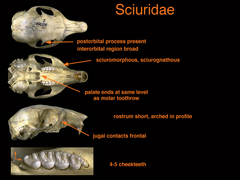
- Family Identification: short rostrum with arched profile, postorbital process well developed, anterior premolar reduced (peglike) or absent, zygomatic arch tilted posteriorly, jugal contacts frontal, 4-5 cheek teeth, palate ends at same level as molar toothrow, sciuromorphous & sciruognathous
- Way to Remember:
- Superorder: Euarchontoglires
- Group: Glires
- Order: Rodentia
- Suborder: Sciuromorpha
- Family: Sciuridae
- General Group: Squirrels (Cape Ground Squirrel)
- Family Geographic Range: Cosmopolitan, except Australia, Madagascar, Polar regions, & Southern half of South America
- Family Diet: herbivorous, occasionally eats insects
- Order Identification: enamel only anterior, 1 pair of incisors, teeth primitively brahcyodont and rooted, well developed pterygoid region, large parocciptal process, complete zygomatic arch
- Family Identification: short rostrum with arched profile, postorbital process well developed, anterior premolar reduced (peglike) or absent, zygomatic arch tilted posteriorly, jugal contacts frontal, 4-5 cheek teeth, palate ends at same level as molar toothrow, sciuromorphous & sciruognathous
- Way to Remember:

- Superorder: Euarchontoglires
- Group: Glires
- Order: Rodentia
- Suborder: Sciuromorpha
- Family: Sciuridae
- General Group: Squirrels (Black-tailed Prarie Dog)
- Family Geographic Range: Cosmopolitan, except Australia, Madagascar, Polar regions, & Southern half of South America
- Family Diet: herbivorous, occasionally eats insects
- Order Identification: enamel only anterior, 1 pair of incisors, teeth primitively brahcyodont and rooted, well developed pterygoid region, large parocciptal process, complete zygomatic arch
- Family Identification: short rostrum with arched profile, postorbital process well developed, anterior premolar reduced (peglike) or absent, zygomatic arch tilted posteriorly, jugal contacts frontal, 4-5 cheek teeth, palate ends at same level as molar toothrow, sciuromorphous & sciruognathous
- Way to Remember:

- Superorder: Euarchontoglires
- Group: Glires
- Order: Rodentia
- Suborder: Sciuromorpha
- Family: Sciuridae
- General Group: Squirrels (Marmot)
- Family Geographic Range: Cosmopolitan, except Australia, Madagascar, Polar regions, & Southern half of South America
- Family Diet: herbivorous, occasionally eats insects
- Order Identification: enamel only anterior, 1 pair of incisors, teeth primitively brahcyodont and rooted, well developed pterygoid region, large parocciptal process, complete zygomatic arch
- Family Identification: short rostrum with arched profile, postorbital process well developed, anterior premolar reduced (peglike) or absent, zygomatic arch tilted posteriorly, jugal contacts frontal, 4-5 cheek teeth, palate ends at same level as molar toothrow, sciuromorphous & sciruognathous
- Way to Remember:

- Superorder: Euarchontoglires
- Group: Glires
- Order: Rodentia
- Suborder: Castorimorpha
- Family: Castoridae
- General Group: Beavers
- Family Geographic Range: North America north of Mexico, Europe, Northern Asia, Siberia
- Family Diet: mostly bark & leaves
- Order Identification: enamel only anterior, 1 pair of incisors, teeth primitively brahcyodont and rooted, well developed pterygoid region, large parocciptal process, complete zygomatic arch
- Family Identification: large skull with small slit-like infraorbital foramen, bullae with boney tubes surroudning external auditory meatus, cheek teeth hyposodont but not persistent in growth, 4 cheekteeth with discitnctive occlusal pattern, jugal broad & contacts lacrimal, sciuromorphous & scuirognathous
- Way to Remember:

- Superorder: Euarchontoglires
- Group: Glires
- Order: Rodentia
- Suborder: Castorimorpha
- Family: Geomyidae
- General Group: Pocket Gophers (Hispid pocket gopher)
- Family Geographic Range: New world, SW Canada south into northern Colombia, South America
- Family Diet: Herbivorous, prefers tubers
- Order Identification: enamel only anterior, 1 pair of incisors, teeth primitively brahcyodont and rooted, well developed pterygoid region, large parocciptal process, complete zygomatic arch
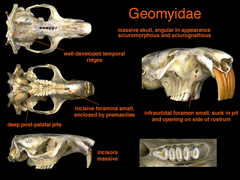
- Family Identification: pit/drop at rear of palate, zygomatic arch flares widely, small infraorbital foramen, well-developed temporal ridges, deep post-palatal pits, incisors massive, large angular skull, sciuromorpheous & sciurognathous
- Way to Remember: looks like bathyergidae but with castormorpha jaw layout

- Superorder: Euarchontoglires
- Group: Glires
- Order: Rodentia
- Suborder: Castorimorpha
- Family: Geomyidae
- General Group: Pocket Gophers (Plains Pocket Gopher)
- Family Geographic Range: New world, SW Canada south into northern Colombia, South America
- Family Diet: Herbivorous, prefers tubers
- Order Identification: enamel only anterior, 1 pair of incisors, teeth primitively brahcyodont and rooted, well developed pterygoid region, large parocciptal process, complete zygomatic arch
- Family Identification: pit/drop at rear of palate, zygomatic arch flares widely, small infraorbital foramen, well-developed temporal ridges, deep post-palatal pits, incisors massive, large angular skull, sciuromorpheous & sciurognathous
- Way to Remember: looks like bathyergidae but with castormorpha jaw layout

- Superorder: Euarchontoglires
- Group: Glires
- Order: Rodentia
- Suborder: Castorimorpha
- Family: Geomyidae
- General Group: Pocket Gophers
- Family Geographic Range: New world, SW Canada south into northern Colombia, South America
- Family Diet: Herbivorous, prefers tubers
- Order Identification: enamel only anterior, 1 pair of incisors, teeth primitively brahcyodont and rooted, well developed pterygoid region, large parocciptal process, complete zygomatic arch
- Family Identification: pit/drop at rear of palate, zygomatic arch flares widely, small infraorbital foramen, well-developed temporal ridges, deep post-palatal pits, incisors massive, large angular skull, sciuromorpheous & sciurognathous
- Way to Remember: looks like bathyergidae but with castormorpha jaw layout
- Superorder: Euarchontoglires
- Group: Glires
- Order: Rodentia
- Suborder: Castorimorpha
- Family: Heteromyidae
- General Group: Kangaroo Rats & Pocket Mice (Ord's kangaroo Rat)
- Family Geographic Range: Western North America into South America
- Family Diet: seeds and vegetable matter
- Order Identification: enamel only anterior, 1 pair of incisors, teeth primitively brahcyodont and rooted, well developed pterygoid region, large parocciptal process, complete zygomatic arch
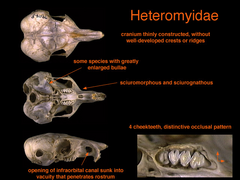
- Family Identification: often enlarged bullae, opening in side of infraorbital allows you to look through rostrum, welll developed zygomatic plate with thin arch, narow nasals, small infraorbital foramen, 4 cheek teeth with distinctive occlusal pattern, cranium thinly constructed without well-developed crests or ridges, sciuromorphous and sciurognathous
- Way to Remember:
- Superorder: Euarchontoglires
- Group: Glires
- Order: Rodentia
- Suborder: Castorimorpha
- Family: Heteromyidae
- General Group: Kangaroo Rats & Pocket Mice (Hispid Cotton Mouse)
- Family Geographic Range: Western North America into South America
- Family Diet: seeds and vegetable matter
- Order Identification: enamel only anterior, 1 pair of incisors, teeth primitively brahcyodont and rooted, well developed pterygoid region, large parocciptal process, complete zygomatic arch
- Family Identification: often enlarged bullae, opening in side of infraorbital allows you to look through rostrum, welll developed zygomatic plate with thin arch, narow nasals, small infraorbital foramen, 4 cheek teeth with distinctive occlusal pattern, cranium thinly constructed without well-developed crests or ridges, sciuromorphous and sciurognathous
- Way to Remember:

- Superorder: Euarchontoglires
- Group: Glires
- Order: Rodentia
- Suborder: Castorimorpha
- Family: Heteromyidae
- General Group: Kangaroo Rats & Pocket Mice (Merriam's Pocket Mouse)
- Family Geographic Range: Western North America into South America
- Family Diet: seeds and vegetable matter
- Order Identification: enamel only anterior, 1 pair of incisors, teeth primitively brahcyodont and rooted, well developed pterygoid region, large parocciptal process, complete zygomatic arch
- Family Identification: often enlarged bullae, opening in side of infraorbital allows you to look through rostrum, welll developed zygomatic plate with thin arch, narow nasals, small infraorbital foramen, 4 cheek teeth with distinctive occlusal pattern, cranium thinly constructed without well-developed crests or ridges, sciuromorphous and sciurognathous
- Way to Remember:

- Superorder: Euarchontoglires
- Group: Glires
- Order: Rodentia
- Suborder: Castorimorpha
- Family: Heteromyidae
- General Group: Kangaroo Rats & Pocket Mice (Mexican Spiny Pocket Mouse)
- Family Geographic Range: Western North America into South America
- Family Diet: seeds and vegetable matter
- Order Identification: enamel only anterior, 1 pair of incisors, teeth primitively brahcyodont and rooted, well developed pterygoid region, large parocciptal process, complete zygomatic arch
- Family Identification: often enlarged bullae, opening in side of infraorbital allows you to look through rostrum, welll developed zygomatic plate with thin arch, narow nasals, small infraorbital foramen, 4 cheek teeth with distinctive occlusal pattern, cranium thinly constructed without well-developed crests or ridges, sciuromorphous and sciurognathous
- Way to Remember:

- Superorder: Euarchontoglires
- Group: Glires
- Order: Rodentia
- Suborder: Castorimorpha
- Family: Heteromyidae
- General Group: Kangaroo Rats & Pocket Mice (Hispid Pocket Mouth)
- Family Geographic Range: Western North America into South America
- Family Diet: seeds and vegetable matter
- Order Identification: enamel only anterior, 1 pair of incisors, teeth primitively brahcyodont and rooted, well developed pterygoid region, large parocciptal process, complete zygomatic arch
- Family Identification: often enlarged bullae, opening in side of infraorbital allows you to look through rostrum, welll developed zygomatic plate with thin arch, narow nasals, small infraorbital foramen, 4 cheek teeth with distinctive occlusal pattern, cranium thinly constructed without well-developed crests or ridges, sciuromorphous and sciurognathous
- Way to Remember:

- Superorder: Euarchontoglires
- Group: Glires
- Order: Rodentia
- Suborder: Castorimorpha
- Family: Heteromyidae
- General Group: Kangaroo Rats & Pocket Mice (Merriam's Pocket Mouse)
- Family Geographic Range: Western North America into South America
- Family Diet: seeds and vegetable matter
- Order Identification: enamel only anterior, 1 pair of incisors, teeth primitively brahcyodont and rooted, well developed pterygoid region, large parocciptal process, complete zygomatic arch
- Family Identification: often enlarged bullae, opening in side of infraorbital allows you to look through rostrum, welll developed zygomatic plate with thin arch, narow nasals, small infraorbital foramen, 4 cheek teeth with distinctive occlusal pattern, cranium thinly constructed without well-developed crests or ridges, sciuromorphous and sciurognathous
- Way to Remember:

- Superorder: Euarchontoglires
- Group: Glires
- Order: Rodentia
- Suborder: Castorimorpha
- Family: Heteromyidae
- General Group: Kangaroo Rats & Pocket Mice (Bailey's tailed Kangaroo Rat)
- Family Geographic Range: Western North America into South America
- Family Diet: seeds and vegetable matter
- Order Identification: enamel only anterior, 1 pair of incisors, teeth primitively brahcyodont and rooted, well developed pterygoid region, large parocciptal process, complete zygomatic arch
- Family Identification: often enlarged bullae, opening in side of infraorbital allows you to look through rostrum, welll developed zygomatic plate with thin arch, narow nasals, small infraorbital foramen, 4 cheek teeth with distinctive occlusal pattern, cranium thinly constructed without well-developed crests or ridges, sciuromorphous and sciurognathous
- Way to Remember:

- Superorder: Euarchontoglires
- Group: Glires
- Order: Rodentia
- Suborder: Myomorpha
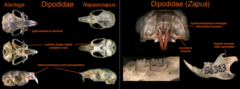
- Family: Dipodidae
- General Group: Birch Mice, Jumping Mice, & Jerboas (Western Jumping Mouse)
- Family Geographic Range: Eurasia, Northern North America, Northern Africa, Near East
- Family Diet: grass seeds, fruits, insect larvae
- Order Identification: enamel only anterior, 1 pair of incisors, teeth primitively brahcyodont and rooted, well developed pterygoid region, large parocciptal process, complete zygomatic arch
- Family Identification: enlarged infraorbital foramen, presence of smaller acessory foramen, molar cusps folded and small, angular processes often perforated (hole at bottom), bullae variable in size, hystricomorphous and sciurognathus, so zygomatic plate
- Way to Remember:

- Superorder: Euarchontoglires
- Group: Glires
- Order: Rodentia
- Suborder: Myomorpha
- Family: Dipodidae
- General Group: Birch Mice, Jumping Mice, & Jerboas (Greater Egyptian Jerboa)
- Family Geographic Range: Eurasia, Northern North America, Northern Africa, Near East
- Family Diet: grass seeds, fruits, insect larvae
- Order Identification: enamel only anterior, 1 pair of incisors, teeth primitively brahcyodont and rooted, well developed pterygoid region, large parocciptal process, complete zygomatic arch
- Family Identification: enlarged infraorbital foramen, presence of smaller acessory foramen, molar cusps folded and small, angular processes often perforated (hole at bottom), bullae variable in size, hystricomorphous and sciurognathus
- Way to Remember:
- Superorder: Euarchontoglires
- Group: Glires
- Order: Rodentia
- Suborder: Myomorpha
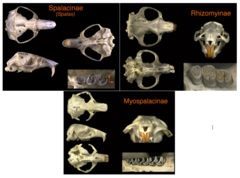
- Family: Spalacidae
- General Group: Mole rats, Zokors (Middle East Blind Mole Rat)
- Family Geographic Range: Old World, Ukraine through Mediterranean region, Africa, and Asia
- Family Diet: Roots, bulbs, rhizomes, & other underground plant parts
- Order Identification: enamel only anterior, 1 pair of incisors, teeth primitively brahcyodont and rooted, well developed pterygoid region, large parocciptal process, complete zygomatic arch
- Family Identification: zygomatic plate narrow and turned downward to near horizontal, large infraorbitla formaen, occiput high and broad with anterior slope, frontal constriction (noticeable narrowing or pinching of the skull immediately behind the eye orbits when viewed from above)
- Way to Remember: looks like bathyergidae but with myomorpha morphology
- Superorder: Euarchontoglires
- Group: Glires
- Order: Rodentia
- Suborder: Myomorpha
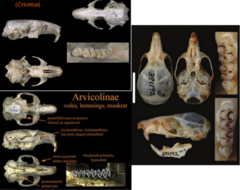
- Family: Cricetidae
- General Group: New World Mice & Rats, voles (some Old World) (Muskrat?)
- Family Geographic Range: Much of the globe from tundras the deserts, North & South America, Europe, & Asia
- Family Diet: Omnivorous
- Order Identification: enamel only anterior, 1 pair of incisors, teeth primitively brahcyodont and rooted, well developed pterygoid region, large parocciptal process, complete zygomatic arch
- Family Identification: infraorbital foramen small; wider on top than bottom (keyhole shaped), zygomatic plate broad and tilted upwards, angular process on dentary not deflected outward, molars with two cusps arranged laterally (muridae have 3)
- Way to Remember:

- Superorder: Euarchontoglires
- Group: Glires
- Order: Rodentia
- Suborder: Myomorpha
- Family: Cricetidae
- General Group: New World Mice & Rats, voles (some Old World) (Packrat?)
- Family Geographic Range: Much of the globe from tundras the deserts, North & South America, Europe, & Asia
- Family Diet: Omnivorous
- Order Identification: enamel only anterior, 1 pair of incisors, teeth primitively brahcyodont and rooted, well developed pterygoid region, large parocciptal process, complete zygomatic arch
- Family Identification: infraorbital foramen small; wider on top than bottom, zygomatic plate broad and tilted upwards, angular process on dentary not deflected outward, molars with two cusps arranged laterally (muridae have 3)
- Way to Remember:

- Superorder: Euarchontoglires
- Group: Glires
- Order: Rodentia
- Suborder: Myomorpha
- Family: Cricetidae
- General Group: New World Mice & Rats, voles (some Old World) (Hispid Cotton Rat)
- Family Geographic Range: Much of the globe from tundras the deserts, North & South America, Europe, & Asia
- Family Diet: Omnivorous
- Order Identification: enamel only anterior, 1 pair of incisors, teeth primitively brahcyodont and rooted, well developed pterygoid region, large parocciptal process, complete zygomatic arch
- Family Identification: infraorbital foramen small; wider on top than bottom, zygomatic plate broad and tilted upwards, angular process on dentary not deflected outward, molars with two cusps arranged laterally (muridae have 3)
- Way to Remember:

- Superorder: Euarchontoglires
- Group: Glires
- Order: Rodentia
- Suborder: Myomorpha
- Family: Cricetidae
- General Group: New World Mice & Rats, voles (some Old World) (Northern Grasshopper Mouse)
- Family Geographic Range: Much of the globe from tundras the deserts, North & South America, Europe, & Asia
- Family Diet: Omnivorous
- Order Identification: enamel only anterior, 1 pair of incisors, teeth primitively brahcyodont and rooted, well developed pterygoid region, large parocciptal process, complete zygomatic arch
- Family Identification: infraorbital foramen small; wider on top than bottom, zygomatic plate broad and tilted upwards, angular process on dentary not deflected outward, molars with two cusps arranged laterally (muridae have 3)
- Way to Remember:

- Superorder: Euarchontoglires
- Group: Glires
- Order: Rodentia
- Suborder: Myomorpha
- Family: Cricetidae
- General Group: New World Mice & Rats, voles (some Old World) (Southern Red-backed Vole
- Family Geographic Range: Much of the globe from tundras the deserts, North & South America, Europe, & Asia
- Family Diet: Omnivorous
- Order Identification: enamel only anterior, 1 pair of incisors, teeth primitively brahcyodont and rooted, well developed pterygoid region, large parocciptal process, complete zygomatic arch
- Family Identification: infraorbital foramen small; wider on top than bottom, zygomatic plate broad and tilted upwards, angular process on dentary not deflected outward, molars with two cusps arranged laterally (muridae have 3)
- Way to Remember:

- Superorder: Euarchontoglires
- Group: Glires
- Order: Rodentia
- Suborder: Myomorpha
- Family: Cricetidae
- General Group: New World Mice & Rats, voles (some Old World) (Long-tailed Vole)
- Family Geographic Range: Much of the globe from tundras the deserts, North & South America, Europe, & Asia
- Family Diet: Omnivorous
- Order Identification: enamel only anterior, 1 pair of incisors, teeth primitively brahcyodont and rooted, well developed pterygoid region, large parocciptal process, complete zygomatic arch
- Family Identification: infraorbital foramen small; wider on top than bottom, zygomatic plate broad and tilted upwards, angular process on dentary not deflected outward, molars with two cusps arranged laterally (muridae have 3)
- Way to Remember:

- Superorder: Euarchontoglires
- Group: Glires
- Order: Rodentia
- Suborder: Myomorpha
- Family: Cricetidae
- General Group: New World Mice & Rats, voles (some Old World) (Northern Pygmy Mouse) -- I think this one got taken out for having bugs inside the skull
- Family Geographic Range: Much of the globe from tundras the deserts, North & South America, Europe, & Asia
- Family Diet: Omnivorous
- Order Identification: enamel only anterior, 1 pair of incisors, teeth primitively brahcyodont and rooted, well developed pterygoid region, large parocciptal process, complete zygomatic arch
- Family Identification: infraorbital foramen small; wider on top than bottom, zygomatic plate broad and tilted upwards, angular process on dentary not deflected outward, molars with two cusps arranged laterally (muridae have 3)
- Way to Remember:

- Superorder: Euarchontoglires
- Group: Glires
- Order: Rodentia
- Suborder: Myomorpha
- Family: Cricetidae? (Container in lab labelled as Muridae, species reclassified as Cricetidae -- not sure which is 'correct' for lab)
- General Group: Fulvescens Harvest Mouse
- Family Geographic Range: Much of the globe from tundras the deserts, North & South America, Europe, & Asia
- Family Diet: Omnivorous
- Order Identification: enamel only anterior, 1 pair of incisors, teeth primitively brahcyodont and rooted, well developed pterygoid region, large parocciptal process, complete zygomatic arch
- Family Identification: infraorbital foramen small; wider on top than bottom, zygomatic plate broad and tilted upwards, angular process on dentary not deflected outward, molars with two cusps arranged laterally (muridae have 3)
- Way to Remember:
- Superorder: Euarchontoglires
- Group: Glires
- Order: Rodentia
- Suborder: Myomorpha
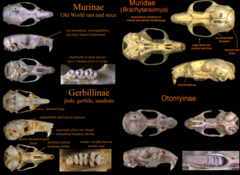
- Family: Muridae
- General Group: Old World Rats & Mice, Gerbils, etc. (House Mouse)
- Family Geographic Range: Africa, Europe, Asia, & Australia, now on every continent except Antartica
- Family Diet: Omnivorous
- Order Identification: enamel only anterior, 1 pair of incisors, teeth primitively brahcyodont and rooted, well developed pterygoid region, large parocciptal process, complete zygomatic arch
- Family Identification: zygomatic plate broad and tilted upwards, infraorbital foramen small and wider on top then bottom, angular process on dentary not deflected outward, skull varies in form but always without postorbital process on frontal, most molars with 3 cusps arranged laterally, jugal does not contact lacrimal, myomorphous and sciurognathous
- Way to Remember:

- Superorder: Euarchontoglires
- Group: Glires
- Order: Rodentia
- Suborder: Myomorpha
- Family: Muridae
- General Group: Old World Rats & Mice, Gerbils, etc. (Brown Rat)
- Family Geographic Range: Africa, Europe, Asia, & Australia, now on every continent except Antartica
- Family Diet: Omnivorous
- Order Identification: enamel only anterior, 1 pair of incisors, teeth primitively brahcyodont and rooted, well developed pterygoid region, large parocciptal process, complete zygomatic arch
- Family Identification: zygomatic plate broad and tilted upwards, infraorbital foramen small and wider on top then bottom, angular process on dentary not deflected outward, skull varies in form but always without postorbital process on frontal, most molars with 3 cusps arranged laterally, jugal does not contact lacrimal, myomorphous and sciurognathous
- Way to Remember:

- Superorder: Euarchontoglires
- Group: Glires
- Order: Rodentia
- Suborder: Myomorpha
- Family: Muridae
- General Group: Old World Rats & Mice, Gerbils, etc.
- Family Geographic Range: Africa, Europe, Asia, & Australia, now on every continent except Antartica
- Family Diet: Omnivorous
- Order Identification: enamel only anterior, 1 pair of incisors, teeth primitively brahcyodont and rooted, well developed pterygoid region, large parocciptal process, complete zygomatic arch
- Family Identification: zygomatic plate broad and tilted upwards, infraorbital foramen small and wider on top then bottom, angular process on dentary not deflected outward, skull varies in form but always without postorbital process on frontal, most molars with 3 cusps arranged laterally, jugal does not contact lacrimal, myomorphous and sciurognathous
- Way to Remember:

- Superorder: Euarchontoglires
- Group: Glires
- Order: Rodentia
- Suborder: Myomorpha
- Family: Muridae
- General Group: Old World Rats & Mice, Gerbils, etc. (Brown Rat)
- Family Geographic Range: Africa, Europe, Asia, & Australia, now on every continent except Antartica
- Family Diet: Omnivorous
- Order Identification: enamel only anterior, 1 pair of incisors, teeth primitively brahcyodont and rooted, well developed pterygoid region, large parocciptal process, complete zygomatic arch
- Family Identification: zygomatic plate broad and tilted upwards, infraorbital foramen small and wider on top then bottom, angular process on dentary not deflected outward, skull varies in form but always without postorbital process on frontal, most molars with 3 cusps arranged laterally, jugal does not contact lacrimal, myomorphous and sciurognathous
- Way to Remember:
- Superorder: Euarchontoglires
- Group: Glires
- Order: Rodentia
- Suborder: Hystricomorpha
- Family: Hystricidae
- General Group: Old World Porcupines (Crested Porcupine)
- Family Geographic Range: Africa, Europe, Asia
- Family Diet: Vegetarian, sometimes carrion
- Order Identification: enamel only anterior, 1 pair of incisors, teeth primitively brahcyodont and rooted, well developed pterygoid region, large parocciptal process, complete zygomatic arch
- Family Identification: arched skull, swollen rostrum due to inflated air chambers, large infraorbital foramen, small paroccipital process, small bullae (new world large), jugal does not contact lacrimal, paroccipital process small, zygomatic arch robust
- Way to Remember:

- Superorder: Euarchontoglires
- Group: Glires
- Order: Rodentia
- Suborder: Hystricomorpha
- Family: Erethizontidae
- General Group: New World Porcupines (North American Porcupine)
- Family Geographic Range: North, Central, and South America
- Family Diet: primarily plant material (specifically cambium layer of trees)
- Order Identification: enamel only anterior, 1 pair of incisors, teeth primitively brahcyodont and rooted, well developed pterygoid region, large parocciptal process, complete zygomatic arch
- Family Identification: short parocciptial process, auditory bullae enlarged (old world small), large almost circular infraorbital canals, jugal does not contact lacrimal, cheek teeth with wide folds, zygomatic arch strongly built, no acessory canals with infraorbital canal
- Way to Remember:

- Superorder: Euarchontoglires
- Group: Glires
- Order: Rodentia
- Suborder: Hystricomorpha
- Family: Erethizontidae
- General Group: New World Porcupines (Mexican Hairy Dwarf Porcupine)
- Family Geographic Range: North, Central, and South America
- Family Diet: primarily plant material (specifically cambium layer of trees)
- Order Identification: enamel only anterior, 1 pair of incisors, teeth primitively brahcyodont and rooted, well developed pterygoid region, large parocciptal process, complete zygomatic arch
- Family Identification: short parocciptial process, auditory bullae enlarged (old world small), large almost circular infraorbital canals, jugal does not contact lacrimal, cheek teeth with wide folds, zygomatic arch strongly built, no acessory canals with infraorbital canal
- Way to Remember:

- Superorder: Euarchontoglires
- Group: Glires
- Order: Rodentia
- Suborder: Hystricomorpha
- Family: Erethizontidae
- General Group: New World Porcupines (North American Porcupine)
- Family Geographic Range: North, Central, and South America
- Family Diet: primarily plant material (specifically cambium layer of trees)
- Order Identification: enamel only anterior, 1 pair of incisors, teeth primitively brahcyodont and rooted, well developed pterygoid region, large parocciptal process, complete zygomatic arch
- Family Identification: short parocciptial process, auditory bullae enlarged (old world small), large almost circular infraorbital canals, jugal does not contact lacrimal, cheek teeth with wide folds, zygomatic arch strongly built, no acessory canals with infraorbital canal
- Way to Remember:

- Superorder: Euarchontoglires
- Group: Glires
- Order: Rodentia
- Suborder: Hystricomorpha
- Family: Petromuridae
- General Group: Dassies (Dassie rat)
- Family Geographic Range: Southwestern Africa
- Family Diet: Grasses and leaves
- Order Identification: enamel only anterior, 1 pair of incisors, teeth primitively brahcyodont and rooted, well developed pterygoid region, large parocciptal process, complete zygomatic arch
- Family Identification: enlarged infraorbital foramen, skull flat in profile (side) view, parocciptal processes long and curved around bullae, palate long and extends beyond toothrow, jugal does not contact lacrimal, cheek teeth "terraced," auditory bullar enlarged, acessory canals present with infraobrital canal
- Way to Remember:

- Superorder: Euarchontoglires
- Group: Glires
- Order: Rodentia
- Suborder: Hystricomorpha
- Family: Bathyergidae
- General Group: Blesmoles & Mole Rats (Dhamara Mole Rat)
- Family Geographic Range: Sub-Saharan Africa
- Family Diet: Vegetarian, eats underground storage organs of plants (geophytes)
- Order Identification: enamel only anterior, 1 pair of incisors, teeth primitively brahcyodont and rooted, well developed pterygoid region, large parocciptal process, complete zygomatic arch
- Family Identification: infraorbital foramen small, large auditory bullae, enlarged angular process, jugal does not contact lacrimal, paroccipral processes small but distinct
- Way to Remember:

- Superorder: Euarchontoglires
- Group: Glires
- Order: Rodentia
- Suborder: Hystricomorpha
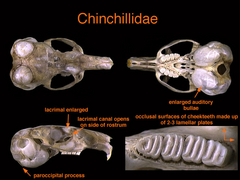
- Family: Chinchillidae
- General Group: Chincallas & Viscachas (Long-tailed Chinchilla)
- Family Geographic Range: Southern South America
- Family Diet: Herbivorous
- Order Identification: enamel only anterior, 1 pair of incisors, teeth primitively brahcyodont and rooted, well developed pterygoid region, large parocciptal process, complete zygomatic arch
- Family Identification: can see enlarged infraorbital foramen from above, molars with 2-3 segments (classically lophodont), lacrimals large, angular process elongate and slightly deflected laterally (sideways), auditory bullae can be very inflated
- Way to Remember:
- Superorder: Euarchontoglires
- Group: Glires
- Order: Rodentia
- Suborder: Hystricomorpha
- Family: Caviidae
- General Group: Guinea Pig, Mara, Cavies, Capybara (Capybara)
- Family Geographic Range: South America
- Family Diet: Herbivorous
- Order Identification: enamel only anterior, 1 pair of incisors, teeth primitively brahcyodont and rooted, well developed pterygoid region, large parocciptal process, complete zygomatic arch
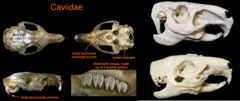
- Family Identification: large parocciptal processes that curve under bullaw, teeth converge anteriorly forming "V" shape, angular process drawn back and not deflect our, infraorbital foramen enlarged and resembles a sideways triangle
- Way to Remember:

- Superorder: Euarchontoglires
- Group: Glires
- Order: Rodentia
- Suborder: Hystricomorpha
- Family: Caviidae
- General Group: Guinea Pig, Mara, Cavies, Capybara (Guinea Pig)
- Family Geographic Range: South America
- Family Diet: Herbivorous
- Order Identification: enamel only anterior, 1 pair of incisors, teeth primitively brahcyodont and rooted, well developed pterygoid region, large parocciptal process, complete zygomatic arch
- Family Identification: large parocciptal processes that curve under bullaw, teeth converge anteriorly forming "V" shape, angular process drawn back and not deflect our, infraorbital foramen enlarged and resembles a sideways triangle
- Way to Remember:
- Superorder: Euarchontoglires
- Group: Glires
- Order: Rodentia
- Suborder: Hystricomorpha
- Family: Caviidae
- General Group: Guinea Pig, Mara, Cavies, Capybara (Cavia sp.)
- Family Geographic Range: South America
- Family Diet: Herbivorous
- Order Identification: enamel only anterior, 1 pair of incisors, teeth primitively brahcyodont and rooted, well developed pterygoid region, large parocciptal process, complete zygomatic arch
- Family Identification: large parocciptal processes that curve under bullaw, teeth converge anteriorly forming "V" shape, angular process drawn back and not deflect our, infraorbital foramen enlarged and resembles a sideways triangle
- Way to Remember:

- Superorder: Euarchontoglires
- Group: Glires
- Order: Rodentia
- Suborder: Hystricomorpha
- Family: Dasyproctidae
- General Group: Acouchis and Agoutis (Ruatan Island Agouti)
- Family Geographic Range: Tropical America, from southern Mexico south throughout the Amazonian Basin in South America
- Family Diet: Herbivorous
- Order Identification: enamel only anterior, 1 pair of incisors, teeth primitively brahcyodont and rooted, well developed pterygoid region, large parocciptal process, complete zygomatic arch
- Family Identification: Parallel tooth rows, wide zygomatic plate, premaxilla and nasals extend beyond incisors, cheekteeth with fold forming islands as they wear, moderately enlarged bullae, no groove seperate from infraorbital (lacks a groove to seperate transmitting nerves)
- Way to Remember:

- Superorder: Euarchontoglires
- Group: Glires
- Order: Rodentia
- Suborder: Hystricomorpha
- Family: Dasyproctidae
- General Group: Acouchis and Agoutis (Central American Agouti)
- Family Geographic Range: Tropical America, from southern Mexico south throughout the Amazonian Basin in South America
- Family Diet: Herbivorous
- Order Identification: enamel only anterior, 1 pair of incisors, teeth primitively brahcyodont and rooted, well developed pterygoid region, large parocciptal process, complete zygomatic arch
- Family Identification: Parallel tooth rows, wide zygomatic plate, premaxilla and nasals extend beyond incisors, cheekteeth with fold forming islands as they wear, moderately enlarged bullae, no groove seperate from infraorbital (lacks a groove to seperate transmitting nerves)
- Way to Remember:

- Superorder: Euarchontoglires
- Group: Glires
- Order: Rodentia
- Suborder: Hystricomorpha
- Family: Ctenomyidae
- General Group: Tuco-Tucos (Maule Tuco-Tuco)
- Family Geographic Range: Southern two-thirds of South America; Southern South America
- Family Diet: Herbivorous (roots, stems, grasses)
- Order Identification: enamel only anterior, 1 pair of incisors, teeth primitively brahcyodont and rooted, well developed pterygoid region, large parocciptal process, complete zygomatic arch
- Family Identification: parietal ridge, spoon teeth, kidney-shaped teeth, paroccipital processes pressed against bullae, flared lower jaw, jugal does not contact lacrimal, process on jugal
- Way to Remember:

- Superorder: Euarchontoglires
- Group: Glires
- Order: Rodentia
- Suborder: Hystricomorpha
- Family: Echimiyidae
- General Group: Nutria and Spiny Rats (Nutria)
- Family Geographic Range: Central America south throughout the Amazon Basin of South America (Nutria introduced throughout North America & Europe)
- Family Diet: Herbivorous
- Order Identification: enamel only anterior, 1 pair of incisors, teeth primitively brahcyodont and rooted, well developed pterygoid region, large parocciptal process, complete zygomatic arch
- Family Identification -- Nutria: knob on the coronoid, elongated and laterally flared parocciptal processes, jugal does not contact lacrimal, sagital crest sometimes present, auditory bullae small, acessory groove absent, fold-looking lophs
- Way to Remember:

- Superorder: Euarchontoglires
- Group: Glires
- Order: Rodentia
- Suborder: Hystricomorpha
- Family: Echimyidae
- General Group: Nutria and Spiny Rats
- Family Geographic Range: Central America south throughout the Amazon Basin in South America
- Family Diet: Herbivorous
- Order Identification: enamel only anterior, 1 pair of incisors, teeth primitively brahcyodont and rooted, well developed pterygoid region, large parocciptal process, complete zygomatic arch
- Family Identification -- Spiny Rats: glat and smooth molars, parallel tooth rows, parocciptial process pressed against bullae, jugal does not contact lacrimal, zygomatic arch relatively delicate, moderately large auditory bullae, fold-looking lophs
- Way to Remember:

- Superorder: Euarchontoglires
- Group: Glires
- Order: Rodentia
- Suborder: Hystricomorpha
- Family: Echimyidae
- General Group: Nutria and Spiny Rats (Armored Rat)
- Family Geographic Range: Central America south throughout the Amazon Basin in South America
- Family Diet: Herbivorous
- Order Identification: enamel only anterior, 1 pair of incisors, teeth primitively brahcyodont and rooted, well developed pterygoid region, large parocciptal process, complete zygomatic arch
- Family Identification -- Spiny Rats: glat and smooth molars, parallel tooth rows, parocciptial process pressed against bullae, jugal does not contact lacrimal, zygomatic arch relatively delicate, moderately large auditory bullae, fold-looking lophs
- Way to Remember:

- Superorder: Euarchontoglires
- Group: Glires
- Order: Rodentia
- Suborder: Anomaluromorpha
- Family: Pedetidae
- General Group: Spring Hares (South African Springhare)
- Family Geographic Range: Southeastern Africa
- Family Diet: Bulbs and grasses
- Order Identification: enamel only anterior, 1 pair of incisors, teeth primitively brahcyodont and rooted, well developed pterygoid region, large parocciptal process, complete zygomatic arch
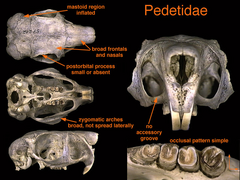
- Family Identification: large skull with broad frontals/nasals/jugals, enlarged infraorbital foramen, postorbital process reduced or absent, mastoid region inflated, zygomatic arches broad and not spread laterally, occlusal pattern simple
- Way to Remember:
- Superorder: Euarchontoglires
- Group: Glires
- Order: Rodentia
- Suborder: Anomaluromorpha
- Family: Pedetidae
- General Group: Spring Hares (South African Springhare)
- Family Geographic Range: Southeastern Africa
- Family Diet: Bulbs and grasses
- Order Identification: enamel only anterior, 1 pair of incisors, teeth primitively brahcyodont and rooted, well developed pterygoid region, large parocciptal process, complete zygomatic arch
- Family Identification: large skull with broad frontals/nasals/jugals, enlarged infraorbital foramen, postorbital process reduced or absent, mastoid region inflated, zygomatic arches broad and not spread laterally, occlusal pattern simple
- Way to Remember:

- Superorder: Laurasiatheria
- Order: Eulipotyphla
- Family: Solenodontidae
- General Group: Solenodons (Cuban solenodon)
- Family Geographic Range: Haiti, Dominican Republic, Cuba
- Family Diet: Omnivorous
- Identification: flat skull with pronounced lambdoidal crest (ridge of bone located at the back of the cranium), incomplete zygomatic arch (jugal absent), no auditory bullae, zalambdodont upper molars, deep groove in scond lower incisor, unqiue bone os proboscides -- extra bone to support tip of rostrim
- Way to Remember:

- Superorder: Laurasiatheria
- Order: Eulipotyphla
- Family: Soricidae
- General Group: Shrews
- Family Geographic Range: Worldwide except Australia, southern South America, and polar regions
- Family Diet: insectivorous and carnivorous (high metabolism -- must eat frequently)
- Identification: no zygomatic arch, no postorbital process, no auditory bullae, tympanic annular with ring shape, Dilambdodont upper molars, first lower incisors procumbent, series of unicuspid teeth, first incisor with accessory cusp, teeth often have dark/red pigment
- Way to Remember:

- Superorder: Laurasiatheria
- Order: Eulipotyphla
- Family: Talpidae
- General Group: Desmans, Moles (Northern Broad-Footed Mole)
- Family Geographic Range: North America & Eurasia
- Family Diet: omnivorous but primarily insects
- Identification: complete zygomatic arch (thin), flat auditory bullae, no postglenoid process, dilambdodont upper molars, no accessory cusp on upper incisors, first upper incisor large and not projecting forward
- Way to Remember:

- Superorder: Laurasiatheria
- Order: Eulipotyphla
- Family: Erinaceidae
- General Group: Gymnures & Hedgehogs (Hedgehog)
- Family Geographic Range: Africa, Eurasia, SE Asia, Borneo
- Family Diet: Omnivorous
- Identification: complete zygomatic arch, incomplete auditory bullae, premaxillary gap, occiput flat or concave, quadrate upper molars, incisors moderately large
- Way to Remember:

- Superorder: Laurasiatheria
- Order: Eulipotyphla
- Family: Erinaceidae
- General Group: Gymnures & Hedgehogs (Long-Eared Hedgehog)
- Family Geographic Range: Africa, Eurasia, SE Asia, Borneo
- Family Diet: Omnivorous
- Identification: complete zygomatic arch, incomplete auditory bullae, premaxillary gap, occiput flat or concave, quadrate upper molars, incisors moderately large
- Way to Remember:

- Superorder: Laurasiatheria
- Order: Eulipotyphla
- Family: Erinaceidae
- General Group: Gymnures & Hedgehogs
- Family Geographic Range: Africa, Eurasia, SE Asia, Borneo
- Family Diet: Omnivorous
- Identification: complete zygomatic arch, incomplete auditory bullae, premaxillary gap, occiput flat or concave, quadrate upper molars, incisors moderately large
- Way to Remember:

- Superorder: Laurasiatheria
- Order: Pholiodota
- Family: Manidae
- General Group: Pangolins
- Family Geographic Range: Tropical Regions of Africa & Asia
- Family Diet: insectivorous/ants
- Identification: incomplete zygomatic arch with no jugal, no teeth, skull smooth with no ridges or crests, no processes on lower jaw, rostrum doesn't curve, mandible narrow and weak, palate long but does not incoporate pterygoids
- Way to Remember:

- Superorder: Laurasiatheria
- Order: Carnivora
- Suborder: Feliformia
- Family: Felidae
- General Group: Cats (Ocelot)
- Family Geographic Range: carnivorous
- Family Diet: cosmopolitan except Antartica, Australia, Madagascar, & most oceanic island
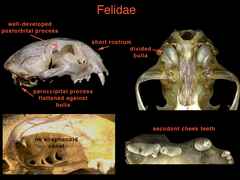
- Identification: usually 14 cheek teeth, short rostrum, bullae large and divided (but prominence varies), post-canine space (the gap or empty space located immediately behind the upper canine teeth and in front of the remaining cheek teeth), upper premolar reduced, paroccipital process flattened against bullae, well-developed postorbital process
- Way to Remember:
- Superorder: Laurasiatheria
- Order: Carnivora
- Suborder: Feliformia
- Family: Felidae
- General Group: Cats (Domestic Cat)
- Family Geographic Range: carnivorous
- Family Diet: cosmopolitan except Antartica, Australia, Madagascar, & most oceanic island
- Identification: usually 14 cheek teeth, short rostrum, bullae large and divided (but prominence varies), post-canine space (the gap or empty space located immediately behind the upper canine teeth and in front of the remaining cheek teeth), upper premolar reduced, paroccipital process flattened against bullae, well-developed postorbital process
- Way to Remember:

- Superorder: Laurasiatheria
- Order: Carnivora
- Suborder: Feliformia
- Family: Felidae
- General Group: Cats
- Family Geographic Range: carnivorous
- Family Diet: cosmopolitan except Antartica, Australia, Madagascar, & most oceanic island
- Identification: usually 14 cheek teeth, short rostrum, bullae large and divided (but prominence varies), post-canine space (the gap or empty space located immediately behind the upper canine teeth and in front of the remaining cheek teeth), upper premolar reduced, paroccipital process flattened against bullae, well-developed postorbital process
- Way to Remember:

- Superorder: Laurasiatheria
- Order: Carnivora
- Suborder: Feliformia
- Family: Felidae
- General Group: Cats (Bobcats)
- Family Geographic Range: carnivorous
- Family Diet: cosmopolitan except Antartica, Australia, Madagascar, & most oceanic island
- Identification: usually 14 cheek teeth, short rostrum, bullae large and divided (but prominence varies), post-canine space (the gap or empty space located immediately behind the upper canine teeth and in front of the remaining cheek teeth), upper premolar reduced, paroccipital process flattened against bullae, well-developed postorbital process
- Way to Remember:

- Superorder: Laurasiatheria
- Order: Carnivora
- Suborder: Feliformia
- Family: Felidae
- General Group: Cats (Jaguar [Left], Cougar [Right]) -- i got tired of all the cat skulls sorry
- Family Geographic Range: carnivorous
- Family Diet: cosmopolitan except Antartica, Australia, Madagascar, & most oceanic island
- Identification: usually 14 cheek teeth, short rostrum, bullae large and divided (but prominence varies), post-canine space (the gap or empty space located immediately behind the upper canine teeth and in front of the remaining cheek teeth), upper premolar reduced, paroccipital process flattened against bullae, well-developed postorbital process
- Way to Remember:

- Superorder: Laurasiatheria
- Order: Carnivora
- Suborder: Feliformia
- Family: Felidae
- General Group: Cats (Bobcat)
- Family Geographic Range: carnivorous
- Family Diet: cosmopolitan except Antartica, Australia, Madagascar, & most oceanic island
- Identification: usually 14 cheek teeth, short rostrum, bullae large and divided (but prominence varies), post-canine space (the gap or empty space located immediately behind the upper canine teeth and in front of the remaining cheek teeth), upper premolar reduced, paroccipital process flattened against bullae, well-developed postorbital process
- Way to Remember:

- Superorder: Laurasiatheria
- Order: Carnivora
- Suborder: Feliformia
- Family: Felidae
- General Group: Cats (Lion)
- Family Geographic Range: carnivorous
- Family Diet: cosmopolitan except Antartica, Australia, Madagascar, & most oceanic island
- Identification: usually 14 cheek teeth, short rostrum, bullae large and divided (but prominence varies), post-canine space (the gap or empty space located immediately behind the upper canine teeth and in front of the remaining cheek teeth), upper premolar reduced, paroccipital process flattened against bullae, well-developed postorbital process
- Way to Remember:

- Superorder: Laurasiatheria
- Order: Carnivora
- Suborder: Feliformia
- Family: Felidae
- General Group: Cats (Cheetah)
- Family Geographic Range: carnivorous
- Family Diet: cosmopolitan except Antartica, Australia, Madagascar, & most oceanic island
- Identification: usually 14 cheek teeth, short rostrum, bullae large and divided (but prominence varies), post-canine space (the gap or empty space located immediately behind the upper canine teeth and in front of the remaining cheek teeth), upper premolar reduced, paroccipital process flattened against bullae, well-developed postorbital process
- Way to Remember:

- Superorder: Laurasiatheria
- Order: Carnivora
- Suborder: Feliformia
- Family: Felidae
- General Group: Cats (Leopard)
- Family Geographic Range: carnivorous
- Family Diet: cosmopolitan except Antartica, Australia, Madagascar, & most oceanic island
- Identification: usually 14 cheek teeth, short rostrum, bullae large and divided (but prominence varies), post-canine space (the gap or empty space located immediately behind the upper canine teeth and in front of the remaining cheek teeth), upper premolar reduced, paroccipital process flattened against bullae, well-developed postorbital process
- Way to Remember:
- Superorder: Laurasiatheria
- Order: Carnivora
- Suborder: Feliformia
- Family: Felidae
- General Group: Cats
- Family Geographic Range: carnivorous
- Family Diet: cosmopolitan except Antartica, Australia, Madagascar, & most oceanic island
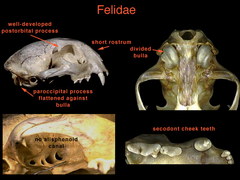
- Identification: usually 14 cheek teeth, short rostrum, bullae large and divided (but prominence varies), post-canine space (the gap or empty space located immediately behind the upper canine teeth and in front of the remaining cheek teeth), upper premolar reduced, paroccipital process flattened against bullae, well-developed postorbital process
- Way to Remember:

- Superorder: Laurasiatheria
- Order: Carnivora
- Suborder: Feliformia
- Family: Herpestidae
- General Group: Mongooses & Meerkats (Crab-Eating Mongoose)
- Family Geographic Range: Africa, 1 genus in Asia & South Europe, some restricted to Madagascar
- Family Diet: carnivorous
- Identification: clear demarcation between ectotympanic & entotympanic, ecto & endo usually same size but some have large ento, bullae parts equal in size, some with full postorbital bar, weak sagittal, developed lambdoidal crest, first pair of lower incisors out of line, large carnassials, median lacerate foramen(?)
- Way to Remember: has duel-chamber bullae (mustelidae does not), has alisphenoid canal (mustelidae does not), usually has complete post-orbital bar (mustelidae does not)

- Superorder: Laurasiatheria
- Order: Carnivora
- Suborder: Feliformia
- Family: Herpestidae
- General Group: Mongooses & Meerkats (Meerkat)
- Family Geographic Range: Africa, 1 genus in Asia & South Europe, some restricted to Madagascar
- Family Diet: carnivorous
- Identification: clear demarcation between ectotympanic & entotympanic, ecto & endo usually same size but some have large ento, bullae parts equal in size, some with full postorbital bar, weak sagittal, developed lambdoidal crest, first pair of lower incisors out of line, large carnassials, median lacerate foramen(?)
- Way to Remember: has duel-chamber bullae (mustelidae does not), has alisphenoid canal (mustelidae does not), usually has complete post-orbital bar (mustelidae does not)

- Superorder: Laurasiatheria
- Order: Carnivora
- Suborder: Feliformia
- Family: Herpestidae
- General Group: Mongooses & Meerkats
- Family Geographic Range: Africa, 1 genus in Asia & South Europe, some restricted to Madagascar
- Family Diet: carnivorous
- Identification: clear demarcation between ectotympanic & entotympanic, ecto & endo usually same size but some have large ento, bullae parts equal in size, some with full postorbital bar, weak sagittal, developed lambdoidal crest, first pair of lower incisors out of line, large carnassials, median lacerate foramen(?)
- Way to Remember: has duel-chamber bullae (mustelidae does not), has alisphenoid canal (mustelidae does not), usually has complete post-orbital bar (mustelidae does not)

- Superorder: Laurasiatheria
- Order: Carnivora
- Suborder: Feliformia
- Family: Hyaenidae
- General Group: Hyenas & Aardwolves (Brown Hyenas)
- Family Geographic Range: Africa, Southwest Asia, India
- Family Diet: Carnivorous, Scavengers
- Identification: third incisor larger than others, bullae divided but difficult to see, parocciptal process contacts bullae (similiar to felidae), no alisphenoid canal, canine-like incisors, large sagittal crest, more cheek teeth than felidae, cheek teeth conical
- Way to Remember:

- Superorder: Laurasiatheria
- Order: Carnivora
- Suborder: Feliformia
- Family: Viverridae
- General Group: Civets, Genets, Linsangs, Binturongs (African Civet) GOD I HATE THIS ONE
- Family Geographic Range: Native to southern Europe, Africa, and Asia (including Indonesia & Philippines), radiated on Madagascar
- Family Diet: Carnivorous
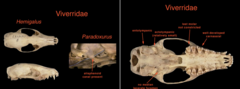
- Identification: bullae with clear demarcation between extotympanic and entotympanic, bullae divided at a slant, ecto smaller than ento, first pair of lower incisors out of alignment, last molar not constricted, well-developed carnassials, alisphenoid canal present
- Way to Remember: have 2 lower molars (canidae has 3)

- Superorder: Laurasiatheria
- Order: Carnivora
- Suborder: Feliformia
- Family: Viverridae
- General Group: Civets, Genets, Linsangs, Binturongs (South African small-spotted genet)
- Family Geographic Range: Native to southern Europe, Africa, and Asia (including Indonesia & Philippines), radiated on Madagascar
- Family Diet: Carnivorous
- Identification: bullae with clear demarcation between extotympanic and entotympanic, bullae divided at a slant, ecto smaller than ento, first pair of lower incisors out of alignment, last molar not constricted, well-developed carnassials, alisphenoid canal present
- Way to Remember: have 2 lower molars (canidae has 3)
- Superorder: Laurasiatheria
- Order: Carnivora
- Suborder: Feliformia
- Family: Viverridae
- General Group: Civets, Genets, Linsangs, Binturongs (Binturong)
- Family Geographic Range: Native to southern Europe, Africa, and Asia (including Indonesia & Philippines), radiated on Madagascar
- Family Diet: Carnivorous
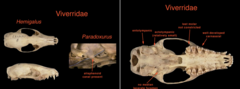
- Identification: bullae with clear demarcation between extotympanic and entotympanic, bullae divided at a slant, ecto smaller than ento, first pair of lower incisors out of alignment, last molar not constricted, well-developed carnassials, alisphenoid canal present
- Way to Remember: have 2 lower molars (canidae has 3)
- Superorder: Laurasiatheria
- Order: Carnivora
- Suborder: Caniformia
- Family: Canidae
- General Group: Coyotes, Dogs, Foxes, Jackals, Wolves
- Family Geographic Range: Worldwide except for Antarctica
- Family Diet: Carnivorous & Omnivorous
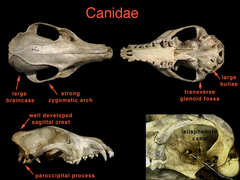
- Identification: elongated rostrum, paroccipital process long, alisphenoid canal present, sagittal crest well developed, large bullae, alisphenoid canal, transverse glenoid fossa
- Way to Remember:

- Superorder: Laurasiatheria
- Order: Carnivora
- Suborder: Caniformia
- Family: Canidae
- General Group: Coyotes, Dogs, Foxes, Jackals, Wolves (Domestic Dog)
- Family Geographic Range: Worldwide except for Antarctica
- Family Diet: Carnivorous & Omnivorous
- Identification: elongated rostrum, paroccipital process long, alisphenoid canal present, sagittal crest well developed, large bullae, alisphenoid canal, transverse glenoid fossa
- Way to Remember:

- Superorder: Laurasiatheria
- Order: Carnivora
- Suborder: Caniformia
- Family: Canidae
- General Group: Coyotes, Dogs, Foxes, Jackals, Wolves
- Family Geographic Range: Worldwide except for Antarctica
- Family Diet: Carnivorous & Omnivorous
- Identification: elongated rostrum, paroccipital process long, alisphenoid canal present, sagittal crest well developed, large bullae, alisphenoid canal, transverse glenoid fossa
- Way to Remember:

- Superorder: Laurasiatheria
- Order: Carnivora
- Suborder: Caniformia
- Family: Canidae
- General Group: Coyotes, Dogs, Foxes, Jackals, Wolves (Common Raccoon Dog)
- Family Geographic Range: Worldwide except for Antarctica
- Family Diet: Carnivorous & Omnivorous
- Identification: elongated rostrum, paroccipital process long, alisphenoid canal present, sagittal crest well developed, large bullae, alisphenoid canal, transverse glenoid fossa
- Way to Remember:
- Superorder: Laurasiatheria
- Order: Carnivora
- Suborder: Caniformia
- Family: Canidae
- General Group: Coyotes, Dogs, Foxes, Jackals, Wolves (Swift Fox)
- Family Geographic Range: Worldwide except for Antarctica
- Family Diet: Carnivorous & Omnivorous
- Identification: elongated rostrum, paroccipital process long, alisphenoid canal present, sagittal crest well developed, large bullae, alisphenoid canal, transverse glenoid fossa
- Way to Remember:

- Superorder: Laurasiatheria
- Order: Carnivora
- Suborder: Caniformia
- Family: Mephitidae
- General Group: Skunks & Stink Badgers (Eastern Spotted Skunk)
- Family Geographic Range: New World (Canada to South America), stink badgaers on island of Indonesia and Philippines
- Family Diet: omnivorous
- Identification: flat auditory bullae, weak or absent postorbital process, palate extends slightly beyond end of toothrow, upper molars quadrate
- Way to Remember:

- Superorder: Laurasiatheria
- Order: Carnivora
- Suborder: Caniformia
- Family: Mephitidae
- General Group: Skunks & Stink Badgers (American Hog-Nosed Skunk)
- Family Geographic Range: New World (Canada to South America), stink badgaers on island of Indonesia and Philippines
- Family Diet: omnivorous
- Identification: flat auditory bullae, weak or absent postorbital process, palate extends slightly beyond end of toothrow, upper molars quadrate
- Way to Remember:

- Superorder: Laurasiatheria
- Order: Carnivora
- Suborder: Caniformia
- Family: Mephitidae
- General Group: Skunks & Stink Badgers (Eastern Spotted Skunk?)
- Family Geographic Range: New World (Canada to South America), stink badgaers on island of Indonesia and Philippines
- Family Diet: omnivorous
- Identification: flat auditory bullae, weak or absent postorbital process, palate extends slightly beyond end of toothrow, upper molars quadrate
- Way to Remember:

- Superorder: Laurasiatheria
- Order: Carnivora
- Suborder: Caniformia
- Family: Mephitidae
- General Group: Skunks & Stink Badgers (Eastern Spotted Skunk)
- Family Geographic Range: New World (Canada to South America), stink badgaers on island of Indonesia and Philippines
- Family Diet: omnivorous
- Identification: flat auditory bullae, weak or absent postorbital process, palate extends slightly beyond end of toothrow, upper molars quadrate
- Way to Remember: