Biochem Exam 2 Review
 Call Kai
 Learn
Learn Practice Test
 Spaced Repetition
 Match
Match Flashcards
 Knowt Play
1/60

There's no tags or description
Looks like no tags are added yet.
Name | Mastery | Learn | Test | Matching | Spaced | Call with Kai | Chat |
|---|
No analytics yet
Send a link to your students to track their progress
61 Terms

What Functional Group is this?
Amino Group

What Functional Group is this?
Hydroxyl Group

What Functional Group is this?
Sulfhydryl Group

What Functional Group is this?
Ether Linkage

What Functional Group is this?
Aldehyde

What Functional Group is this?
Ketone

What Functional Group is this?
Carboxyl Group or Carboxylate Group (when H is removed)

What Functional Group is this?
Ester Linkage

What Functional Group is this?
Thioester Linkage

What Functional Group is this?
Amido Group

What Functional Group is this?
Imino Group

What Functional Group is this?
Phosphoester Linkage

What Functional Group is this?
Phosphoryl Group
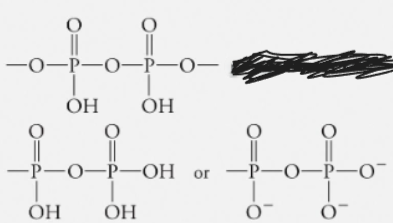
What Functional Group is this?
Diphosphoric Acid Ester (Phosphonahydride Linkage, Diphosphoryl Group, or Pryophosphoryl Group)
a Helix Structure
Hydrogen bonds between C=O and N-H 4 residues, with each residue forming 2 hydrogen bonds. Side chains point outward
B Sheet Structure
Polypeptide backbone hydrogen bonds with neighboring strand where each residue forms 2 hydrogen bonds
What are the two types of B sheets?
Antiparallel B Sheets and Parallel B Sheets
Antiparallel B sheets
Hydrogen Bonds are linear, N and C termini are opposite, and there are shorter loops between them
Parallel B sheets
Hydrogen Bonds are staggered, N and C termini are matched (on same side), and there are longer loops between them
Secondary Structure
How small sequences of the peptide chain fold
What are the Three main types of Secondary Structure?
a-Helix, B-Sheet, and Unstructured/Irregular
Which type of bonds are responsible for holding together secondary structured proteins?
Hydrogen bonds
What types of intermolecular interactions occur between amino acid side chains in the core of a globular protein?
Van der Waals/LDF
What types of intermolecular interactions occur between amino acid side chains and water on the surface with water in the environment?
Hydrogen bonds and Ion-dipole interactions
What are the four intermolecular forces that stabilize tertiary and quaternary structure?
Hydrophobic Interactions, Ion pairs (Salt Bridges), Disulfide Linkages, and Metal Ions
Which of the four intermolecular forces that stabilize tertiary and quaternary structure be affected by pH?
Ion pairs (salt bridges)
Which of the four intermolecular forces that stabilize tertiary and quaternary structure be affected by reducing agents?
Disulfide bonds
What are four techniques of Protein Separation?
SDS-PAGE, Ion exchange Chromatography, Size exclusion Chromatography, and Affinity Chromatography
What is the Separation Property in SDS-PAGE?
Molecular weight
What is the Separation Property in Ion exchange Chromatography?
Net charge
What is the Separation Property in Size exclusion Chromatography?
Molecular size
What is the Separation Property in Affinity Chromatography?
Specific binding to a ligand
How does SDS-PAGE work?
SDS denatures proteins and gives them a similar charge-to-mass ration, and then Polyacrylamide gels acts as a molecular mesh that slows larger proteins (Proteins that weigh more are further back, and Proteins that weigh less are further ahead)
How does Ion exchange Chromatography work?
Proteins are attracted to oppositely charged groups attached to column resin. After the similarly-charged proteins leak out, the attracted proteins are eluted with change in pH or salt concentration in eluent.
How does Size exclusion Chromatography work?
The column has porous beads. Smaller proteins enter into the pores and take longer to pass through but larger proteins enter fewer pores.
How does Affinity Chromatography work?
A ligand is attached to the column and proteins that bind the ligand are retained. Free ligand can then release bound proteins after all other liquid was drained
Which proteins elute first in SDS-PAGE?
Smaller proteins migrate faster and farther through the gel
Which proteins elute first in Ion exchange Chromatography?
Proteins that don’t bind or bind weakly to the column (So basically ones of the same or similar charge of the resin)
Which proteins elute first in Size exclusion Chromatography?
Larger proteins
Which proteins elute first in Affinity Chromatography?
Proteins that don’t bind to the initial ligand
Actin
structural protein that shapes, contracts, and traffics cells and is made up of 4 Globular actins to make a Filamentous actin.
Collagen
extracellular structural protein that connects cells, organs and bone together and is in the shape of a triple helix.
Hemoglobin
Transport protein that delivers O2 in blood and has 4 subunits.
Immunoglobulin (Antibodies)
Defensive proteins that have two heavy chains and two light chains, and are linked by disulfide bonds. They recognize antigens.
Keratin
extracellular structural protein that makes up hair and nails, is made of a coiled coil, and is insoluble in water.
Kinesin
Motor protein in cellular transport that “crawls” along microtubules to carry cargo in a single direction.
Myoglobin
Transport protein that receives O2 in muscles and has only 1 subunit.
Myosin
Motor protein that “pull” actin in muscle to promote muscle contraction, and has two heads intertwined into a single tail.
Tubulin
structural protein that’s involved in cell division and shapes, moves, and traffics cells and is made form a- and B-tubulin to form a dimer.
Which proteins bind to ATP?
Actin, Myosin, and Kinesin
Which protein binds to GTP?
Tubulin
Bohr effect
Low pH causes Hemoglobin to release O2 (Lower Affinity) and High pH causes Hemoglobin to bind O2 (Higher Affinity)
Cooperative binding
Hemoglobin’s affinity for O2 increases as more O2 binds to it
Tense (T) state (deoxy)
The conformation when Hemoglobin is not bound to oxygen
Relaxed (R) state (oxy)
The conformation when Hemoglobin is bound to oxygen
What is Actin’s Structure?
Globular actin monomers that assemble into filaments which are thin solid fibers
What is Tubulin’s Structure?
a- and B-tubulin heterodimers assemble into protofilaments that form hollow microtubules
What is Actin’s Function?
Maintaining cell shape, Supports the cell membrane, Contributes to cell movement, and Muscle contraction
What is Tubulin’s Function?
Forms the mitotic spindle for chromosome segregation and serves as tracks for intracellular transport by motor proteins
What Nucleotide does Actin bind to?
ATP
What Nucleotide does Tubulin bind to?
GTP