lec 18 - T cell regulation
 Call Kai
 Learn
 Practice Test
 Spaced Repetition
 Match
 Flashcards
 Knowt Play
1/40

There's no tags or description
Looks like no tags are added yet.
41 Terms
What paradigm of the immune system will we discuss today?
Regulation!

Rem. we already talked about how too much regulation can be bad, and too much effector activation can also be bad. We need a balance.
…
What are the 2 ways in which T cells are regulated?
Restricting activity within the T cell.
T regs suppressing effector activation.

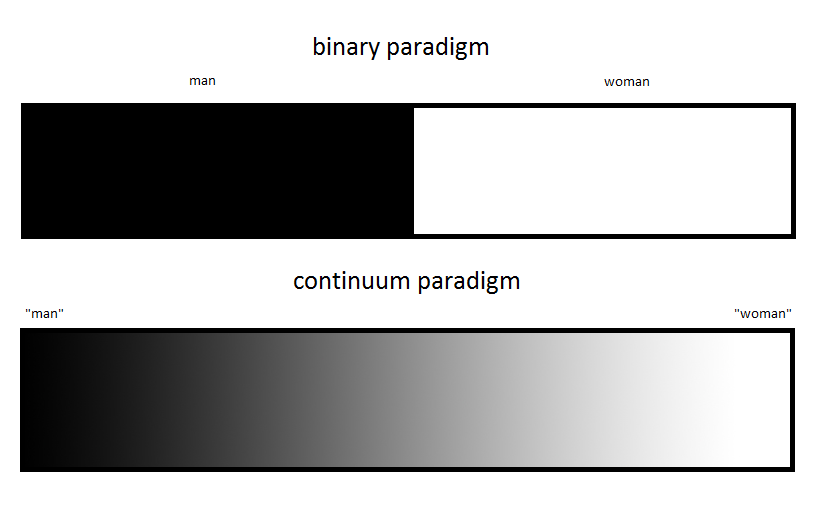
So far our idea of T cells is that they’re binary. The APC or target cell either presents the peptide or doesn’t. The APC either has co-stimulation or doesn’t.
Is this true?
no!!! it’s a continuum.

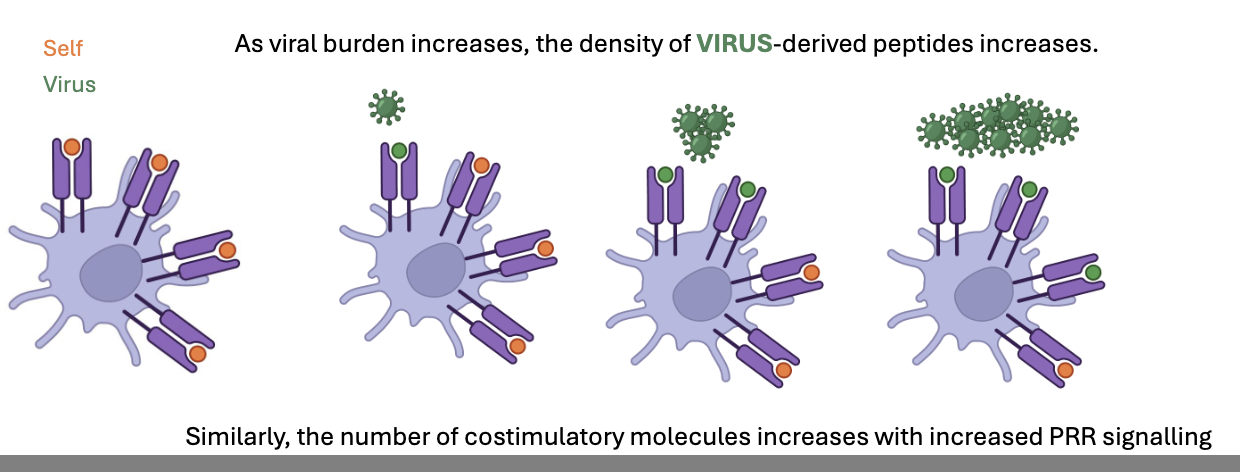
When there’s no pathogen, MHC on DCs are entirely loaded with self peptides. What does this signal T cells to do?
signals them to do nothing! means these cells are self (granted immunity!)

But as the pathogenic infection progresses, the density of virus peptides so too rises.
….
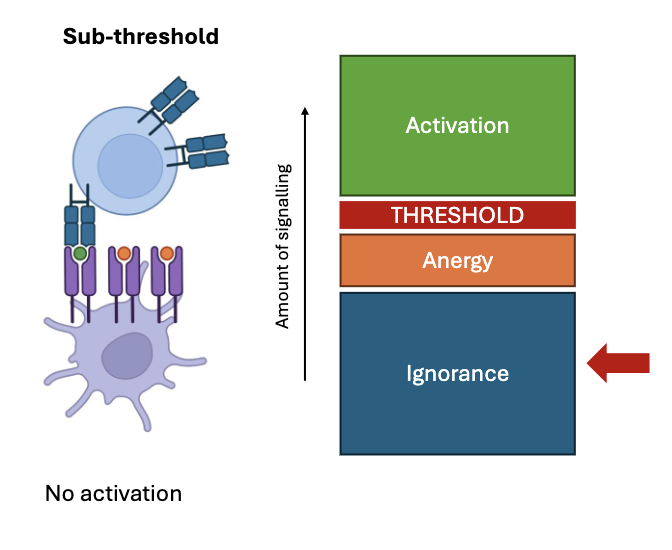
Ok so we know T cell activation isn’t binary. It’s a continuum. What point along the continuum does the T cell know to become activated?
once it reaches a threshold point!


When T cells receive a very low (sub-threshold) signal, what do they do?
they act like they didn’t see the antigen at all! i.e. ignores it!
What about if T cells receive a moderate signal (sub-but-just-below-the-threshold) signal? Do they still ignore the antigen completely?
noooo in fact they undergo a hyporesponsive state called Anergy.
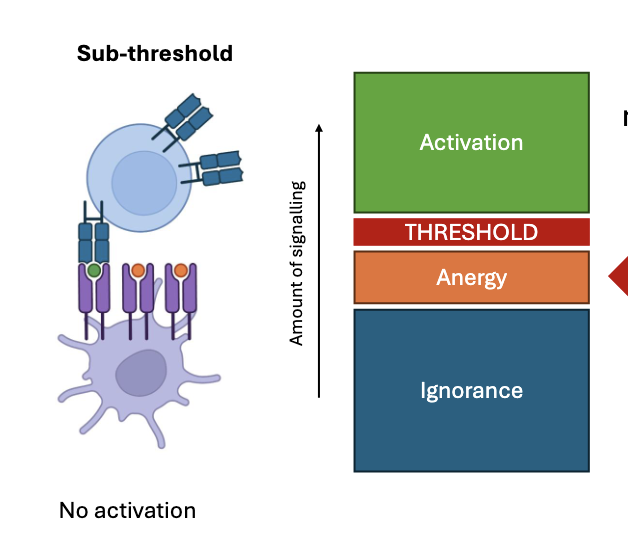
What happens in the Anergy state?
The T cell stays alive, but upon activation, the T cell actually proliferates less, produces less IL-2, and produces weaker effector cells.
That T cell now needs an even stronger signal than normal to be activated.
Can anergy be escaped?
yes!! but only by a VERY large activation stimulus.
If a T cell has low affinity for an antigen, it will naturally require more _____ bindings to engage/activate it.
If a T cell has low affinity for an antigen (binds it weakly), it will naturally require more pMHC bindings to engage/activate it.
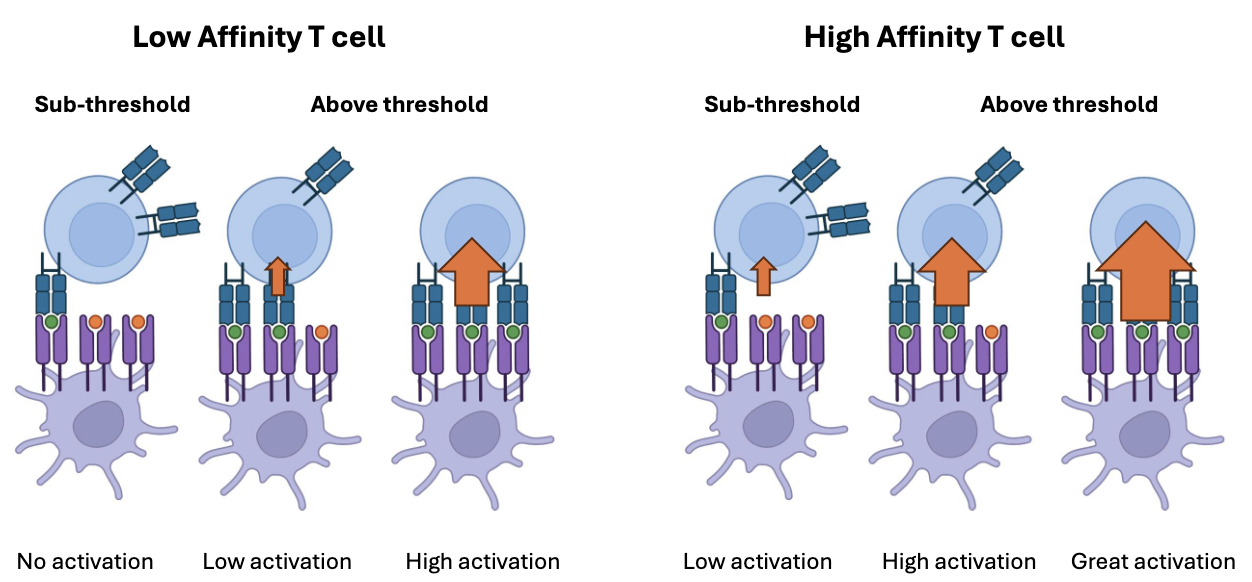
If a T cell has high affinity for an antigen, it will naturally require less pMHC bindings to engage/activate it. Why?
cuz each binding delivers a more powerful signal —> lowering the activation threshold —> fewer antigens are needed.
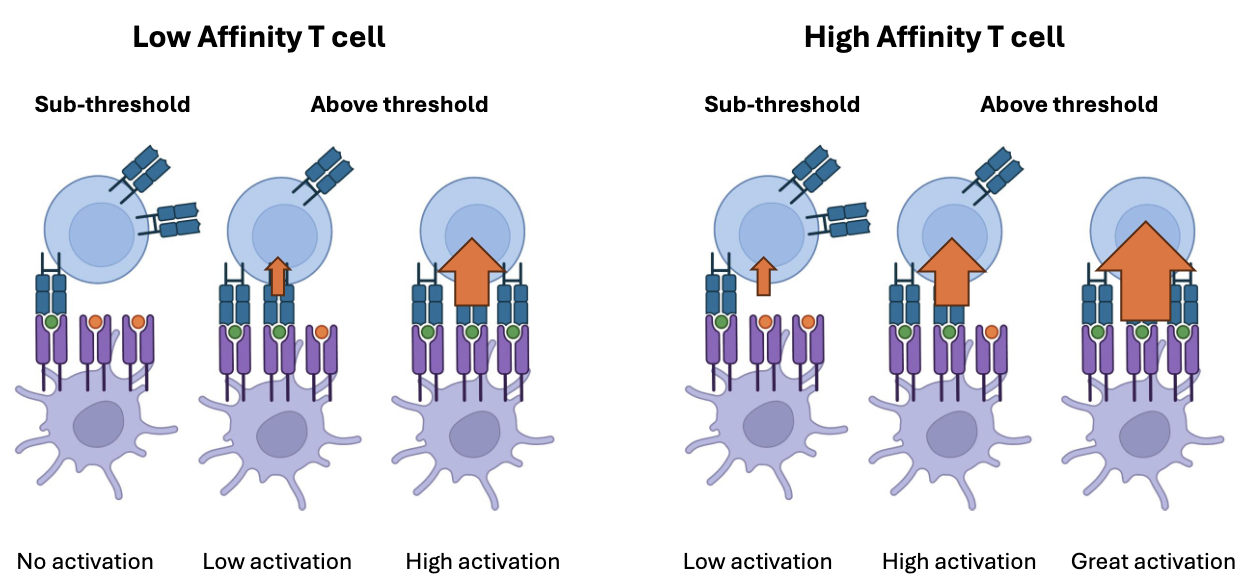
What is making for the activation threshold inside the T cell?
Turning the signal ON via phosphorylation: When the TCR binds antigen, kinases add phosphate groups to the receptor complex (the CD3-zeta signaling tails).
Turning the signal OFF via dephosphorylation: At the same time, inhibitory enzymes (phosphatases) are constantly removing those phosphate groups to shut down weak or accidental signals.
Enough receptors must be ligated and phosphorylated at the same time to send a strong enough downstream signal (red arrow) to change gene transcription.

What do you call the enzymes that dephosphorylate?
phosphatase!
What is the most important phosphatase to know?
SHP-1
For a T cell to activate, TCR binding must add phosphates faster than SHP-1 removes them. This balance is literally what creates the ….
… the activation threshold!
Now that you know what SHP-1 is, why are anergic T cells harder to activate?
Anergic T cells intentionally make more SHP-1 (and other inhibitory regulators) —> removes phosphates much faster —> raising the activation threshold so only a massive antigen stimulus can overcome the brakes.

So phosphorylation vs SHP-1 is one thing that tips the scale.
What else?
Receptor binding must phosphorylate enough signaling tails to drive gene transcription changes.
Activating signals must outpace inhibitory molecules (like SHP-1) that strip off phosphates.
et activation signals (TCR + co-stimulation via CD28, green arrows) must outweigh co-inhibitory signals (like CTLA-4, red arrow) for the T cell to cross the threshold.
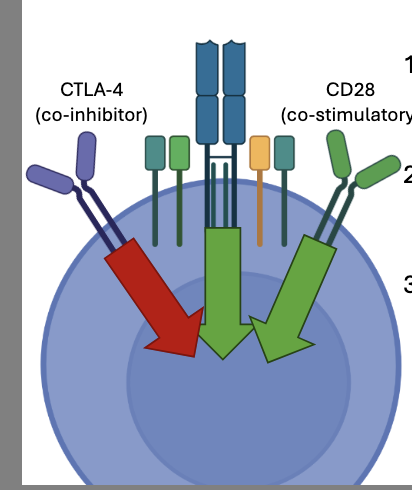
We don’t want T cells to over react or cause inflammation. So it comes with a built in negative feedback system. Explain it.
Hint: CTLA-4
When a naïve T cell gets activated by a DC and differentiates into an effector T cell (TH1), TCR signaling activates transcription factors that directly transcribe CTLA-4.
CTLA-4 is a co-inhibitory receptor!
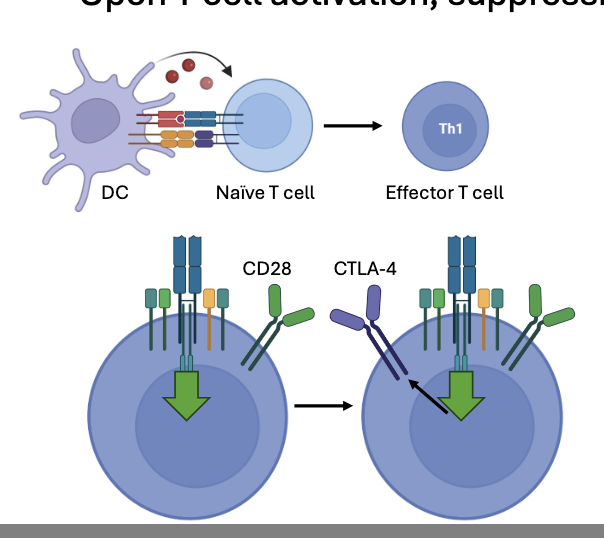

How does CTLA-4 work to inhibit?
For a naïve T cell to activate strongly, CD28 on the T cell must bind B7 ligands on the APC to provide signal 2 (co-stimulation). CTLA-4 binds the exact same B7 ligands but with a much higher affinity than CD28 —>
By grabbing B7 first, CTLA-4 starves CD28 of its co-stimulatory signal!
CTLA-4 doesn’t just block B7, it PULLS the ligands off the surface of the APC and throws it into the T cell to be degraded! What is this called?
trans-endocytosis
In chronic infections or cancers, T cells are exposed to antigen non-stop without clearing the threat.
Over-stimulated T cells progressively upregulate co-inhibitory receptors (like CTLA-4) and intracellular suppressors (like SHP-1).
With the brakes turned up, the T cells become poorly responsive to antigen and lose effector function (less killing, proliferation, and cytokines). What do you call such T cells?
EXHAUSTED T cells

Because exhausted T cells can no longer mount an effective attack, tumor cells can …
… grow unchecked and chronic infections can spread.
Restoring CD28 co-stimulation re-invigorates T cell responses so they can attack tumors again — a discovery that revolutionized cancer treatment.
Who won the nobel prize for this in 2018?
Dr. Jim Allison! Therapeutic antibodies bind and block CTLA-4. This prevents CTLA-4 from hogging B7, freeing it up to bind CD28 instead.

Ok now let’s focus on the second way T cells are regulated (T regs)!
…
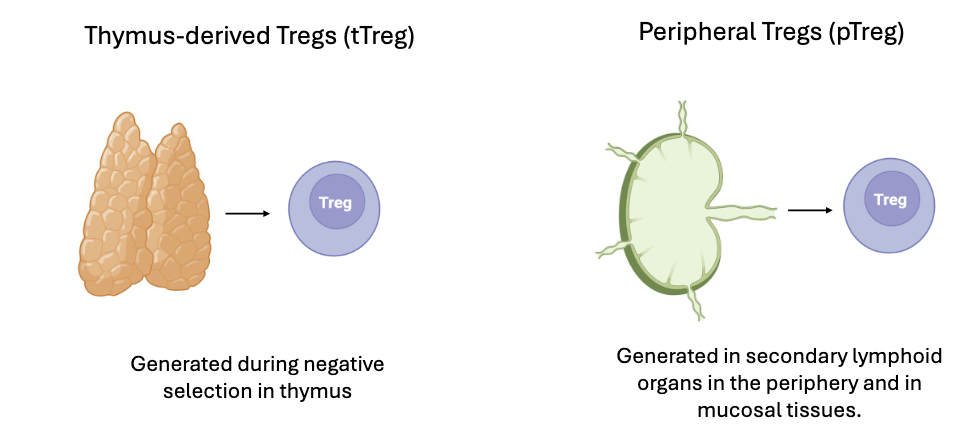
What are the two types of T regs?
Hint: their names are based on where they’re born
tTreg (thymus-derived)
generated during negative selection in thymus
pTreg (peripheral)
generated in secondary lymphoid organs in the periphery and in mucosal tissues
How are tTregs made?
Normally, developing T cells (thymocytes) that bind self-antigens too tightly in the thymus are killed (negative selection). However, a subset of these strongly self-binding thymocytes are _______ and instead turn into tTregs.
Normally, developing T cells (thymocytes) that bind self-antigens too tightly in the thymus are killed (negative selection). However, a subset of these strongly self-binding thymocytes are spared and instead turn into tTregs.
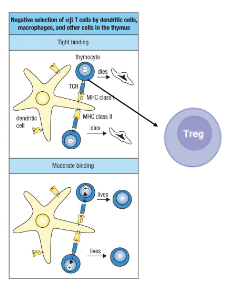
What do tTregs do after being spared during negative selection?
They travel out into the periphery and potently suppress T cell responses against self-antigens!

Out in the periphery, resting antigen-presenting cells present self-antigens with Signal 1 (TCR–MHC) ONLY—without Signal 2 (no co-stimulation) because there is no infection or danger signal.
If there is a strong signal 1, what happens to the self-reactive T cell?
If there is a moderate signal 1, what happens to the self-reactive T cell?
Strong signal 1 (without signal 2) —> The self-reactive T cell either dies (clonal deletion) or differentiates into a peripheral Treg.
Moderate signal 2 (without signal 2) —> The self-reactive T cell becomes anergic.
Wait how come self-reactive T cells can escape the thymus and become Tregs?
cuz either the T cell didn’t capture their antigen (it couldn’t bump into the exact self-antigen it’s specific for) OR some tissue specific antigen isn’t available there.
Summary of the signal and the associated outcome:
…


What is the master transcription factor of the Treg fate?
FoxP3
Humans with a mutation in FoxP3 have ______ syndrome.
IPEX syndrome
—> no Tregs, massive autoimmunity that targets multiple tissues, and lethal in the first 2 yrs of life without treatment

Why is IPEX syndrome bad?! Cuz duhhh, Tregs are a critical req for maintaining self-tolerance.
….
What are peripheral Tregs (pTregs) induced by?
TGF-beta
T/F: TGF-beta can induce pTregs with ONLY signal 1 or with BOTH signal 1 and 2.
true!
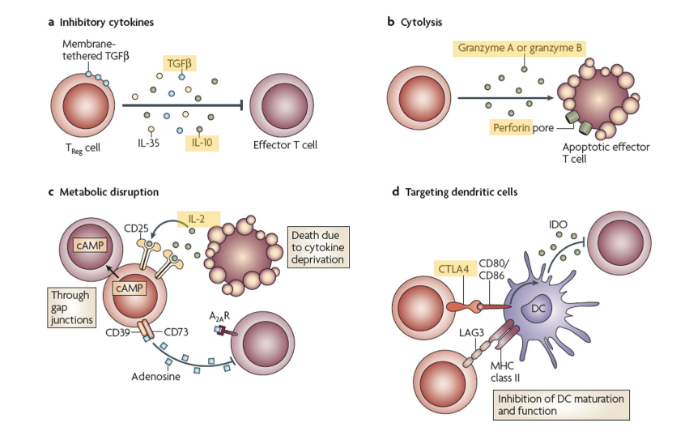
What are the 4 ways in which Tregs inhibit T cell activation?
inhibitory cytokines (TGF-beta, IL-10) that directly block effector T cell activation and proliferation.
cytolysis (perforin and granzymes A and B)
cytokine deprivation — Treg cells express high levels of the high-affinity IL-2 receptor, soaking up local IL-2 so nearby effector T cells starve and undergo death due to cytokine deprivation.
targetting dendritic cells — Tregs express CTLA-4, which binds CD80/CD86 (B7 ligands) on dendritic cells—preventing DCs from delivering Signal 2 (co-stimulation) to effector T cells and inhibiting DC maturation and function.
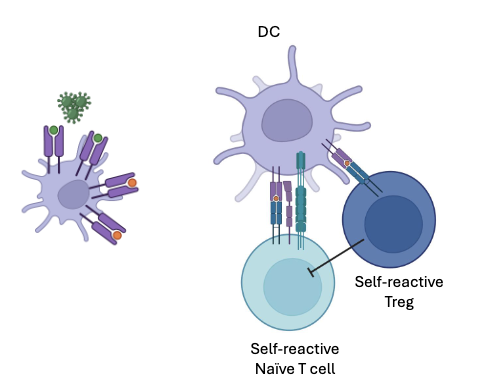
Activated DCs express co-stimulation and cytokines alongside self-peptides, which could accidentally activate escaped self-reactive naïve T cells and cause autoimmunity…. Fuck.
How do Tregs prevent autoimmunity?
Self-reactive Tregs recognize self-peptides on those same activated DCs and suppress the nearby self-reactive naïve T cells before they can activate.
We know we have commensal good gut bacteria. How do Tregs maintain tolerance for such bacteria?
The intestine uses TGF-beta as a shared base signal to balance tolerating harmless commensal bacteria with fighting pathogens.

What is a food-specific pTreg? How do they prevent food allergies?
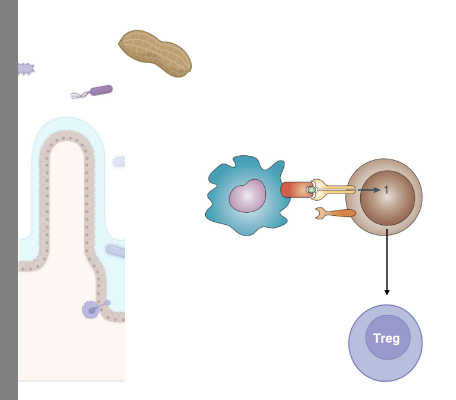
When you eat something (like a peanut), gut DCs pick up food proteins. Because food isn't a germ, there are no danger signals (PAMPs), so the DC stays calm (no DC activation = no co-stimulation/Signal 2).
That calm DC shows the food protein to a food-specific naïve T cell (strong Signal 1) while surrounded by the gut's peaceful cytokine TGF-beta, with no co-stimulation. Instead of becoming an attack cell, that T cell turns into a food-specific pTreg.
These pTregs actively block TH2 cells (the helper T cells that trigger IgE and allergic reactions) —> prevents food allergy!