Trauma
 Call Kai
 Learn
Learn Practice Test
 Spaced Repetition
 Match
Match Flashcards
 Knowt Play
1/7

There's no tags or description
Looks like no tags are added yet.
Name | Mastery | Learn | Test | Matching | Spaced | Call with Kai | Chat |
|---|
No analytics yet
Send a link to your students to track their progress
8 Terms


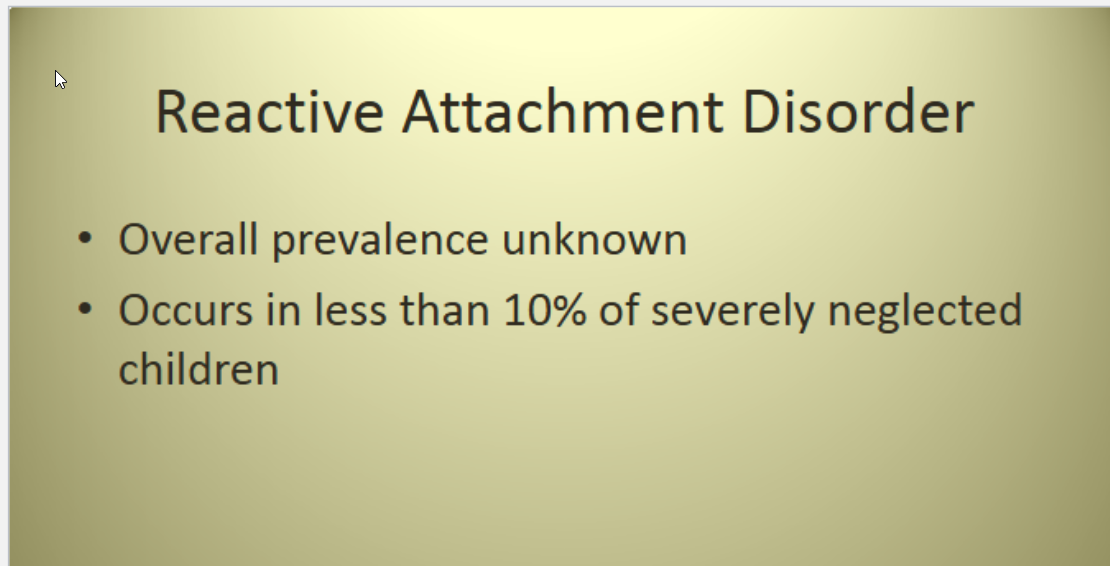
Describe Reactive Attachment Disorder
Dx criteria (7)
Tx
Dx Criteria:
Consistent pattern of inhibited, emotionally withdrawn behavior toward caregivers; as indicated by BOTH:
Child rarely/minimally seeks/respond to comfort when distressed
Persistent social/emotional disturbance; As indicated by 2:
Minimal social/emotional responsiveness to others
Limited positive affect
Episodes of unexplained/unprovoked irritability, sadness, or fearfulness
Child experienced extremes of insufficient care; as indicated by ONE:
Social neglect of deprivation:
Caregivers = not meeting child’s emotional need
(comfort, stimulation, affection)
Repeated changes of Caregivers
Limit opportunities forming stable attachments
Rearing in unusual settings that limit severely limit selective attachments
Disturbance is evident before age 5; Child has developmental age of at least 9 months
Treatment
Basic medical care
Provision of adequate caretaking
Parent education/psychiatric treatment
Legal intervention
Ongoing psychotherapy interventions
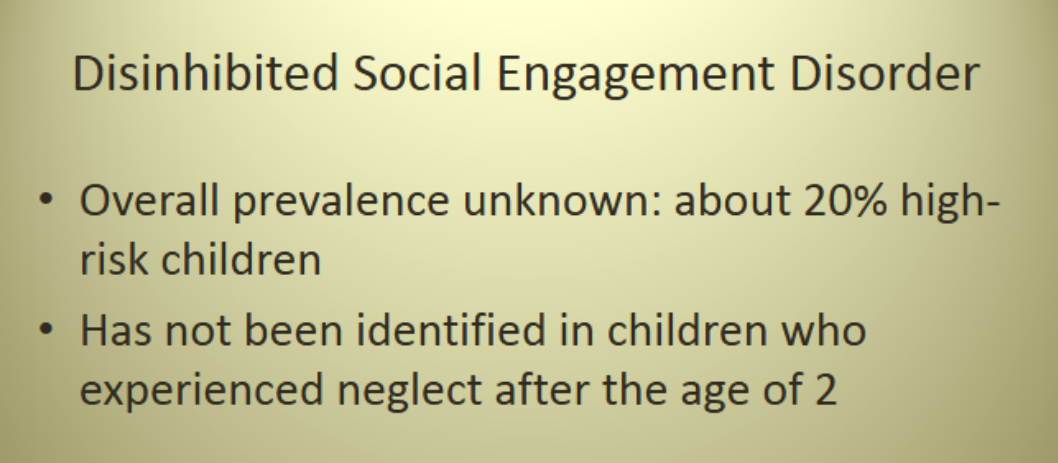
Describe Disinhibited Social Engagement Disorder
Dx criteria (7)
Tx
Dx Criteria:
Behavior pattern where child act. approaches/interacts w/ strangers; as indicated by TWO:
Reduced/absent reticence in approaching/interacting w/ strangers
Willingness to go w/ stranger w/o hesitation
Overly familiar verbal or physical behavior
Diminished/absent checking back w/ caregiver after venturing away
Child experienced patterns of insufficient care; indicated by ONE:
Social neglect of deprivation
Repeated changes of caregivers
Rearing in unusual settings
Child has developmental age of at least 9 months
Tx:
Provision of adequate caretaking
Parent education/psychiatric tx
Child will need ongoing psychotherapy interventions with adult caregivers


Describe PTSD
Dx criteria
Management
Dx Criteria:
Exposure to actual/threatened death, serious injury, or sex. Violence in ONE:
Directly experiencing event
Witnessing (in person) event
Learning that close friend/family affected by event
Experience repeated/extreme exposure to aversive details of event
Presence of intrusive symptoms associated w/ event; as indicated by ONE
Recurrent/involuntary/intrusive distressing memories of event
May be repetitive play in children
Recurrent distressing dreams of the event
Children: nightmares w/o recognizable content
issociative reactions (e.g. flashbacks) where pt feels/act as if event were recurring
Children: trauma-specific reenactment may occur in play
Intense prolonged psychological/physiologic distress at exposure to cues resembling event’s aspects
Persistent avoidance of stimuli associated w/ event; evident by ONE:
Avoidance of distressing memories, thoughts, or feelings associated w/ event
Avoidance of external reminders that arose distressing memories/thoughts/feelings of event
(people, places, conversations, activities, objects, situations)
Negative alterations in cognitions/mood associated w/ event; indicated by TWO:
Inability remembering important aspect of event
Persistent/exaggerated negative beliefs/expectations
Oneself, others, or the world
Persistent, distorted cog about cause/consequences of event -> blame themselves
Persistent negative emotional state
Markedly dim interest/participation in significant activities
Feelings of detachment/estrangement from others
Persistent inability to experience positive emotions
Marked alterations in arousal/reactivity; as indicated by 2:
Irritable behavior and angry outbursts
Reckless/self-destructive behavior
Hypervigilance
Exaggerated startle response
Problems with concentration
Sleep disturbance
Duration >1 Month
Management
First-line
SSRI’s and SNRI’s
Group therapy
Family therapy
CBT/ Prolonged exposure therapy
Correct cognitive distortions
Controlled exposure for avoidance
Imaginal therapy
Second-line
Benzodiazepines
Prazosin (nightmares and hypervigilance)
Becoming first-line treatment
Experimental
Stellate ganglion block in military PTSD
How does these work:
Prolonged Exposure Therapy
EMDR
Prolonged Exposure Therapy
Imaginal Exposure
Patient recounts traumatic event in detail
Therapist helps patient process the memory
In vivo exposure
Gradually confronting real-life situations or places the patient has been avoiding due to trauma
Duration: 8 to 15 weekly sessions
Effective for both military and civilian trauma
EMDR: Eye Movement Desensitization and Reprocessing
Pt move eyes side to side of follow therapist’s finger
Pt asked to activate disturbing memory
Pt identify feelings/cognition about memory, modify irrational cognitions, follow chains of associations to explicate the personal meanings of emotionally charged memories
Drawback:
MOA not clearly established; long-term efficacy not firmly established
APA position: needs further study
VA and DOD position: “strongly recommended”
Describe Criteria for Acute Stress Disorder
Dx criteria (4,1,2,2,5)
Prognosis/Treatment
Criteria for Acute Stress Disorder
Dx Criteria:
Exposure to traumatic events (same as PTSD)
Presence of nine (or more) of following symptoms
Intrusion Symptoms
Recurrent involuntary/intrusive distressing memories of event
Recurrent distressing dreams of event
Dissociative reactions (e.g. flashbacks) where pt feels/act as if event were recurring
Intense/prolonged psychological/physiological distress/reactions in response to cues (int/ext) of event
Negative Mood
Persistent inability to experience positive emotions
Dissociative Symptoms
Altered sense of reality (oneself/surroundings)
Inability to remember important aspects of event
Avoidance Symptoms
Efforts to avoid distressing memories, thoughts, or feelings about event
Efforts to avoid external reminders that arouse distressing memories, thoughts, or feelings about event
Arousal Symptoms
Irritable behavior and angry outbursts,
Sleep disturbance
Hypervigilance
Exaggerated startle response
Problems with concentration
DURATION: 3 days - 1 month (max)
Prognosis/Treatment:
80 % progresses to PTSD
Tx:
Relaxation training
Short course of benzodiazepine
Possible beta-blockers