3.1 The Mole and Molar Quantities
 Call Kai
 Learn
 Practice Test
 Spaced Repetition
 Match
 Flashcards
 Knowt Play
1/56

There's no tags or description
Looks like no tags are added yet.
57 Terms
Why have we devised a familiar quantity that represents the number of particles in a sample of a substance?
Atoms are incredibly small
A small amount can have a very large number of atoms or molecules
How many H2O molecules are in 1 litre of pure water?
3.346 X 1025
33 460 000 000 000 000 000 000 000
To make counting atoms and molecules easier, what do chemists use?
A mole
What is a mole?
1 mole = 6.02 X 10²³
What is the universal system of measurement units called? When was it formed?
Le systeme International d’Unites
Formed in 1960
The International System (SI) has 7 base units from which all others can be derived. List them
s, second (time)
m, Metre (length)
kg, Kilogram (mass)
A, ampere (electric current)
K, kelvin (temperature)
mol, Mole (amount of substance)
cd, candela (luminous intensity)
What is standard notation?
When a number is written using only numbers
What is scientific notation?
Scientists use numbers that are very big and very small
Standard notation would have too many zeroes
Represent these numbers as powers of 10
M x 10n
Where M is bigger or equal to 1
n is the number of decimal places to be moved
What does a + and - exponent mean in scientific notation?
Positive: indicates the standard form is a large number
Negative: indicates the standard form is a small number
Explain significant digits
In order to maintain a truthful level of accuracy, numerical results are presented using a set of rules that allows for no more accuracy than was measured through the experiment
How many sig digs would be in the answer to 62 ÷ 41?
2
Because 62 has two digits and 41 has two digits
Any number that isn’t _____ is a significant number
Zero
How many sig digs would be in the answer to 782 ÷ 231?
3
Round up when needed
Answer would be 3.39
How many sig digs would be in the answer to 56 x 28?
Two meaning the rest become zero
Long answer is 1568
We only care about the first two (plus rouding)
Answer would be 1600
What would your sig dig answer be if you were multiplying a number with 5 sig digs and another with 2?
You would default to the lower one
True or false: zeroes sandwiched between non-zero digits are always significant. Is it the same for decimals?
True
Yes
True or false: zeroes that comes before all non-zero digits (to the left) are never significant
True
How many sig digs are there in 83 000?
If no decimal place, the zeroes are not significant
Two sig digs
How many sig digs are there in 83 000.?
Zeroes are significant
5 sig digs
How many sig digs are there in 83.000?
Zeroes after decimal point are significant
5 sig digs
What is the rule for sig digs and addition/subtraction?
Use the same number of decimal places as the measured number with the smallest number of decimal places in the question
What is the rule for sig digs and multiplication/division?
Use the same number of significant digits as the measured number with the smallest number of significant digits in the question
How many sig digs are there in 0.00340?
3
Any zero to the left of the first number is not significant
How many sig digs are there in 0.0001?
1
Any zeroes before first number are not significant
An atoms is composed of what 3 subatomic particles? What are their charges?
Protons (positively charged)
Electrons (negatively charged)
Neutrons (no charge)
_____ and _____ are found in the centre of the atom in a structure called the _____
Protons and neutrons
Nucleus
The total mass of an atom is the sum of what?
ALL the electrons, protons, and neutrons
Which is heavier- protons/neutrons or electrons?
Protons/neutrons
If protons/neutrons are heavier than electrons, what does this mean for the weight distribution in an atom?
Means almost all the mass of an atom is located within the nucleus
An atom with a differing number or protons and neutrons is called what?
An isotope
Isotope: every Carbon atom has _____ protons in the nucleus but can have _____, _____, _____ neutrons in the nucleus
6
6, 7, 8
If Carbon can have 6, 7, or 8 neutrons, what does this mean for the isotopes of Carbon?
Means there are three possible isotopes of Carbon
A Helium atom has 2 protons and 2 neutrons meaning it's mass is-
4
(2+2)
Define isotopic abundance
Number of atoms of each isotope
Name 2 things that determine the average atomic mass of an element
Isotopic abundance
Mass of each isotope
On Earth, any sample of an element is made up of all of the isotopes of that particular element in _____ . Give an example
-known abundances
Magnesium: a sample of magnesium contains 3 isotopes


Relative abundance of Magnesium
How would you determine the average atomic mass of naturally occurring Magnesium?
You need to know the masses of the individual isotopes and their relative abundances
What is the equation for Atomic Massaverage?
(abundanceisotope 1)(massisotope 1) + (abundanceisotope 2)(massisotope 2) + (abundanceisotope 3)(massisotope 3)
*Abundance as a decimal
What is the units for calculating atomic mass?
u
(for units)
“The atomic mass found on the periodic table is actually the sum of-”
“-all the masses of the individual isotopes of the element and the relative abundances of each isotope”
“An _____ of a particular element is a very small entity that cannot be seen”
-atom-
In order to see an element/measure it for use in an experiment, what must we do?
We need a very large number of atoms of that element
How many particles have scientists decided we need to make useful measurements of most elements?
6.02 × 10²³
What does this mean: NA = 6.02 × 10²³
Avogadro’s Constant
Solution is in particles/atoms/formula units/molecules
In chemistry, when the unknown quantity is moles, it is denoted by the variable _____ and its unit is _____
n
mol
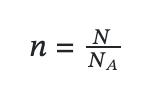
What does this mean:
Convert between moles and number of particles
n = number of moles
N = number of particles/atoms/formula units/molecules
NA = Avogadro’s number
Definition 1/3: ATOM
An atom is the smallest unit of an element

Definition 2/3: MOLECULE
Smallest unit of a covalent compound

Definition 3/3: FORMULA UNIT
Shows the kinds and numbers of atoms in the smallest representative unit of a substance


Explain:
Atomic mass is EQUAL to the mass of one mole of that particular element
This value is molar mass (M)
Defined as the mass of one mole of the element in question
What are the units for molar mass?
grams/mol
g/mol
If the atomic mass for Magnesium is 24.30 u, what is the molar mass?
Molar mass of magnesium is 24.30 grams/mol
24.30 g/mol
In this course, all molar masses will be rounded to _____ decimal places
2
How do you find the molar mass of a compound?
The sum of all the individual molar masses of all the elements present in the compound

Explain:
Converting from moles to mass using molar mass
n = number of moles in the compound (mol)
m = mass of the compound (g)
M = molar mass of the compound (g/mol)
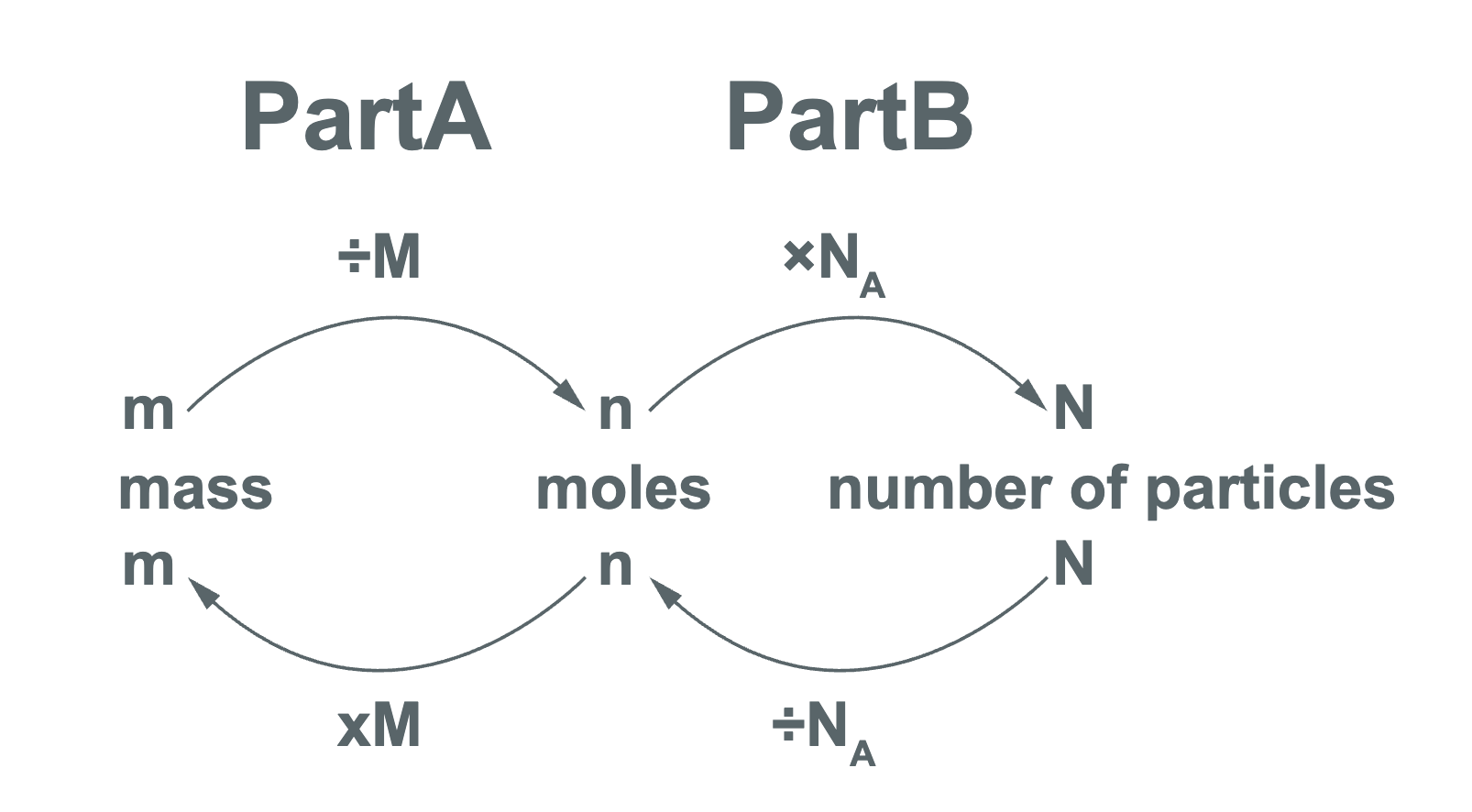
Explain:
Mole maze
Way to convert between mass, moles, number of particles/atoms/formula units/molecules