EPS 116 - Midterm 1
 Call Kai
 Learn
 Practice Test
 Spaced Repetition
 Match
 Flashcards
 Knowt Play
1/99

There's no tags or description
Looks like no tags are added yet.
100 Terms
geometric models
descriptive models of what you can see
kinematic models
how does it get there/move?
mechanical models
why did it get there? What are the mechanics behind it?
what determines if a rock behaves ductiley or brittley?
Temp
Pressure
deformation rate
rock type (mafic vs felsic)
where does the transition from brittle to ductile occur?
~300-350 C
how do seismic velocities change with depth?
lower velocities at depth (higher temp)
how old is the oldest continental and oceanic crust, respectively?
4 Ga
200 Ma

left or right lateral?
right
what kind of stress do the dark and light part of beach balls represent?
dark = compression
light = tension
what do normal vs reverse beach balls look like?
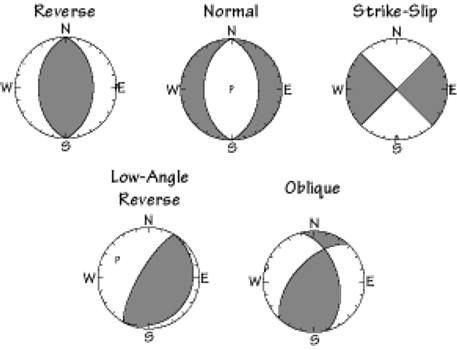
what forces drive plate tectonics
slab pull
ridge push
trench suction
bottom drag
hot spots
what force is behind ridge push
gravity. uprising magma pushes plates upward at MORs and gravitational potential energy causes the to fall apart
how does trench suction work
the convection in the mantle drags the subducting plate down
bottom drag
the friction between the plate and the mantle, slowing down the movement of the plate
what relationship exists between rate of plate motion and frequency of earthquake (if any)?
first order correlation
how has plate motion changed in recent geologic history?
remained fairly consistent the past 2 Ma
primary structures (and examples)
structures that form prior to tectonics (ie during or shortly after deposition or crystallization)
cross bedding
load casts
graded bedding
desiccation cracks
etc
secondary structures (examples)
structures that form after tectonics
fractures
folds
lineations
foliations
what is rake?
lineation on planes (the angle of linear feature from horizontal or strike)
True or false: strike line is always horizontal
true
true or false: dip angle is the maximum slope on a plane?
true
true or false: angular values for strike and dip uniquely describe the attitude of a plane
false: you need dip direction
true or false: plunge is another term to describe slop of a plane
false: it is used to describe linear features
thrust fault symbol
triangles
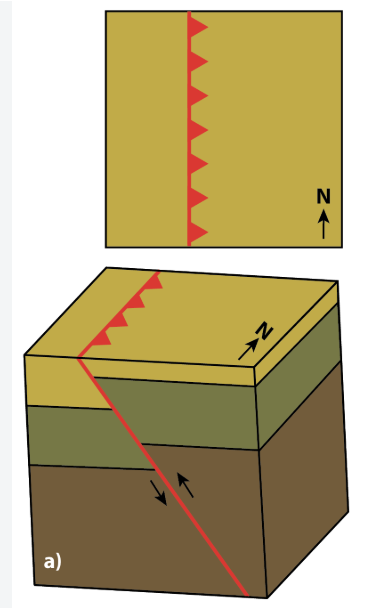
normal fault symbol

what are histograms and rose diagrams?
histograms: used to quantify frequency or number of features vs. orientation (strike or trend)
rose diagrams: angular histograms (looks like a dial)
equal angle vs equal area stereonet projection and what are they better for?
equal area: plotting distributions of fold axes, lineations, etc.
equal angle: determining geometric relationships (plotting angular relationships, focal mechanisms, etc.)

what does the first motion on vertical seismograph look like for push and pull stresses? how does this correspond to beach ball?
push: up, dark
pull: down, light
mode 1 fractures
extension (aka joints)

mode 2 fractures
shear (aka faults)

mode 3 fractures
tear

what do joints do?
accommodate extension across fractures
plumose tecture
feathery texture on joint surfaces. occurs in the direction of the crack opening
dips of normal faults
~60 degrees
dip of thrust faults
shallow ~30 degrees
dip of reverse faults
steep, greater than 45 degrees
true or false: faulted planar features are unique indicators of fault slip
false: they don’t always reflect motion happening outside plane
back arc extension
basin located behind convergent fault (phillippines)
out rise extension
tension and fractures on the subducting plate from large amounts of bending (doesnt occur everywhere)
forearc extension
extensional stresses in front of volcanic arc at subduction zones. could be do to rollback, or gravity
how do we get extension in continental collisions?
plates move perpendicular to compressive force to accommodate
transpressional transform bends
when strike slip faults curves in a direction that opposes relative motion of tectonic plates (happens at san andreas every time time we step left)
strike slip faulting in continental collision
as the plate is trying to move perpendicular to collision to make room for colliding plate, we get shearing
what force is behind brittle structures?
stress
force
rate of change of momentum
traction
force per unit area on a surface of particular orientation
normal stress
internal force acting perpendicular to material’s cross sectional area
can be compressive or tensile
3d stress tensor
6 independent components fully described by 1 normal and 2 shear stresses on 3 mutually perpendicular planes
what convention do we use for stress tensors
on/in convention. the force is acting ON a plane, IN a direction
principal stresses
the maximum and minimum normal stresses that act on orthogonal planes within a material where all shear stresses vanish
σ1
largest (positive) principal stress
σ2
second biggest stress (between 1 and 3)
σ3
smallest principal stress
what is θ on mohr diagram
between max principal stress axis and the normal of a plane. angles are double those in physical space. angle between σ1 and σn
where is maximum shear stress at in mohr circle
θ=45 (top of circle)
positive vs negative shear stress represented
positive: arrows pointing to top left and bottom right
negative: arrows point to bottom left and top right
how do fluids affect stress and mohr circles
makes it more likely to fail, moves circle left
temperature gradient of earth
+ 25 degrees C per km
set
many fractures in same area with same orientation
systematic joints
regular parallel orientations and spacing
non-systematic joints
curved, irregular joints. nearly always terminate against older joints
sheet joints
sub-parallel to topography. characterized by rounded topography, late formation. also form from plutonic cooling
columnar joints
separated into hexagonal or pentagonal columns
gash fractures
mineral-filled s- or z- shaped extensional fractures formed in ductile shear zones. forms either pinnate/feather features en echelon
stress directions in mode 1 fractures
minimum principal stress is normal to the joints, max in direction of trajectories
stress directions in mode 2 fractures
shear stress perpendicular to plane of fracture
stress directions in mode 3 fractures
shear stress parallel to plane
hackle fringe
describes a set of extension fractures that are aligned en echelon and rotated away from joint axis
rib marks
curved features perpendicular to the lines of hackle of the fracture face
are principal stresses always orthogonal to each other?
yes
is shear stress maximum on planes perpendicular to the max compressive principal stress
no, shear stress is 0.
what does the top of a mohr circle represent
max shear stress
is there a particular coordinate system in which the off-diagonal components of the stress tensor are zero?
yes, always
where does max shear stress occur
on planes oriented 45 degrees from principal stresses
what terms describe stress?
tension (tensile stress)
compression (compressive stress)
what terms describe strain
extension
contraction (or shortening)
what is T0. what does a line through it represent? what happens if a mohr circles cuts across it
tensile strength of a material
a line through it indicates the tension fracture envelope
in an unstable stress state, failure criterion
where do tensile (mode 1) fractures form?
at θ=90 (parallel to max compressive principal stress)
why do we care about both shear and normal stress in compressive faults?
because compressional faults form at θ=60, NOT θ=45 (where shear stress is maxed out). if we only cared about shear stress, we would get failure at top of mohr circle (or at θ=45)
coulomb failure criterion
stress conditions at which faulting occurs
what happens to the principal stresses and mohr circle at higher pressures?
the mohr circle gets bigger and the difference between σ1 and σ3 increases
what is ϕ?
angle of internal friction (~ 30 degrees)
at what angle from σ1 do faults occur. how does this explain what we see in nature?
at around 30 degrees. this explains why thrust faults form at around 30 from horizontal (because σ1 is also horizontal). and why normal faults form at 60 (because σ1 is vertical)
what is byerlees law
the amount of shear stress required to slide rocks past each other in pre-existing faultsd
what does the y intercept represent for byerlees law?
cohesion (where σn = 0) and any shear stress could cause failure
what happens to the normal stress if you increase water pressure?
it decreases in all directions
what do earthquakes indicate about a fault?
it is stick slip
what determines fault behavior
fault zone material (mineralogy major component of creep vs stick slip)
fluid pressure
stress state
rate and history
more
does mode of slip reflect frictional strength (friction coefficient)
not necessarily
how does strain relate to stress in an elastic material? what law relates them?
strain is proportional to stress. hooke’s law
what are some true statements about elastic strain
it is linearly related to stress
it’s instantaneous
it’s reversible
young’s modulus
a mechanical property that measures the stiffness or resistance to elastic deformation of a solid material when stretched or compressed
how to calculate mean normal stress
(σ1+σ3)/2
how to calculate max shear stress
(σ1-σ3)/2
what rules must slickenlines (linear features) follow to make sense with the measured strike and dip
rake must always be within 0-90 degrees
plunge can never be greater than the dip
what are the types porphyroclasts with tails and what do they look like


horst
graben
half grabens
synthetic faults (in same direction as main fault)
antithetic faults (in opposite direction as main fault)
detachment fault
listric faults
listric faults and roll over folds visual

fault propagation fold visual

fault bend fold visual
