Topic 1: Atomic Structure
 Call Kai
 Learn
 Practice Test
 Spaced Repetition
 Match
 Flashcards
 Knowt Play
1/29

Earn XP
Description and Tags
30 Terms
The relative mass of an electron
1/1840
The radioactive isotope used in carbon dating and its half-life
Carbon-14, 5730 years
Heisenberg’s uncertainty principle
“You cannot determine the position and momentum of an electron at the same time”
(you cannot know exactly where an electron is)
The Aufbau Principle
“Electrons enter the lowest available energy level”
Pauli’s Exclusion Principle
“No two electrons in the same atom can have identical quantum numbers."
(Two electrons can go in each orbital, providing they are of opposite spin)
Hund’s Rule of Maximum Multiplicity
“When in orbitals of equal energy, electrons will try to remain unpaired”
(There is electrostatic repulsion when two electrons are in the same orbital as they are both negatively charged. Placing each electron in a separate orbital reduces repulsion and makes the system more stable)
The shape of an S orbital
Spherical
The shape of a P orbital
Dumb-bell
Two electrons in the same orbital
Must have opposite spin
The number of orbitals in an S sub-level
1
The number of orbitals in an P sub-level
3
The number of orbitals in an D sub-level
5
The number of orbitals in an F sub-level
7
The equation which shows first ionisation
X(g) → X+(g) + e-
Trends in ionisation energy across a period
as a result of the higher nuclear charge and a similar level shielding, electrons are brought inwards
Going across a period ionisation energy increases
Trends in ionisation energy down a group
going down a group shielding increases between the nucleus and the outermost electron
less electrostatic FOA between outermost electrons and the nucleus
Going down a group 1st IE decreases
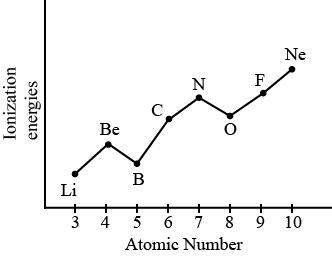
Reasons for the energy changes in the 1st ionisation energies of Period 3
Na → Mg = increase in protons
Mg → Al = entering a new sub-shell
Al → Si → P = increase in protons
P→ S = Electrons are beginning to double up
S → Cl → Ar increase in protons
Ar → K = new shell
The steps of mass spectroscopy
Vacuum
Ionisation
Acceleration
Ion drift
Detection
Data analysis
The reason 1st IE requires the least energy
The electron is being removed from a neutral atom
Vacuum
Apparatus is kept under a vacuum to prevent the ions produced from colliding with mole cules in the air
Methods of ionisation
Electrospray
Electron Impact
Electrospray steps
Sample is dissolved in a volatile solvent
Sample is forced through a hypodermic needle
The hypodermic needle is connected to a positive terminal of a high voltage supply producing positively charged droplets
The solvent evaporates from the droplets
The droplets get smaller and smaller until they contain no more than a single ion
Electron Impact steps
Sample is vaporised
High energy electrons are fired via ann electron gun (Hot wire filament with a currrent running through which emits a beam of high energy electrons)
This knocks off one electron from each particle forming a +1 ion
X(g) + e- → X-(g) + 2e-
Acceleration
Positive ions are attracted towards a negatively charged plate and accelerate towards i
All particles have the same KE, therefore the velocity depends on its mass
Lighter ions have a greater velocity
Ion drift
Ions pass through a hole in the negatively charged plate forming a beam
The ions travel along the flight tube
Detection
The positively charged ions hit a negatively charged plate gaining an electron and discharged
This generates a current through the plate
The size of this current is proportional to the number of ions present
Data Analysis
The current produced during selection is passed to a computer
The computer generates a mass spectrum
This shows the mass to charge ration (m/z) against the abundance of each ion
A use of the mass spectra
To identify the isotopes which make up an element
Low resolution spectroscopy
When work is done to 1dp
RAM calculation
(% abundance x Ar) + (% abundance x Ar) / 100