intro to microbio + bacterial genome (1+5)
 Call Kai
 Learn
 Practice Test
 Spaced Repetition
 Match
 Flashcards
 Knowt Play
1/34

There's no tags or description
Looks like no tags are added yet.
35 Terms
Differences in cell structure of prokaryotes and eukaryotes
Eukaryotes
linear chromosomes, nucleus, histone proteins
Membrane bound organelle
Prokaryotes
no nucleus
Singular circular chromosome tightly coiled and proteins in nucleotides structure
No membrane bound organelle
Differences in transcription between eukaryotes and prokaryotes
Eukaryotes
in nucleus
Spliced transcript goes to ER or cytoplasm for translation
Monocistronic transcript
Introns that require splicing
RNA polymerase requires transcription factor to bind to the promoter region
Modified by 5’ cap and 3’ poly A tail
Prokaryotes
no nucleus occurs in cytosol
Transcription and translation are concurrent
Polycistronic transcript
No introns so no splicing needed
RNA polymerase require sigma factor to bind to promoter
No cap or poly A tail modification
Polycistronic meaning
One mRNA strand can be used to code for multiple different proteins
Differences between translation in eukaryotes and prokaryotes
Eukaryotes
splicing and coupling
Eukaryotic ribosome 80S
→ large 60S subunit made of 5S,5.8S,28S rRNA
→ small 40S subunit made of 18S rRNA
Initiator Methionine doesn’t need to be modified by formyl group
Prokaryotic
Concurrent transcription and translation
Prokaryotic ribosome 70S
→ large 50S subunit made of 5S,23S rRNA
→ small 30S subunit made of 16S rRNA
requires formyl group to modify initiator methionine
Describe and explain the method of gram staining
Heat fix glass slide stain with crystal violet and wash
→ stains the peptidoglycan layer of bacteria
Add potassium iodide
→ acts as a mordant forms a large complex with crystal violet so it can move out of peptidoglycan
Add a few drops ethanol and immediately rinse
→ dissolves the outer lipid membrane and shrinks the thin peptidoglycan layer in gram - causing purple violet to leave while peptidoglycan layer is thicker in gram so remains
Safranin
→ counterstain that causes the gram- bacteria to be stained red so they can be observed
Structure of peptidoglycan
Linear polymer
Alternate NAG and NAM residues linked by glycosidic bonds
Polymers crosslinked by 3-5 amino acid long peptides form a mesh structure
Provides structural strength to resist osmotic pressure
Difference in peptidoglycan structure between gram+/-
Gram+
thicker 20-80nm
Extensive crosslinking
Indirect crosslinking via peptide interbridges(small chain of amino acids)
Contain teichoic acids a linked to peptidoglycan
Pores allow proteins through
→ provide rigidity to gram+
→ highly diverse phosphate rich polysaccharide
Gram-
Thinner 5-8nm
Direct Cross linking between stem peptides
No teichoic acids present
Pores allow proteins through
Outer membrane composition
Made of phospholipids, proteins, and lipopolysaccharides
What us a lipopolysaccaride made up of
Variable repeating sugar unit
Core sugar domain
Lipid A attatched
Lipid A function
Virulence determinant (causes disease)
Endotoxic shock released by lysis causes overactive immune response
What is a capsule and what is its function
Thick layer surrounding some bacteria
Protection and a virulence determinant
→ antiphagocytic
→ antigenic
→ prevents desiccation
→ protection against phage infection(when virus infects bacteria)
polysaccharide or glycoprotein
What are spores and what are their function
bacteria sporulate in response to change in conditions or when lacking a key nutrient
They becomes dormant and can germinate when conditions become normal
Resistant structure against heat desiccation chemicals and radiation
Flagellum structure and function
Allows bacteria to be motile/directionality / chemotaxis of bacteria to attractants or repellants
whip like structure that rotates proton driven
Type 3 secretion system assemble the flagellum
What is purpose of injectisome/type3 secretion system
surface structure forming a needle which can inject protein into eukaryotic cells which act as virulence determinants
Formation of flagellum
Structure and function of the pili
Hair like protein structures in bacteria
→ antigenic / variable
→ can be glycosylated ( sugar can be attatched to it)
allows attatchement to host cell
Conjugation create connection to 2 bacteria and transfer genetic matierial to increase genetic variation
Bacterial nucleoid structure
chromosomes condensed into nucleoid organised into a large supercoiled domain loop
Occupies a fifth of the cell usually 0.2-0.4 mm3
No membrane boundary
DNA has proteins bound to it
In growing cells within the centre and bilobed (dumbbell like shape)
What is the role of the oriC and terC in chromosome replication
Replication of bacterial chromosome bidirectional (2 replication forks)
Starts at oriC
Replisome replicate the DNA at each fork
2 replisomes approach the terC site, the end site of replication
how does the bacteria cell divide into 2
FtsZ protein forms a ring shaped complex around the middle of the dividing cell
Septum grows inwards from the cell equator cutting off the 2 daughter cells
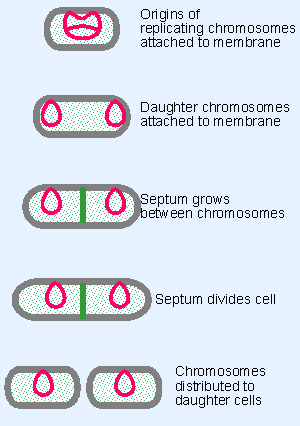
how does growth rate regulate DNA replication
time taken to replicate chromosomes takes longer than the time taken to divide in some bacteria
Next round of chromosome replication can be initiated before the 1st is completed
Fast growing cells have multiple replication forks
How are plasmids replicated
autonomous replicationi independant of chromosome
Origin at oriV
Some have specific initiator protein
Can use host DNA synthesis functions e.g. DNA polymerase
Semi conservative replication
Short replication time compared to chromosome due to shorter nucleotide sequence
How are plasmids self regulated
some plasmids have afixed number of copies per cell
Copy control genes linked to the initiation of replication at oriV
Related plasmids cant co exist do to plasmid incompatibility
Roles of a plasmid
Conjugative plasmids
→ allow transfer of plasmids between other bacteria
tumour induction e.g. in plants
Resistance plasmids e.g. to antibiotics and antimicrobial production
Metabolic capacity
Virulence
What do bacteriophages do and what are their properties
Virus that infects a bacteria
Lytic cycle
Contains a protein coat containing the phages genome
Can produce pores on the bacterial envelope and cause cell lysis
Insert genetic matierial into chromosome
What are transposons and what are thei functions
DNA sequence that can change positions within a bacterias genome
Mediated by transposases
Have inverted sequence at the ends
Can insert into chromosomes bacteriophage and plasmid
Can have a cargo gene added which can contain genes for anti microbial resistance
Usually mutagenic as movement can disrupt their sequence
How is genetic matierial exchanged between bacteria
conjugation
→ transfer of DNA directly between bacterial cells via cell cell contact via pilus
→ usualy plasmids
transformation
→ bacteria taking up DNA from its environment
→ bacteria need to be in a competent state to take up DNA
Transduction
→ transfer of bacteria via a bacteriophage infection
→ phage infects the cell replicates and produces new viruses
→ DNA can be packaged inside the virus and pased to other bacteria
How is genetic variation increased in bacteria
Mutations: 10^-10 chance of occuring
Genetic recombination
Other gen etic element e.g. plasmids from other bacteria and. Bacteriophages
Core and non core genome contents(non core found in some strains)
Pangenome meaning
the entire set of genes found in all strains of a species
What are antimicrobials
compound that stops/slows the spread of microorganisms
E.g. antibiotics
History of antibiotics
Beofre treatment wasnt targeted to just pathogens e.g. heavy metals like mercury to treat syphilis
1st antibiotic = pyocanase (Emmerich and Low)
→bacteria that cause one disease can cure another however cause side effects
penecillin (Flemming)
Antibiotic resistance
How do antibiotics work
inhibit cell wall synthesis
Disrupty cell wall
Inhibit protein synthesis
Inhibit DNA synthesis
How do bacteria become resistant to antibiotics
horizontal gene transfer
Genes that encode resistance inherited
Spontaneous mutations
Natural change in expression levels of genes
Mechanisms of antibiotic resistance
efflux pumps which remove the antibiotic or downregulation of influx of antibiotics
Inactivation of antibiotic: Enzyme which modifies the antibiotics so they become inactive
Target site modification: so no longer complimentary to the antibiotic
Target protection protein: that has a higher affinity to the antibiotic target site binds prevent antibiotic from binding
Target bypass: Bacteria develop an alternate metabolic pathway that involves a different protein that performs the same function as the target protein
What is a Recombinant
DNA molecule with segements that originate from different organisms