Lecture 3: Hematopoiesis
 Call Kai
 Learn
Learn Practice Test
 Spaced Repetition
 Match
Match Flashcards
 Knowt Play
1/36

There's no tags or description
Looks like no tags are added yet.
Name | Mastery | Learn | Test | Matching | Spaced | Call with Kai | Chat |
|---|
No analytics yet
Send a link to your students to track their progress
37 Terms
All mature blood cells including RBC + WBCs arise from what?
HSC - Hematopoietic stem cells
the cell type from which all lineages of blood cells arise
Define hematopoiesis
The processes of formation and differentiation of blood cells
*****What is the hotspot regions of Hematopoiesis in Adults?
Bone marrow (yellow marrow)
pelvis, sternum, vertebrae, and proximal ends of our limbs

****Stem cells are defined by what 2 capacities?
Ability to regenerate or “self renew”
Ability to Differentiate into diverse cell type

*****How are EMBRYONIC SCs different than ADULT SCs?
Embryonic = have the capacity to generate almost every specialized cell type in an organism: they are considered pluripotent
Adult = Have the capacity to give rise to the diverse cells types that specify a particular tissue: they are considered Multipotent
many adult organs harbor stem cells that five rise to cells for that specific tissue (tissue specific stem cells)
****What was the first tissue specific stem cell identified?
HSC (hematopoietic SCs)
Source of RBC and WBC
****Where do HSCs originate and where do they primarily reside?
Where are a small portion of HSCs found?
Originate in fetal tissues and reside primarily in the bone marrow of adult
vertebrate.
Small number may be found in adult spleen and liver.
****Are HSCs RARE or COMMON cells?
Rare
less than 50000 in the bone marrow.
***HSC numbers are strictly controlled by what? (3 events)
a balance of cell division, death, and differentiation
****What are HSCs like under steady state or homeostatic conditions (NO infection)
Most HSC are resting
Only a small number divide, generating daughter cells
****What are the 2 possible fates of HSC DAUGHTER CELLS
Some daughter cells retain the self-renewal characteristics of the mother cell = replenish the source
Some daughter cells differentiate
****What do HSCs Differentiate into?
progenitor cells
Myeloid + Lymphoid progenitors
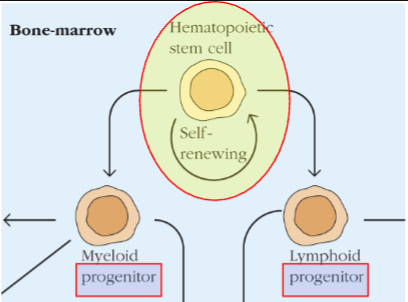
***What are PROGENITOR CELLS? how do they differ from HSCs?
Limited self-renewal capacity
Become progressively more committed to a particular blood cell lineage
****Where is the ONLY LOCATION that progenitor cells are found in the hematopoiesis process?
BONE MARROW
progenitors are not allowed outside/ not found outside the bone marrow (generally)
*****EXCEPTIONS: What is the ONLY cell that can EXIT the Bone marrow still as a progenitor
T- CELLS
Go to the thymus to continue maturation

***What are the processes that occur in the BONE MARROW?
Differentiation of HSCs into PROGENITOR CELLS
Generally all cells undergo a progenitor precursor stage in the bone marrow

*****EXCEPTIONS: What are 2 cells that are can skip the Progenitor stage
MAST CELLS
ILC (innate lymphoid cells)

*How does the number of HSCs change as one ages? Why?
Number of HSCs decreases (there are limits to self-renewal)
*****EXCEPTIONS: What is the ONLY cell that can be derived from both myeloid + lymphoid cells?
DENDRITIC CELLS
but in this case we will mostly be referring to myeloid derived dendritic cells
****List the MYELOID vs. LYMPHOID cells
Myeloid
dendritic
Monocytes => Macrophages
Neutrophil
Eosinophil
Basophils
Platelets
Erythrocytes
Mast Cells
Lymphoid
Dendritic
B cells
T cells
ILC (innate Lymphoid cells)

Key concepts: All RBCs and WBCs develop from _______ ________during a highly regulated process called _______
All RBCs and WBCs develop from multipotent HSCs during a highly regulated process called
hematopoiesis.
Key concepts: Hematopoiesis occurs in the adult _____ ______ __________ that supports both the ______ and ________ of the HSC into multiple cell types
Hematopoiesis occurs in the adult vertebrate Bone Marrow (a primary lymphoid organ) that supports both the self-renewal and differentiation of the HSC into multiple cell types
*****What are the specific stages that a HSC undergoes after it is induced to differentiate and before dividing into myeloid/lymphoid progenitors?
Hint: 3 different stages of differentiation
LT hsc
ST hsc
MPP
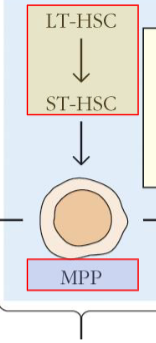
*****What is a LT-HSC, ST-HSC and MPP?
differences between them
As an HSC continues to differentiate it LOSES its ability to SELF RENEW as it progresses from LT-HSC to MPP
LT-HSC = LONG TERM HSC are the most quiescent (inactive) and retain pluripotency throughout the life of an organism maintain the stem cell pool
ST-HSC = mainly quiescent but divide more frequently and have limited self renewal capacity
MPP = Multipotent progenitors have LOST the capacity for self-renewal, but can proliferate rapidly and give rise (i.e., differentiate) along multiple hematopoietic lineages
****What are the 4 hematopoietic lineages that MPPs can give rise to?
Lymphoid, myeloid(granulocytes, monocytes, macrophages, and some DC ), erythroid, and megakaryocytic.
*****What are the the 2 lineage commitment choices an MPP cell can make?
aka what is the next step in differentiation after MPP?
Myeloid Progenitor
Lymphoid Progenitor

***What cells do MYELOID vs. LYMPHOD+ID progenitors give rise to?
Myeloid Progenitor: RBCs, platelets, and myeloid cells (e.g., granulocytes, monocytes, macrophages, and some DC populations).
Lymphoid Progenitor: B and T lymphocytes, innate lymphoid cells (ILCs), as well as specific DC populations.
ILCs have features of both innate and adaptive cell
*****EXCEPTIONS: Precursors of of RBCs and platelets can also arise directly from the earliest HSCs
****What are the next steps of differentiation from a Myeloid or Lymphoid progenitor?
Myeloid
DC
Granulocyte-monocyte Progenitors
Erythroid Progenitors
Lymphoid
DC
T cell progenitors
B cell progenitors

Key concepts: The HSC is a ___ (rare/common) cell type that is ______
and _______, which also has the capacity to ________ or rapidly replace blood cells.
The HSC is a rare cell type that is self-renewing and multipotent, which also has the capacity to differentiate and rapidly replace blood cells.
Key concepts: HSCs include multiple subpopulations that vary in their ______ and capacity to _______
HSCs include multiple subpopulations that vary in their quiescence and capacity to self-renew
LT HSC
ST HSC
Key concept: ______ are the most quiescent and long-lived. They give rise to ______ which can develop into more proliferative ______, which give rise to _____or_____cell types
outlines the specific stages of HSC differentiation
Long-term HSCs are the most quiescent and long-lived. They give rise to short-term HSCs, which can develop into more proliferative MPPs, which give rise to lymphoid and myeloid cell types
Key concept: HSCs that are induced to differentiate make one of two broad lineage choices:
They can give rise to CMPs (common Myeloid progenitors) that develop into myeloid cell types.
They can give rise to CLPs (common Lymphoid progenitors) that develop into lymphoid cell types
*****As progenitors differentiate, they progressively LOSE WHAT 2 ABILITIES?
Self-renew
Ability to give rise to other cell lineages.
Major Myeloid and Lymphoid cell types, their life spans, and relative amounts in our blood.
ARRANGED based on AMOUNTS in blood

****What is the TRADITIONAL method used to Distinguishing Blood Cells under the Microscope
H + E stain = a pH sensitive stain
Hematoxylin Eosin
********What part of the cell does Hematoxylin vs. Eosin stain? What is their respective COLOUR? Which is an acidic dye and which is a basic dye?
Hematoxylin = basic dye
binds basophilic (neg - charged) nucleic acids
BLUE.
Eosin = The acidic dye
binds eosinophilic proteins (pos + charged) in the granules and the cytoplasm
PINK