7.4 and 7.5 active transports uses engergy and goes against the concentration gradient
 Call Kai
 Learn
Learn Practice Test
 Spaced Repetition
 Match
Match Flashcards
 Knowt Play
1/41

There's no tags or description
Looks like no tags are added yet.
Name | Mastery | Learn | Test | Matching | Spaced | Call with Kai | Chat |
|---|
No analytics yet
Send a link to your students to track their progress
42 Terms
Facilitated diffusion
despite the fact it is helped by transport proteins, is still a type of passive transport
active transport
moves substances against the concentration gradients
Hydrolysis of ATP
is the way energy is expended to preform active transport
Specific carrier proteins
what active transport is always preformed by
these specific carrier proteins are often called
pumps
Active transport is important because
it allows cells to maintain internal concentrations of chemical that differ from the surroundings
Sodium potassium pump
a type of transport system, and the main one for animal cells
membrane potential
is the voltage (difference in electrical potential) across a membrane
potential
the potential energy available to do work
voltage
is created by differences in the distribution of positive and negative ions across a membrane
Membrane potential of the plasma membrane
-50 to -200 milivolts
electrochemical gradient
electrical force and chemical force, combine to drive the diffusion of ions
electrical force
the effect of the membrane potential on the ions movement, opposites charges attract
chemical force
the diffusion of an ion down its concentration gradient
The inside of a cells membrane
has a negative voltage relative to the outside of the membrane, favoring cations in and anions out
electrogenic pump
transport proteins that generate voltage across a membrane, contributing to its potential
Proton pump
the main elecrogenic pump of plants, fungi and bacteria and are powered by ATP hydrolysis
by contributing to membrane potential, electrogenic pumps
help store potential energy that can be used for cellular work
A solute that exists in different concentrations across a membrane
can do work as it moves across the membrane by diffusion down its concentration gradient
Contransport
occurs when active transport of one solute (against its concentration gradient) indirectly drives the transports of other solutes ( against their own concentration gradient)
Plants use the gradient of hydrogen ions generated by proton pumps
to drive active transport of nutrients into the cells

what is happening in this image
H+ gradient is crated and maintained by ATP proton pump
It concentrates H+ outside the cell and stores potential energy for active transports
the sucrose H+ contransporter carrier protein use the diffusion of H+ down its electrochemical gradient into the cell to uptake sucrose against its concentration gradient

What type of transport is this
passive

What type of transport is this
active
Large molecules have to cross the membrane in
large packages in vesicles
Bulk transport
requires energy
endocytosis
forming new vesicles in the plasma membrane to uptake macromolecules an bacteria
three types of endocytosis
phagocytosis
pinocytosis
receptor mediated
Phagocytosis
the cell engulfs a foreing particle by packaging it into a food vacuole
macrophages
Pinocytosis
molecules are taken up when extracellular fluid is “gulped” into tiny vesicles, not selective
the receptor mediated endocytosis
binding specific ligand to receptors on the extracelluar surface of a cell membrane triggers vesicle formation in the membrane
extremely selective
Ligand
any molecule that bind specifically to a receptor site of another molecule
How does ATP attach to the Carrier protein in active transport
one phosphate group is bound to the carrier protein, this changes the proteins shape and affinity (in sodium potassium pump, changes from sodium to Potassium, and when the phosphate is lost it cycles back to sodium).
What does the sodium potassium pump do to cell charge
more positive sodium outside less positive potassium inside, the cell is surrounded by a more positive solution (the cell is more negative compared to the outside)
The pull of sodium into the cell
is strong
It is more acidic inside or outside the cell
outside: high in H+ and low in pH
What do animal cells use to cotransport
Sodium (there is excess around the cell)
What molecules can passively diffuse (most common)
CO2 and O2

What type of Transport is C
Passive transport, it flows at a steady rate
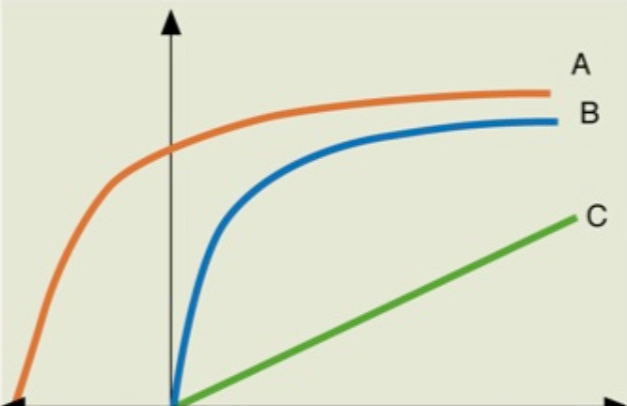
What type of transport is B
Passive transport protein- starts around 0 and needs a bump to get going

What type of transport is A
Active transport- it starts as a negative and needs help to get going
Hypocholesterolemia
High level of cholesterol, blocks LDL from entering the cells