3.3-3.5 Electron Configurations and Orbital Diagrams, Paramagnetism/Diamagnetism
 Call Kai
 Learn
Learn Practice Test
 Spaced Repetition
 Match
Match Flashcards
 Knowt Play
1/18

There's no tags or description
Looks like no tags are added yet.
Name | Mastery | Learn | Test | Matching | Spaced | Call with Kai | Chat |
|---|
No analytics yet
Send a link to your students to track their progress
19 Terms
valence electrons
for Main Group Elements**, the electrons in the outermost principal energy level (the highest value of n)
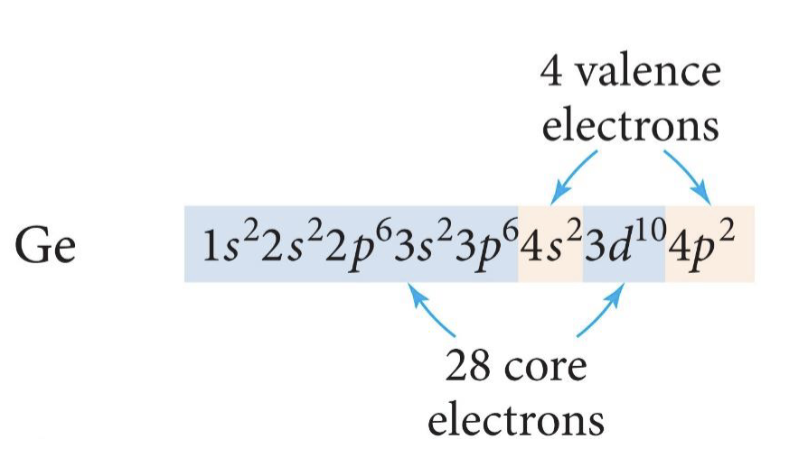
valence electron purpose
important fact for how an atom behaves chemically and physically, and responsible for chemical bonding
core electrons
inner electrons in complete principal energy levels
core electrons purpose
responsible for shielding effects but NOT responsible for bonding
Main Group Number (1A-8A)
How many Valence electrons an atom has (Letter Number on top of the column)
for 1A, 2A, and aluminum, group number gives charge of _____ (lose valence electrons)
cations (Na in 1A —> Na+)
for 7A, 6A, and 5A, their charge is calculated by Group Number - 8 and therefore gives charge of _____ (gain valence electrons)
anions (O in 6A —> 6-8 = -2 so it becomes O2-)
period number/principal quantum number
the principal energy level of the valence electrons (The row number (period) tells you the highest energy level (𝑛) where those valence electrons live)
exception to the Aufbau principle
Normally, you fill the 𝑠-orbital completely before putting any electrons into the 𝑑-orbital. However, elements like Chromium (Cr), Copper (Cu), Molybdenum (Mo), and Silver (Ag) steal one electron from their outer 𝑠-orbital to optimize their 𝑑-orbital
irregular configurations to know
Cr: [Ar] 4s1 3d5
Cu: [Ar] 4s1 3d10
Mo: [Kr] 5s1 4d5
Ag: [Kr] 5s1 4d5
(1s is given to d)
electron configuration of ions writing process
write electron configuration of the neutral parent atom
Add or remove electrons depending on the charge:
Anions (Negative charges): Add electrons to the lowest empty spot available.
Cations (Positive charges): Remove electrons from the outermost shell (the highest shell number, 𝑛)
elements gain or lose electrons to match the electron count of the nearest ____ __ (Group 8A)
noble gas
what do metals form?
cations (lose electrons)
what do nonmetals form?
anions (add electrons)
paramagnetism
The atom or ion is attracted by an external magnetic field. This property arises because it contains unpaired electrons (single arrows alone in a box)
diamagnetism
The atom or ion is slightly repelled by an external magnetic field. This property occurs because all electrons are paired up (every box has two opposing arrows, or is completely empty).
principal quantum number for d-electrons reminder
period/row number - 1
alkali metal, alkaline earth metal, halogen, and noble gas periodic table

spdf orbital diagrams reminder
