4.1.1 Microeconomics - Economic Methodology and the Economic Problem
 Call Kai
 Learn
Learn Practice Test
 Spaced Repetition
 Match
Match Flashcards
 Knowt Play
1/70

There's no tags or description
Looks like no tags are added yet.
Name | Mastery | Learn | Test | Matching | Spaced | Call with Kai | Chat |
|---|
No analytics yet
Send a link to your students to track their progress
71 Terms
ceteris paribus
all other things held constant
What is a social science ?
studies human behaviour as individuals + parts of organisations and their use of scarce resources
What are similar methodologies between natural sciences and other sciences?
develop theories + create models
test theories + models against known facts
use empirical data + use economics models
What are different methodologies between natural sciences and other sciences?
no controlled lab experiments where only one variable changed at a time
eg. trying to examine whether price of cheese changes demand for it won’t factor in a change in consumer income
Positive statement
A statement including facts, which can easily be proved / disproved
e.g. Raising tax will lead to increase in tax revenue
normative statements
A value-based judgement, based on an opinion, that can not be easily proved / disproved
e.g. The free market is the best way to allocate resources
What are 4 ways economic decisions could be made?
Normative statements - opinions
Moral views and value judgements - eg. people shouldn’t be poor so share wealth
Political judgements - eg. lowering taxes wins government votes
Short term positive consequence - ⬇tax ➔ win election ➔ ⬇government income ➔ public spending cuts
The fundamental economic problem
How to allocate scarce resources given unlimited wants, forcing choices to be made
- e.g. Water scarcity, food scarcity
Central purpose of economic activity
Production of goods and services to satisfy the needs and wants of society
What are the key economic decisions?
What to produce?
How to produce it?
Who is to benefit from the goods and services produced.
Why is choice central to the basic economic problem
all economic decisions incur an opportunity cost
Utility
the satisfaction or benefit that you obtain from consuming a good or service
Opportunity cost
The cost of giving up the next best alternative
Law of opportunity cost
As more of a good is produced, more of another good has to be sacrificed in production
Absolute advantage
Fewer resources are used in production
Comparative Advantage
When one can perform an activity at a lower opportunity cost than anyone else
Law of comparative advantage
Trade can benefit countries if they specialise in goods in which they have a comparative advantage + lower opportunity cost
Marginal cost
The cost of doing / buying one extra thing
The factors of production
Land, labor, capital and enterprise
Land
The natural resources, agriculture, water, fuel, energy
Labour
All human resources which contribute to output to produce goods
Enterprise
Creativity and initiative needed to start a business
Capital
Types of property such as machinery and tools that are used to produce goods
Why is the environment a scarce resource?
aren’t enough natural resources to satisfy everyone demands
How does land affect businesses?
The quality of the land can impact the cost and feasibility of using the land
Reward : Rent
How does labour affect businesses?
The quality and skills of the work force can influence productivity, efficiency and output of the product
Reward: Wages
How does capital affect businesses?
Better capital can improve production capability and technological advancement
Reward: interest from investment
How does enterprise affect businesses?
Enterprise can lead to business growth, as it can lead to better profits, as the entrepreneur is willing to take risk
Reward: Profit
Scarcity
A lack of resources
What does scarcity require?
Choices on the careful allocation of scarce resources
renewable resource
A resource that is produced at a faster rate that it is consumed
non-renewable
a finite resource, produced at a slower rate than when it is used up, so it runs out
Commodity
Something tradeable - gold, silver
Sustainable development
Meets the needs of the present, without damaging the future
PPF
A graph to show the various combinations of 2 goods/services that can be produced with given factors of production
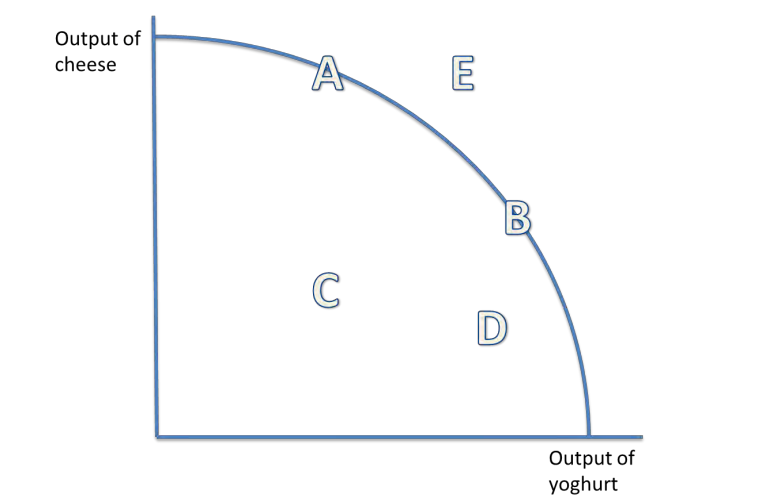
A & B - productively efficent
C & D - productively inefficient
E - not attainable
How do PPFs show opportunity cost
A move to increase consumer goods has an opportunity cost of the drop in capital goods
Concave PPF
(Bows outwards)
increasing opportunity cost, as workers may be differently skilled
Some resources are more specialised that others
Would a fall in unemployment shift a PPF
No, we would move closer to the line, as we are not produce at productive capacity
Convex PPF
decreasing opportunity cost, as making first product is hard, but gets easier
Straight line PPF
Constant opportunity cost
All points on the PPF curve are
Productively efficient but not necessarily allocatively efficient
Production
the output of goods and services
Productivity
the output per unit of input
Economic welfare
A measure of progress in improving people's lives
Economic growth
An increase in the real value of goods and services produced, measured by the change in GDP
Economic good
Something that is scarce, as their use has an opportunity cost
They are created from scarce resources, so command a price
Intermediate goods
Goods used in the production of other goods
Free good
Something that is not scarce and everyone should have access to
Have no opportunity cost
e.g. Air
Zero-priced good
Socially needed, hard to value, set by government
e.g. Healthcare, Parks
Capital good
machinery used - indirect satisfaction
Consumer good
What the consumer buys - direct satisfaction
three types of efficiency
Productive, Allocative, Pareto
3 economic agents
1. Consumer
2. Producer
3. Government
Public sector
government
Private sector
part of the economy involving private ownership of businesses
Buffer stock scheme
A scheme intended to stabilise the price of a commodity by purchasing excess in supply when supply is high, and selling commodity reserves when supply is lowP
Productively efficient
When maximum output is produced from the available Factor of productions
Any point on the PPF curve is productively efficient, as the economy is producing at full current capacity
Pareto Efficiency
Nothing can be made better off without making something else worse off
Allocative efficiency
When factors of production are used to produce the combination of goods and services that maximise society's welfare (meets needs)
What are PPF used to illustrate?
different features of the fundamental economic problem, such as: resource allocation, opportunity cost and trade-offs, unemployment of economic resources, economic growth.
What is a trade off?
Have to choose between conflicting objectives because you can’t achieve all objectives at same time.
Involves compromising & aiming to achieve each objective a bit
Why are all points on the boundary productively efficient but not all points on the boundary allocatively efficient?
Not all points will reflect the production of goods that people want or need
Whats a movement along the PPF
reallocation of resources
How can you shift a PPF?
increase the quality and quantity of the factors of production
What does an increase in the production of capital goods on a PPF indicate?
lower living standards
What does an outward shift of the PPF show?
Economic growth
Outward shift of PPF caused by:
-Technological improvement = higher productivity / efficiency
- Changes that increase working population (Immigration, raise in retirement age)
- Improvement in education / training
- Innovation of new product / discovery of new resources
Inward shift of PPF caused by:
- Damaging effect of natural disaster
- Large scale labour migration
- Loss of factor inputs
- Wars
- Prolonged recession
- Global warming / climate change
Economic decision-makers are primarily concerned with
maximising their welfare
Economic resources
Those which can contribute to increased production