Session 3: Enzymes
 Call Kai
 Learn
 Practice Test
 Spaced Repetition
 Match
 Flashcards
 Knowt Play
1/7

There's no tags or description
Looks like no tags are added yet.
8 Terms
Explain the effects of enzymes on chemical reaction:
Enzymes are catalysts, they do not alter the equilibrium constant or the enrgetics of the reaction, they just make the reaction reach equilibrium a lot faster. They do so, but decreasing the activation energy.
The binding of substrate to enzyme key for enzymatic catalysis:
The substrate and enzyme’s active site bind together in non-covalent and weak so product can be released
The reaction occurs where the enzyme ezcludes the water molecules that may interfer

Define the term activity, international unit of enzyme activity, km and Vmax
1 unit = The amount of enzyme that produces 1micromole of product per minute under standard conditions.
If we have a substrate of known concentration, then add the enzyme, we can measure the initial rate of reaction which is known as V0.


The Vmax equals to the maximum rate of enzyme reaction.
The Michaelis-Menten equation:
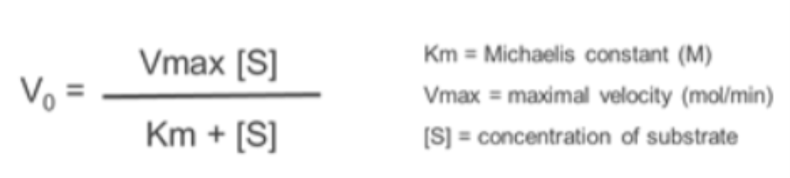
Km is the substrate concentration when half of Vmax = quantifies the enzyme’s affinity for its substrate.
The lower the km the higher the affinity, meaning the enzyme can achieve a significant reaction rate even at low substrate concentrations
Lineweaver-Burk plots make it easier to quantify km and vmax: where 1/v0 is y and 1/s is x


Describe the effects of enzyme inhibitors on enzyme kinetics and be able to distinguish them from simple graphs
Two types of enzyme inhibitors:
Competitive inhibitors:
bind to the active site of enzyme and temporarily block active site
These increase km, requiring a higher substrate concentration to each half maximum velocity
The Vmax remains unchanges

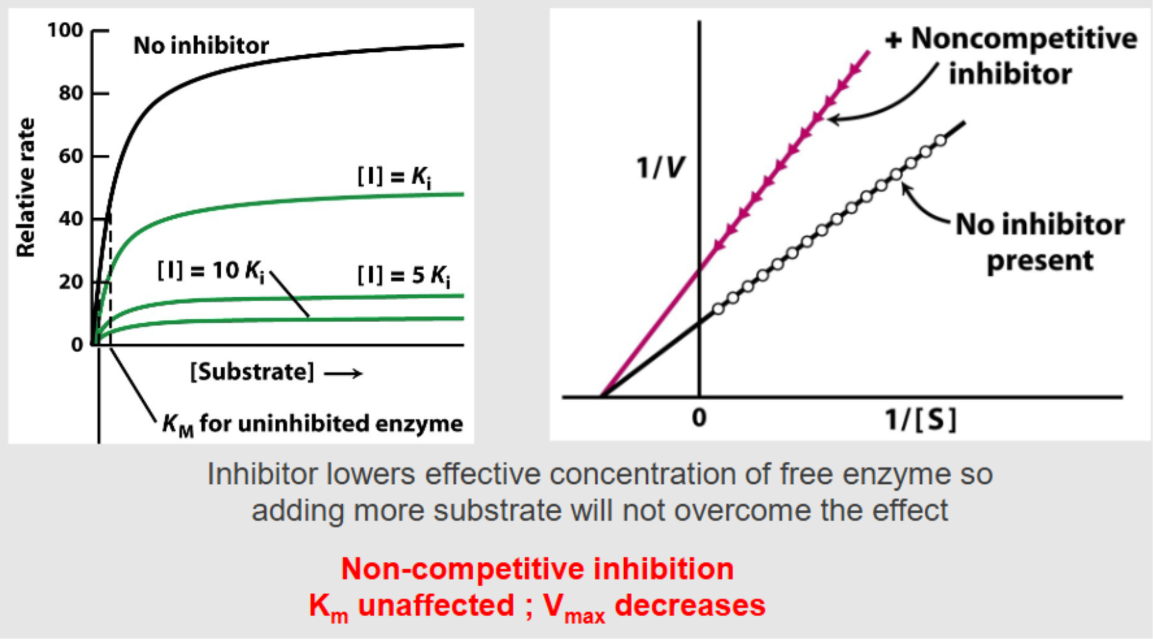
Non-competitive inhibitors:
bind to the allosteric site of enzyme and change the active site, preventing substrate from binding.
Decreased Vmax
Km is not effected
List major regulatory mechanisms that control enzyme activity:
Enzyme activity can be regulated by allosteric regulation, covalent modification, changes in enzyme concentration, substrate availability, and proteolytic activation.
Allosteric regulation: A molecule binds somewhere other than active site of enzyme, changing enzymes activity.
Covalent modification: A chemical group is covalently attached to or removed from an enzyme, changing its activity e.g. phosphorylation
If a phosphate group is added to protein/ enzyme, performed by enzyme called protein kinase [Protein + phosphate → Phosphorylated protein]
Changes in enzyme concentration: Availability of active sites
Substrate availability: If there is no substrate then the enzyme has nothing to bind to and undergo reaction
Proteolytic activation: When part of the enzyme is cut off to form an activated form of protein [zymogen]
Discuss the allosteric properties of key regulatory enzyme
Enzymes exist in two states:
T state (tense state) = low-affinity
R state (relaxed state) = high-affinity

Example: Phosphofructokinase 1 is an allosterically regulated enzyme
Discuss the concept of enzyme cascades and the use of protein kinases and phosphatases to regulate activity
Protein kinase: Addition of a phosphate group to specific amino acid residues => typically with hydroxyl (serine, threonine or tyrosine), there are thousands of protein kinases in cells => they don’t phosphorylate randomly, but seek specific motifs for covalent modification
Protein phosphatases: Catalyse the removal of phosphate groups
Define the term zymogen
Proteolytic activation: Some enzumes are initally produced as inactive precursors, they become active when part of the protein is cut off.
A zymogen is activated by cleaving off a specific region known as the prosegment and this makes the enzyme active.
This process is irreversible as peptide bond in the protein is broken and the result are changes of protein sequence, structure and therefore activity, these processes are tightly controlled.
Important in blood clotting, digestion and Apotosis.
What are isoenzymes?
Distinct forms of enzymes that catalyse the same chemical reaction, but possess different primary structure
So this means they have different kinetic properties, regulatory mechanisms or tissue distributions
Isoenzymes can be coded by entirely different genes or they can be different forms produced by alternative splicing of a gene
Example, hexokinase vs glucokinase (found in liver) both of them are responsible to catalyse the phosphorylation of glucose. Hexokinase has 0.1mM = Km// Glucokinase has 5mM =Km, so at lower substrate (glucose concentration) hexokinase can start of phosphorylation and start off glycolysis, but glucokinase needs higher glucose concentration