MATH135 EXAM
 Call Kai
 Learn
 Practice Test
 Spaced Repetition
 Match
 Flashcards
 Knowt Play
1/22

There's no tags or description
Looks like no tags are added yet.
23 Terms
Independent
define
how to determine (x2)
One event occurring does NOT effect the probability of the next event occurring.
P(A and B) = P(A) P(B)
P(A given B) = P(A)
Mutually Exclusive
define
how to determine (x2)
Both events cannot occur together (no overlap)
P(A and B) = 0
P(A or B) = P(A) + P(B)
Probability of NEITHER
how to determine
1 - P(A or B)
A^c
define
how to solve
NOT A
1 - P(A)
P(A or B) (2 ways!)
P(A) + P(B) - P(A and B)
1 - P(neither)
P(A and B)
if they’re independent we can multiply
dependent:

P(A - B)
in A but not in B
P( A / B)
define
solve
Probability of A given that B occurs
P(A and B) / P(B)
How to Calculate the # of DISTINCT ARRANGEMENTS with REPEATED elements?
n! / (k1!) (k2!) (kn…!)
eg How many ways to rearrange AABBA
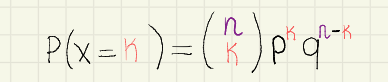
EXACTLY K successes
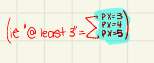
“at least”
Amount of combinations when order doesn’t matter
n! / k!(n-k)!
Amount of different arrangements in specific order
n! / (n-k)!
Multiplication Principle
if action 1 can be performed M ways, and action 2 can be performed N ways, then action 1 followed by action 2 can be performed MN ways.
Sample Space
List of all possible outcomes
how to multiple matricies
columns of A must match rows of B
Matrix = leftover Row & Column
How to calculate Eigenvalue
(abcd) -bc + ad - aE - dE _ E²
How to Calculate Eigenvector
A(x/y) = E (x/y)
then set x = 1
Leslie Matrix
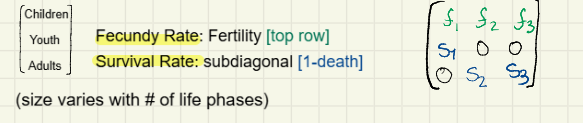
Leslie Matrix equation
total population = C(initial value) E^t
Dominant Leslie Eigenvalue
= LARGEST
base in exponential growth model
Dominant Eigenvector
what shoudl you do to get the fraction of each age group
ratios of the population structure in the long term
normalize —> probability vector
Define Transient period
period before long-term dynamics take over (can be very short or very long)