Module 3: Oral Squamous Cell Carcinoma (OSCC)
 Call Kai
 Learn
 Practice Test
 Spaced Repetition
 Match
 Flashcards
 Knowt Play
1/86

There's no tags or description
Looks like no tags are added yet.
87 Terms
Neoplasm:
is an abnormal growth of tissue caused by cells that do not undergo cellular death (apoptosis) at regular intervals
o Neoplasms can be benign, potentially malignant, or malignant

Tumor:
is a neoplasm that forms a distinct mass or lump that can be palpated or otherwise seen visually or via diagnostic imaging. Note: all tumors are neoplasms, but not all neoplasms are tumors (the neoplasm may not form a mass or a distinct "lump")
Cancer:
is a disease where neoplasms become malignant and have the ability to invade surrounding or distant tissues. Not all neoplasms turn cancerous

Benign Neoplasms:
is one that contains abnormally dividing cells or tissue; however, it IS NOT currently spreading to adjacent tissues and "stays in place"
Many neoplasms start off as ______ and have the ability to turn cancerous while others may not have the ability to do so and will remain benign throughout the life of the pt
benign
Even though a neoplasm may remain benign….
it may still cause localized destruction of tissue if it grows large enough
Is chemotherapy performed for benign neoplasms? Radiation?
Never and very rarely
What is the treatment for Benign Neoplasms:
Even neoplasms that are deemed benign at the time of diagnosis are often removed, especially if they have the potential to turn malignant and if they are accessible via surgery. If they are not, radiation tx is sometimes an option for such lesions
Potentially Malignant Neoplasm:
(also commonly called carcinoma in situ) is a neoplasm that is starting to show histological signs that it is spreading from its point of origin into adjacent healthy tissue but has not yet invaded distant tissues
o Some neoplasms start off as benign and can turn → potentially malignant over time
o Potentially malignant neoplasms have the chance to turn → fully malignant
Treatment for Carcinoma in situ: (potentially malignant neoplasms)
often involves surgically removing the affected tissue, along with possible radiation tx to ensure its destruction. Chemotherapy is often not needed, as long as the neoplasm is a true carcinoma in situ and has not moved from its original site
The time interval between benign ---> potentially malignant ---> malignant can vary with some neoplasms turning into cancer relatively quickly (within weeks or months) while others can be extremely slow (most prostate cancer being a famous example)
▪ Neoplasms known to become quickly cancerous:
Some GI polyps
Melanoma
Oral Squamous Cell Carcinoma (!!!)

Malignant Neoplasm:
(cancer) is one that is continually growing and has turned cancerous, meaning it has invaded surrounding tissue and is no longer "walled off" from healthy tissue
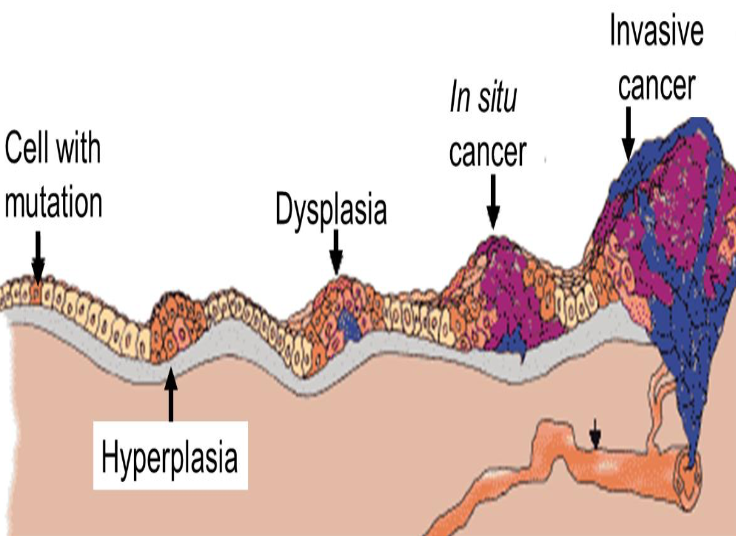
Metastasis:
Malignant neoplasms are also ones that have the ability to spread to distant sites via blood or lymph vessels
o The malignant cancer cells can attach to new tissues throughout the body and continue growing

Carcinoma:
Cancer arising from the epithelial layer of cells. Epithelial cells are present in skin, mucosa, and the lining of most internal organs***
Percentage of Carcinomas and most common cancers that are carcinomas:
80-90%
o Breast
o Bladder
o GI
o Pancreatic
o Lung
o Esophageal
o Prostate
o Basal Cell
Biopsy:
A procedure where tissue is removed from a suspected pathological lesion and undergoes microscopic examination and testing in order to determine a diagnosis
Depending on the size/type/appearance of a suspected lesion, there are several different types of biopsies that may be performed

Biopsy: Aspiration
removal of fluid, cells, or tissue with a needle
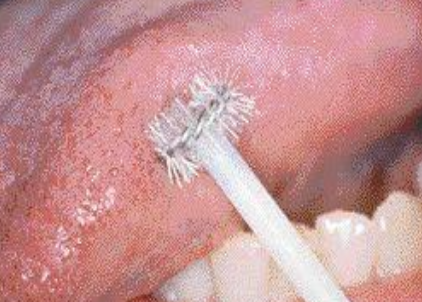
Biopsy: Brush
A specialized brush is used to scrape the surface of a suspected lesion, collecting cells that can be examined by the pathologist

Biopsy: Excisional
The removal of a suspected lesion IN ITS ENTIRETY along with a margin of "healthy" tissue, usually performed with a scalpel or cautery device

Biopsy: Incsisional
Removal of a portion of a suspected lesion. Used in cases where the lesion is large or near sensitive structures
Biopsy: Punch
Biopsy technique where a relatively small (about the size of a pencil eraser) size of circular tissue is "punched" out and removed for histologic stud
Prognosis:
is a best estimate for the outcome of the disease and whether it will respond to tx
5 Year Survival Rate:
is the percentage of people who are still alive five years after a cancer has been diagnosed and tx has begun
o The 5-year survival rate is an _______ and only looks at historic data, not individual circumstances
ESTIMATE
The 5-year survival rate does not take into account how _____ a cancer was detected, nor what tx is being performed
o It also does not look at other factors such as a pt's age, overall health, etc
EARLY

5-year survival rates of some common cancers:
o Prostate - 97%
o Breast - 88%
o Colorectal - 63%
o Lung – 28%
o Pancreatic - 12%

While most cancer in the mouth is squamous cell carcinoma, the location is distinguished between the____ ______ and the _____________
o The location of the OSSC lesion can have a huge difference in its appearance, detection, and ultimate survival rate
ORAL CAVITY, OROPHARYNX
For purposes of this lecture, the ORAL CAVITY will include:
o Lower lip
o Anterior 2/3rds of the tongue
o Floor of the mouth
o Buccal mucosa and all gingiva
o Hard palate
The OROPHARYNX includes:
o Posterior 1/3rd (base) of the tongue
o Soft palate
o Tonsillar area
Oral squamous cell carcinoma (OSCC):
is a cancerous growth of squamous epithelial cells that line the entire oral cavity (including all mucosal surfaces, gingiva, tongue, and hard/soft palate), often resulting in ulceration of tissue ***

OSCC usually starts as a _______ ___ ______, but over time has the potential to become overtly malignant and can spread to adjacent tissues, along with the ability to travel through the lymphatic and vascular systems and invade other organs (metastasize)
carcinoma in situ

Surrounding the oral cavity are large chains of lymph nodes which can provide "avenues" for malignant cells to spread
o ______ (sides of the neck) and _______ (underneath the chin) lymph nodes are most commonly associated with OSCC spread **
o Once spread to other organs, OSCC will often prove to be fatal by disrupting normal organ function
Cervical, submental
OSCC can occur on ___ intraoral mucosal surface, though as we will see some sites are more common than others (i.e. lateral tongue/floor of mouth
ANY

OSCC, at its early stages, often initially appears as one of the following: ***
o A non-healing, non-wipeable white patch called a leukoplakia (15%)
o A non-healing, red patch called erythoplakia (50%)
o A mixture of red and white plaques
o A small, non-healing and non-painful ulcerated area with no known cause
Mid stage OSCC represent a critical transition point where…
lesions represent a critical transition point where a superficial growth becomes a deeply invasive tumor

Mid stage OSCC classically appears…
non-healing reddish/white ulcerated area that is usually non-painful ***
More mature OSCC ulcerated areas may have…
rolled borders and exhibit continual growth***
Upon palpation, a mid stage OSCC lesion often has a firm, hard texture upon palpation (called _______). This occurs because the malignant epithelial cells have broken through the basement membrane and stimulated a response in the surrounding connective tissue that lays down additional fibrous tissue
induration

Late stage, mature OSCC lesions usually present as:
as a non-healing, indurated ulcer that has appreciably grown in size (usually more than 3-4 cms) and may become exophytic (growing outward) ***
o At this late stage, pain or paresthesia may be present, as cancer spread may affect nearby nerves ***
o If located near gingiva, teeth may become loose as tissue is continually displaced and destroyed
Late stage of OSCC development, the cancer has grown through the basement membrane of surrounding tissue (including into bone if nearby) and has likely contacted and spread into nearby ____ _____
lymph nodes
o Lymph nodes on affected side will likely be palpable
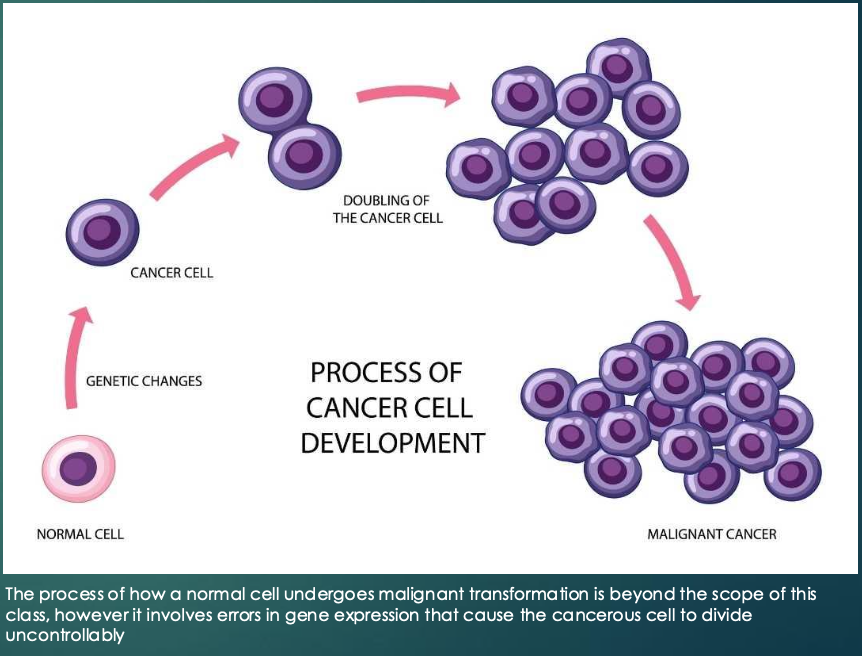
Cause of OSCC:
like any cancer, is caused by an accumulation of a number of discrete genetic events that lead to uncontrollable growth, division, and malignant potential in a cell (in this case an epithelial cell)
o There are several risk factors that can directly cause malignant changes in epithelial cells that can cause OSCC, however it may occur randomly with no known risk factor

OSCC Risk Factors:
o Tobacco use (smoking & smokeless), including pipes & cigars
o Betel nut use
o Alcohol consumption
o UV exposure to the lips
o Human Papillomavirus (HPV 16 &18) infection
o Immunosuppression
o Some nutritional deficiencies
o Radiation exposure to the head and neck
Chronic mechanical irritation (like from ill-fitting dentures)
Poor oral hygiene

OSCC Risk Factors – Tobacco Use
Of all the risk factors that can cause OSCC, tobacco use is by far the MOST significant (at least in the U.S.) ***
o About 80% of all pts diagnosed with OSCC use tobacco in some form (in the U.S.)
o Smoking tobacco in ALL forms is a risk factor; however pipe and cigar smoking is a more significant risk than cigarettes
o "Reverse smoking" - smoking a cigarette with the lit end in the mouth has the highest risk for OSCC due to the increased intensity and temperature of tobacco combustion which is directly related to cancer risk. Can result in nicotine stomatitis
The VOLUME of smoking is also significant with a 2 pack per day habit of smoking a much higher risk than <1 pack per day
Smokeless tobacco use also is a risk factor, but thought to be lower than that of cigarettes - Smokeless tobacco keratosis

OSCC Risk Factors - Areca (Betel) Nut Use
o The areca nut (aka betel nut) has long been chewed in some southeast Asian countries
o Effects on the body are similar to tobacco
o There is a VERY STRONG correlation The areca nut (on the left) is placed in a betel leaf with slaked lime and chewed. Other flavorings may be added between chewing betel nut and OSCC (along with other oral pathologies) ***
o In India, where betel nut chewing is commonplace and widespread, OSCC accounts for 50% of ALL cancer cases!!!
o Not commonly seen in the U.S., however it is not regulated and still can be found
OSCC Risk Factors – The Role of Alcohol
o Alcohol consumption was previously thought to only be an oral cancer modifier, however it has since been determined alcohol consumption alone can cause OSCC ***
o Alcohol is SYNERGISTIC with other risk factors and raises the risk for development of OSCC especially when used in conjunction with tobacco products ***
o Alcohol acts as a mucosal irritant, making it easier for tobacco carcinogens to enter cells
▪ The major break-down product of alcohol, acetaldehyde, is a known carcinogen
o A major difficulty when studying pt's with OSCC is that many pt's who use tobacco also consume alcohol
o The VOLUME of alcohol consumption increases the risk for OSCC development (heavy drinkers more likely than moderate drinkers to develop OSCC)

OSCC Risk Factors - Human Papillomavirus (HPV)
is the most common sexually transmitted disease in the U.S., with most cases being asymptomatic
o There are over 200 different strains of HPV, but only a small handful are thought to be risk factors for cancer development; cervical cancer being the most common but increasingly it has been proven that HPV can cause OSCC development, most commonly in the oropharynx
o HPV is thought to infect cells in the oropharynx, integrating their viral DNA into the host cells and shutting down tumor- suppressing genes. Why HPV has a predilection for invading cells in this particular area is unknown
HPV is thought to be the LEADING cause of _________ (tonsillar region) cancer with 60-70% of tumors in this area having a link to HPV (subtypes 16 & 18) while only around 10% of OSCC in the tongue/floor of mouth have an HPV link ***
OROPHARYNGEAL
Oral cancer as a whole (all types of cancer that afflict the oral cavity, including oropharyngeal cancer) account for about 2% of ALL cancers for women and __% for men
3
o Men are more likely to be diagnosed with oral cancer (about a 2 to 1 ratio) simply because men are more likely to engage in risky social behaviors (i.e. smoking/drinking)
There are about _____ cases of oral cancer diagnoses in the U.S. each year
58,000
__% of cancer deaths of women are caused by oral cancer and 2% of men
1
The 5-year survival rate for all oral cancers combined is ___%
o African American 5-year survival rate≈ 52%
o Socioeconomic/racial discrepancies between detection and tx of oral cancer exist!
68
Oral squamous cell carcinoma is by far the most common malignancy in the
____, accounting for
mouth
Cancer that is caught ____ and that is still localized will have a much greater chance of survival
early
Cancers with a higher survival rate (___/___ _____) are more likely to be seen by the pt or dental professional and therefore treated earlier
o Cancer in these locations also can be treated (cut out) more effectively
o Cancers in these areas may also spread slower
lip/anterior tongue

Cancers in less conspicuous areas (floor of mouth, posterior tongue, oropharygeal space, less likely to be caught early and treatment is more difficult
o ________ cancer is almost never caught in beginning stages and is often only seen once significant spread has occurred
Oropharyngeal
OSCC of the _____ is the most common intraoral malignancy and account for around 30-40% of ALL oral carcinomas **
tongue
Who is most commonly affected by tongue OSCC?
men between 60-80 years old

The most common location for OSCC of the tongue will be seen on the____ _____
lateral border
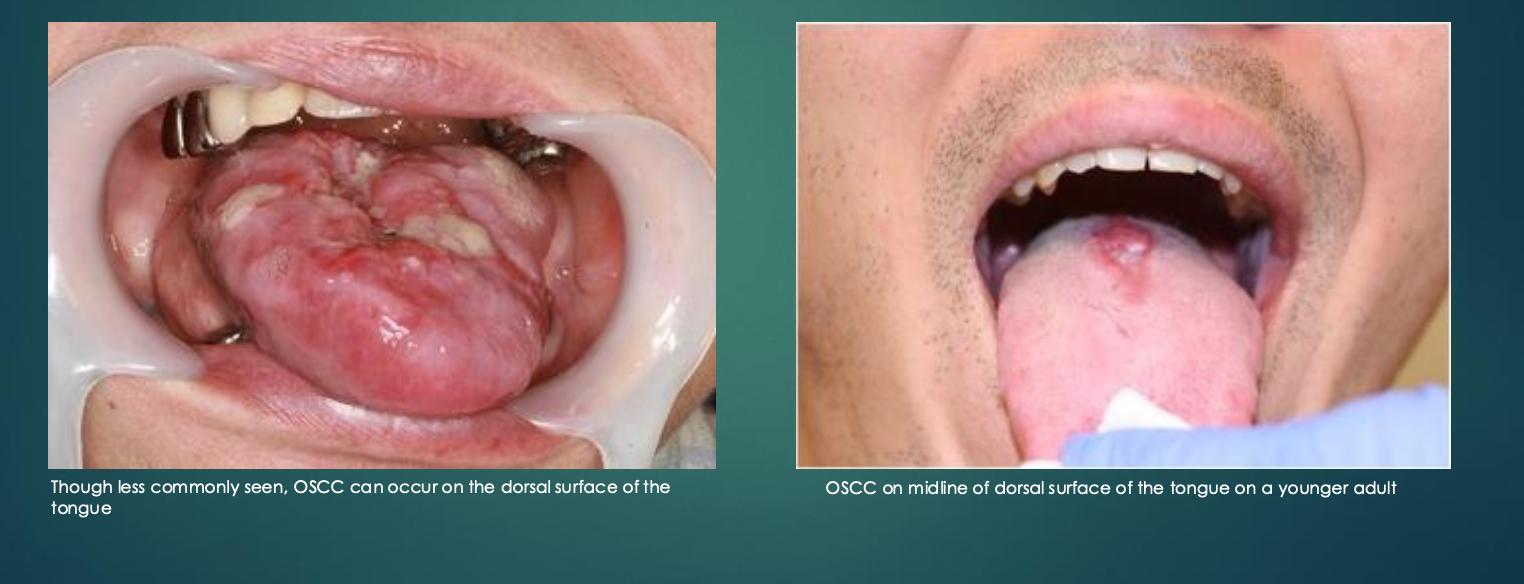
Cancer of the _____ and ___ of the tongue are rarely seen
dorsum, tip
Cancer of the posterior 1/3 or base of the tongue is particularly problematic as it is difficult to detect clinically and often __________
asymptomatic

Visual Appearance - OSCC of the Tongue
Early stages of OSCC of the tongue may appear as red reddish/white patches that do not heal
Later stages of OSCC may appear as reddish to reddish/white ulcerated lesion with raised and rolled borders
Late stage may appear exophytic (outwardly growing)

Pictures of Early Stage OSCC

Pictures of Mid Stage OSCC
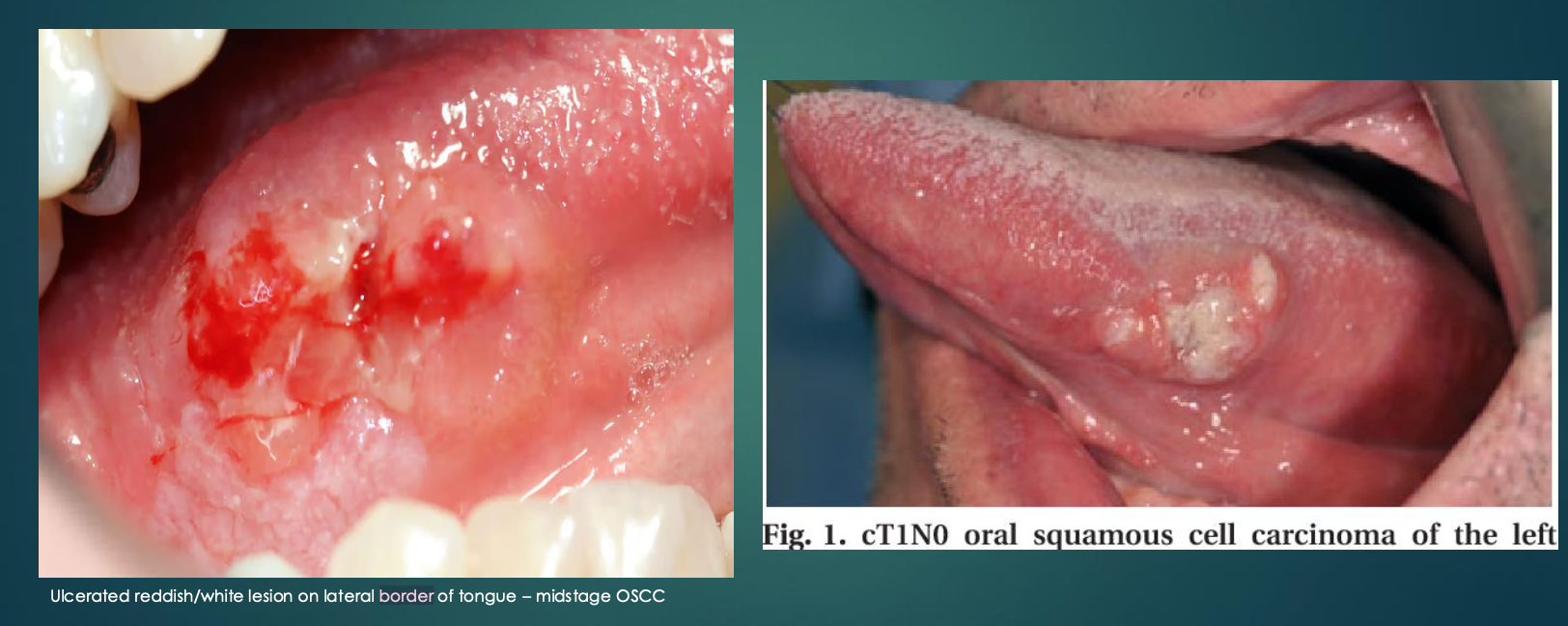

Pictures of Late Stage OSCC

What is the second most common intraoral location of OSCC?
floor of mouth (15-20% of diagnosed cases)

Relevant Statistics – OSCC of the Floor of the Mouth
Predominantly present in older men, especially those who smoke & drink
When metastasis occurs, it is usually via the submandibular lymph nodes in this area
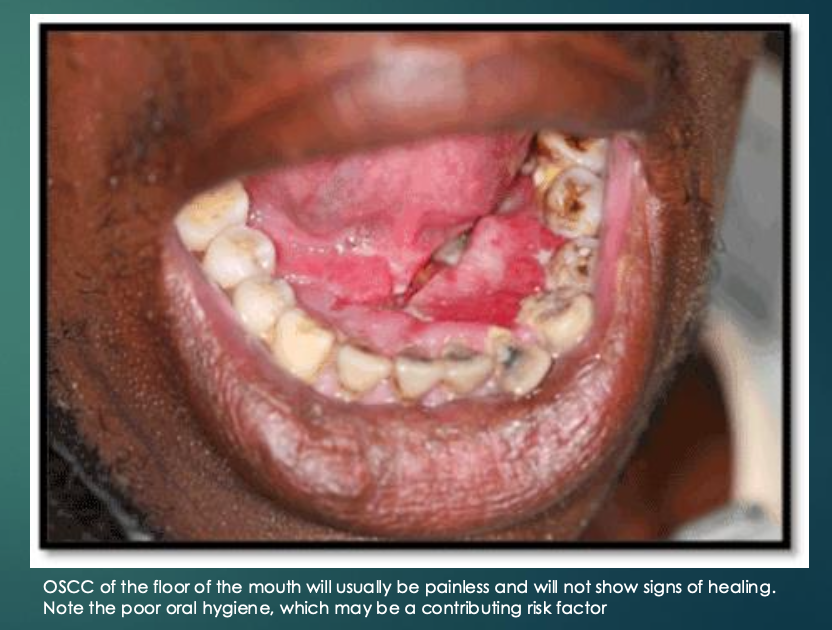
Visual Appearance - OSCC On the Floor of the Mouth
The usual appearance of OSCC on the floor of the mouth is that of a painless, non-healing, indurated ulcer of reddish/white coloration
Later stage OSCC may be exophytic

Relevant Statistics – OSCC of Buccal Mucosa/Gingiva
Carcinoma of the buccal mucosa or gingiva each make up about 10% of OSSC cases
Buccal mucosa and gingival OSCC more common in pt's who use smokeless tobacco or chew betel nut
Verrucous carcinoma, a subset of OSSC, will be more commonly seen in older men who chew smokeless tobacco
OSCC of the buccal/labial mucosa and gingiva often get misdiagnosed/ignored, especially in early stages until significant spread has occurred

Visual Appearance - OSCC of Buccal Mucosa/Gingiva
The presenting clinical appearance varies from a white patch to a nonhealing reddish/white ulcer to an exophytic lesion
Especially on the buccal mucosa with the use of smokeless tobacco, the lesion may appear as a broad-based wartlike mass

Relevant Statistics - OSCC of the Lip
OSCC of the lip is somewhat unique among OSCC, in that the biggest risk factor for development of cancer in this region is chronic UV sunlight exposure ***
OSCC of the lower lip is far more common than that of the upper lip (about 90% of lip cancers affect the lower lip) and has a better prognosis due to slow growth and infrequent metastasis to submental lymph nodes
Smoking (especially pipe smoking) is the second most significant risk factor for carcinoma of the lower lip
Occur most commonly in pts between 50-70 years of age and affect men more than women

Visual Appearance – OSCC of the Lip
Usually appears as an ulcerated, red to reddish/white/yellow lesion that does not heal.
Margins of the ulcer may be elevated and scabbing may be present
Actinic cheilitis (farmer's lip) is a precancerous condition caused by UV sunlight exposure and is characterized by persistent, rough, scaly, and dry chapped lips that do not heal
May become exophytic (enlarged and growing outward) in later stages

Relevant Statistics – OSCC of the Soft Palate/Oropharynx
Hard palate instances of OSCC is relatively rare. Salivary gland tumors occur more frequently in the hard palate area
o Almost all OSCC occur in the soft palate/tonsillar/oropharynx areas
As previously mentioned, OSCC of the tonsillar region is heavily linked with HPV 16 & 18 ***
OSCC of the palate and oropharynx can result in metastasis to the cervical lymph nodes (sides of the neck) which is a dangerous sign that spread of the cancer has already occurred

Visual Appearance - OSCC of the Soft Palate & Oropharynx
Incredibly difficult to spot at early stages, as most OSCC of the oropharynx starts relatively small and hidden in tonsillar fold area
Usually present as unilateral asymptomatic red or white plaques or ulcerated masses
Lesions will not heal and should be separated from general sore/strep throat which will be symptomatic and bilateral

Most common to least common OSSC:
Tongue→ Oral Floor → soft palate = buccal mucosa = lower lip = gingiva
While many pathologies share similar visual characteristics as OSCC, any intraoral reddish or reddish/white ulcerated mass should be viewed with extreme ________***
suspicion
Pt's medical & social hx of ______/_______ use should ALWAYS be taken into account and even innocuous looking lesions that present themselves with "classic" cases (older male with a hx of tobacco/alcohol) should be referred to a specialist for further evaluation promptly
tobacco/alcohol
Early stage OSCC is usually ____ symptomatic (i.e. painful) and later stages may remain asymptomatic as well ***
NOT
Later stage OSCC may present with _______ or pain around lesion. If significant destruction of tissue is present it may impede other structures such as nerves
numbness
OSCC will NOT heal. If a lesion is suspected, often the rule of thumb is to wait _ weeks. After _ weeks if no resolution of appearance, referral should be made for biopsy ***
*If a suspected lesion is present and any lymph nodes around the head & neck are palpable, prompt referral to a specialist should be made
2
Certain areas where OSCC can show up can be PARTICULARLY problematic for both pts and dental examiners and are often missed until significant growth of the lesion occurs: *** for example:
o OSCC in the tonsillar area often starts behind the tonsil pillars (the folds of tissue in front of the tonsils) and can be nearly impossible to detect under a normal clinical setting (i.e. without a scope) until it has spread enough to become visible
o OSCC of the alveolar gingiva is often mistaken for other entities until it has undergone significant spread. Atypical, non-healing red/white lesions on the gingiva should always be viewed suspiciously

There are a multitude of ulcerative pathologies that mimic the appearance of OSCC, ESPECIALLY at early stages: *** Differential Diagnosis:
o Erythroplakia/Leukoplakia of unknown origin
o Traumatic ulcer
o Primary syphilis
o Tuberculosis
o Deep fungal infection

When Should You/The Dentist Make A Referral?
Any ulcerated lesion with no known cause should be viewed with suspicion. Traumatic ulcers and aphthous ulcers should resolve within 2 weeks. If they do not, biopsy of a suspected lesion should be obtained ***
Non-healing red, reddish white, or white lesions should be biopsied if no known cause can be discerned. For these lesions, okay to wait 2 weeks to see if any healing occurs. If not, referral for biopsy is recommended***
Intraoral pictures of lesions are highly recommended for comparison
New pts that present to clinic for tx with long standing ulcers or red/white plaques with no diagnosis should be referred
Particularly dangerous looking ulcers (reddish/white/large) should always be biopsied
How Does Pt Referral For Biopsy and Diagnosis Work?
Most general dentists will not perform biopsies of suspected lesions and referrals are often made for this reason
o If possible, referrals to an oral pathologist is usually the best option
o Oral pathologists will often be associated with teaching institutions like dental schools (including IUSD) and referrals can be sent to these places ifnearby
o Oral surgeons are usually the next best option as they will generally perform most biopsy procedures and submit the tissue samples to an oral pathologist for review
o No matter who performs the biopsy, the tissue sample will be sent to a board certified pathologist, who will section the tissue samples andplace them on slides to view microscopically
o The oral pathologist will then submit a report to both the DOR and the specialist performing the biopsy with the diagnosis and further instructions for removal of the lesion (if needed) or a recommendation for referral to oncological services if warranted
OSCC Treatment will vary depending on several factors::
o Stage at which the cancer is caught (early/mid/late)
o Presence of lymph node involvement
o Location of the lesion
o Size

OSCC Treatment:
In almost all cases, incisional biopsy followed surgical removal of the suspected lesion, along with surrounding structures will be performed
o If lymph node spread has been found, a radical neck dissection (removal of lymph nodes, internal jugular vein, sternocleidomastoid muscle, posterior end of the parotid gland, and spinal accessory nerve) on the affected side may be done
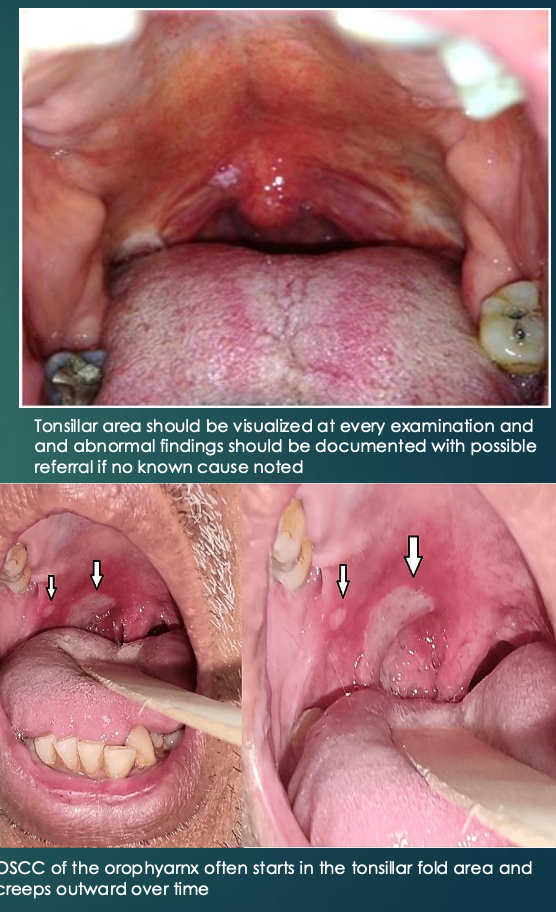
OSCC Oropharynx Treatment:
Though often found in later stage of development, OSCC caused by HPV responds particularly well to chemotherapy & radiation
As early detection as possible still crucial to find the disease before it spreads to lymph system. Make sure to check your pt's tonsillar area!
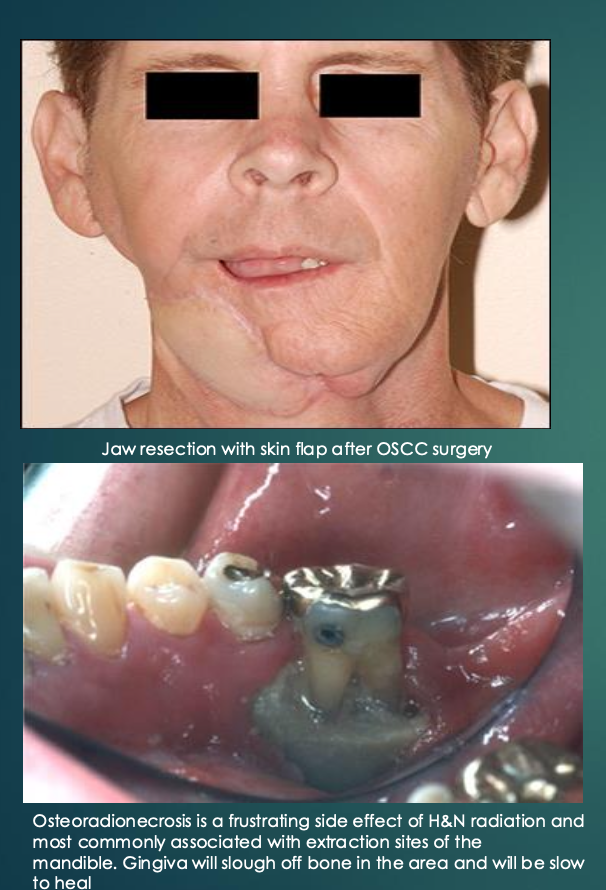
Unfortunately, OSCC treatment can lead to life altering and often disfiguring consequence. As with many later stage cancers,
chemotherapy and/or radiation tx may also be indicated
H&N radiation can have widespread destructive side effects and poses its own significant challenges
o Necrosis of bone, especially in the mandible
o Xerostomia
o Severe ulcerations of intraoral tissue