LESSON 4 - CELL MEMBRANES & SIGNALLING (PART 1)
 Call Kai
 Learn
 Practice Test
 Spaced Repetition
 Match
 Flashcards
 Knowt Play
1/48

There's no tags or description
Looks like no tags are added yet.
49 Terms
WHY ARE SELECTIVELY PERMEABLE MEMBRANES IMPORTANT?
Cells and organelles need a barrier to separate INTERNAL and EXTERNAL contents
WHAT ARE THE QUALITIES THAT A BARRIER MUST FOLLOW?
Impermeable to most molecules and ions
Ability to exchange specific molecules/ions between compartments
Insoluble in water
Permeable to water
WHAT DOES A PERMEABILITY BARRIER CONSISTS OF?
Phospholipids, glycolipids
Sterols (except in bacteria):
Cholesterol (animals)
Ergosterol (fungi)
Phytosterols (plants)
Membrane proteins
WHAT DO MEMBRANE PROTEINS INCLUDE?
Integral proteins (transmembrane)
Peripheral membrane proteins
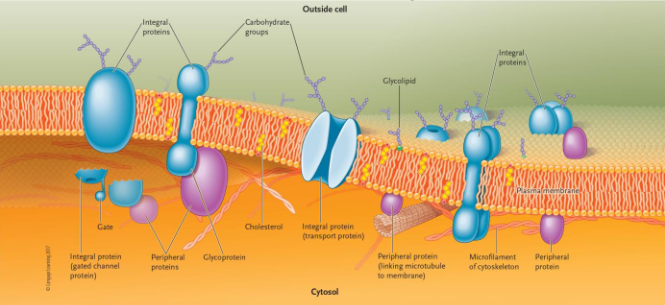
WHAT DOES THE FLUID MOSAIC MODEL OF MEMBRANES SHOW?
Membranes are not rigid
Consists of a fluid bilayer where proteins are embedded and float freely
WHAT IS POLARITY?
An uneven distribution of charge
WHAT DO ELECTRONEGATIVE OXYGEN ATOMS ASSOCIATE WITH?
Associates with ELECTROPOSITIVE hydrogen atoms of adjacent water molecules to form HYDROGEN BONDS
WHAT DO POLAR/CHARGED MOLECULES FORM?
Forms HYROGEN/IONIC BONDS with water molecules
WHAT IS A SOLVENT?
A fluid in which another substance, called a SOLUTE, can be dissolved
WHAT IS HYDROPHILIC?
Is “water-loving” and dissolves in:
Sugars
DNA
RNA
Organic acids
Some of the amino acids
WHAT IS HYDROPHOBIC?
Is “water-fearing” and does not dissolve in:
Water
Lipids (hydrocarbons)
Some amino acids (those in integral membrane proteins that associate with lipids)
WHAT IS INCLUDED IN HYDROPHOBIC MOLECULES?
No polar regions
Does not interact electrostatically with water
Disrupts the hydrogen-bonded structure of water
Tends to coalesce with each other in water
Water molecules tend to exclude molecules that disrupt hydrogen bonding
Hydrophobic interactions are a major driving force in:
Folding of molecules (like proteins)
Assembly of cellular structures
Membrane organizations
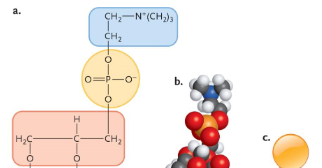
IS THE POLAR HEAD GROUP HYDROPHILIC OR HYDROPHOBIC?
Hydrophilic
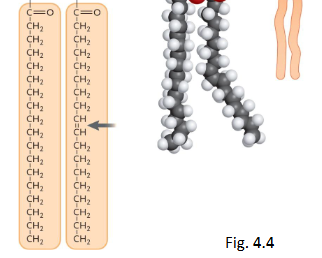
ARE THE 2 NON-POLAR HYDROCARBON TAILS HYDROPHILIC OR HYDROPHOBIC?
Hydrophobic
WHAT IS THE PURPOSE OF THE FLUIDITY OF A MEMBRANE?
Important for a membrane’s function
Dependent on how densely individual lipid molecules can pack together
WHAT ARE THE 2 MAJOR FACTORS THAT INFLUENCE THE FLUIDITY OF A MEMBRANE?
Composition of lipid molecules
Degree of unsaturation of fatty acid tails
Presence of sterols
Temperature
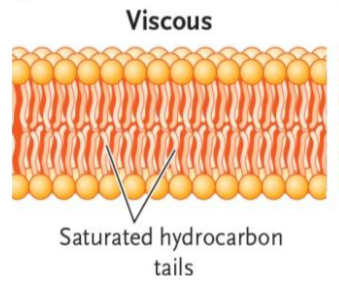
WHEN PHOSPHOLIPIDS ARE COMPOSED OF SATURATED FATTY ACIDS…
Each carbon is bound to max number of hydrogens (all single bonds between C’s)
Straight shape
Tighter packing
WHEN PHOSPHOLIPIDS ARE COMPOSED OF UNSATURATED FATTY ACIDS…
Double-bonds between carbons introduce kinks
Less dense packing

WHEN TEMP IS LOW…
Phospholipid molecules become closely packed
Membranes form a highly viscous, semisolid gel
Enzymes and proteins cannot function if fluidity is not maintained
WHEN TEMP IS HIGH…
Enzymes and proteins become too fluid
Leakage occurs
WHAT OCCURS WHEN ADJUSTING THE FATTY ACID COMPOSITION OF THE PHOSPHOLIPIDS?
Proper fluidity can be maintained over a broad range of temperatures
WHAT DO DESATURASE ENZYMES PRODUCE?
Produces unsaturated fatty acids during fatty acid synthesis
WHAT DOES THE REGULATION OF DESATURASES ALLOW?
Allows for organisms to closely regulate the amount of unsaturated fatty acids and membrane fluidity
AT HIGH TEMPS STEROLS…
Helps restrain the movement of lipids
Prevents membranes from becoming too fluid
AT LOW TEMPS STEROLS…
Disrupts fatty acids from associating with one another
Slows the transition to the semisolid gel state
ORGANISMS CAN MODIFY THE LIPID COMPOSITION OF THEIR MEMBRANES TO OPTIMIZE FLUIDITY IN RESPONSE TO DIFFERENT TEMPS MY CHANGING…
Fatty acid desaturation
Cholesterol content
WHAT ARE THE 4 KEY FUNCTIONS OF MEMBRANE PROTEINS?
Transport
Enzymatic activity
Signal transduction
Attachment/recognition

WHAT ARE INTEGRAL MEMBRANE PROTEINS?
Proteins embedded in the phospholipid bilayer
Composed predominantly of nonpolar amino acids (coiled into alpha helices)
AKA transmembrane proteins
WHAT ARE PERIPHERAL MEMBRANE PROTEINS?
On the surface of the membrane
Do not interact with the hydrophobic core
Held together by noncovalent bonds
Many are on the cytoplasmic side of the membrane
Made up of a mixture of polar and nonpolar amino acids
WHAT IS PASSIVE TRANSPORT?
Movement of molecules across a membrane without the need to expend chemical energy like ATP
Simple Diffusion
Facilitated Diffusion
Active Transport
WHAT IS DIFFUSION?
Net movement of a substance from a region of higher to lower concentration
Primary mechanism of solute movement within a cell
Rate depends on the concentration difference, or concentration gradient

WHAT IS SIMPLE DIFFUSION?
Passive transport of molecules across a membrane from a high to low concentration without the involvement of a transporter
WHAT IS FACILITATED DIFFUSION?
Passive transport of molecules across a membrane from a high to low concentration with the involvement of a transporter
WHAT IS OSMOSIS?
Diffusion of water molecules across a selectively permeable membrane from a low to high solute concentration
WHAT IS A HYPOTONIC SOLUTION?
Low concentrations of solute molecules
WHAT IS A HYPERTONIC SOLUTION?
High concentrations of solute molecules
WHAT IS ACTIVE TRANSPORT?
The movement of molecules across a membrane from a low to high concentration that requires a direct or indirect input of energy derived from ATP hydrolysis or concentration gradients
WHAT ARE THE 2 KINDS OF ACTIVE TRANSPORT?
Primary Active Transport
Secondary Active Transport
WHAT IS PRIMARY ACTIVE TRANSPORT?
Directly uses ATP to power the transport of positively charged ions across membranes:
H+ pumps (proton pumps)
Cells lining stomach
Ca2+ pump
Maintain low intracellular Ca2+ concentration
Na+/K+ pump
3 Na+ out and 2 K+ in per pump cycle
Creates a negative membrane potential
Creates an electrochemical gradient across the membrane
WHAT IS SECONDARY TRANSPORT?
Transport indirectly driven by ATP hydrolysis
Uses the energy from a favorable concentration gradient of ions to transport anotehr moelcule across the membrane
WHAT IS SECONDARY TRANSPORT?
Indirectly uses energy from an ion concentration gradient to power the transport of another molecule across membranes:
Can occur through:
Symport
Antiport
WHAT IS SYMPORT?
The transported solute moves in the same direction as the gradient of the driving ion
WHAT IS ANTIPORT?
The transported solute moves in the direction opposite from the gradient of the driving ion
WHAT IS EXOCYTOSIS?
A secretory vesicle that carries secreted materials
Moves through the cytoplasm and contacts the plasma membrane
The vesicle membrane fuses with the plasma membrane, releasing contents to the cell exterior
WHAT IS ENDOCYTOSIS?
Encloses materials outside the cell in the plasma membrane
Pockets inward and forms an endocytic vesicle on the cytoplasmic side
WHAT ARE THE 2 MAIN FORMS OF ENDOCYTOSIS?
Bulk-phase (pinocytosis)
Receptor-mediated endocytosis
WHAT ARE THE STAGES OF BULK-PHASE ENDOCYTOSIS (PINOCYTOSIS)?
Solute & H2O molecules outside the PM
Membrane pockets inward, enclosing solute & H2O molecules
Membrane pockets pinches off as endocytic vesicle

WHAT ARE THE STAGES OF RECEPTOR-MEDIATED ENDOCYTOSIS?
Molecules bind to receptor proteins on the outer cell surface
After binding, receptors collect into a depression in the PM called a coated pit, where there is a network of proteins called clathrin on the cytoplasmic side
The pit pinches off the PM to form an endocytic vesicle

WHAT IS PHAGOCYTOSIS?
A type of endocytosis in which a cell can take in:
Large aggregates of molecules
Cell parts
Whole cells - prey