TEAS biology section smart edition pt.5 gastrointestinal system
 Call Kai
 Learn
Learn Practice Test
 Spaced Repetition
 Match
Match Flashcards
 Knowt Play
1/33

There's no tags or description
Looks like no tags are added yet.
Name | Mastery | Learn | Test | Matching | Spaced | Call with Kai | Chat |
|---|
No analytics yet
Send a link to your students to track their progress
34 Terms

1. What is the digestive system?
Your digestive system breaks food down so your body can absorb nutrients and use them for energy, growth, and repair.
Think of it like a food-processing machine!
Digestive tract: The long tube food travels through, from your mouth to your anus.
Accessory organs: Organs that help digestion by making or releasing substances, even though food doesn't travel through them. Examples include the liver, pancreas, and salivary glands.
Important TEAS tip:
Digestive tract = the whole path food travels.
GI (gastrointestinal) tract = commonly used for the digestive tract, but your notes use it more narrowly to mean the stomach and intestines .

2. The path food takes
Food moves through these organs:
1. Mouth (oral cavity)
Chews food and mixes it with saliva.
2. Pharynx
The throat; passes swallowed food toward the esophagus.
3. Esophagus
A muscular tube that pushes food to the stomach.
4. Stomach
Mixes food with acid and digestive enzymes.
5. Small intestine
Finishes much of digestion and absorbs most nutrients.
6. Large intestine
Absorbs water and helps form solid waste.
7. Rectum and anus
Rectum stores stool; anus is where stool exits.

Oral cavity =
mouth
Masticate means chew.
Your teeth break food into smaller pieces.
Your tongue moves food around.
Saliva moistens food and breaking begins down starch.
🧠 Memory trick: “Mouth = munch and moisten!”
Pharynx = throat
Connects the mouth to the esophagus for swallowed food.
Helps direct food toward the digestive tract.
🧠 Memory trick: “Pharynx = passage through the throat.”
Esophagus = food tube
Moves swallowed food toward the stomach.
Uses squeezing muscle movements called peristalsis .
🧠 Memory trick: “Peristalsis pushes!”

4. Teas facts to remember
Word | Super-easy meaning |
|---|---|
Digest | Break food down |
Absorb | Move nutrients into the blood |
Accessory organs | Help digestion without food passing through them |
Oral cavity | Mouth |
Pharynx | Throat |
Esophagus | Tube that carries food to the stomach |
Peristalsis | Muscular squeezing that pushes food along |
Fast memory phrase: “Mouth munches → throat passes → esophagus pushes.”
What does masticate mean?
Chew
What connects the mouth to the esophagus?
Pharynx
3. What does the esophagus do?
Pushes food toward the stomach
Which is an accessory digestive organ?
Pancreas
Where are most nutrients absorbed?
Small intestine

Esophagus =
The food slide
The esophagus is a muscular tube that carries food to your stomach.
It uses squeezing movements called peristalsis to push food down.
It's about 25 cm long .
🧠 Memory trick: “Esophagus = food slides down!”

2. Stomach =
the food mixer
Your stomach mixes food with acid and digestive enzymes to break it down.
There are 2 sphincters you need to know:
Cardiac sphincter = entrance
Food enters the stomach through this opening from the esophagus. It also helps prevent stomach contents from flowing backward.
Pyloric sphincter = exit
Controls when partially digested food leaves the stomach and enters the small intestine.
🧠 Memory trick: “Cardiac comes in; pyloric pushes out!”
What are rugae?
Rugae = folds inside the stomach.
When your stomach is empty, it has folds. When you eat, the folds stretch out, letting the stomach expand.
🧠 Memory trick: “Rugae = stomach wrinkles!”

3. Small intestine =
the nutrient absorb
The small intestine is about 6 meters long and has 3 parts.
Part | Easy way to remember |
|---|---|
Duodenum | First: receives food from the stomach and digestive juices |
Jejunum | Middle: absorbs lots of nutrients |
Ileum | Last: absorbs remaining nutrients, including vitamin B12 and bile salts |
🧠 Memory trick: “DJI: Don't Jump In!” Remember the order: Duodenum → Jejunum → Ileum.
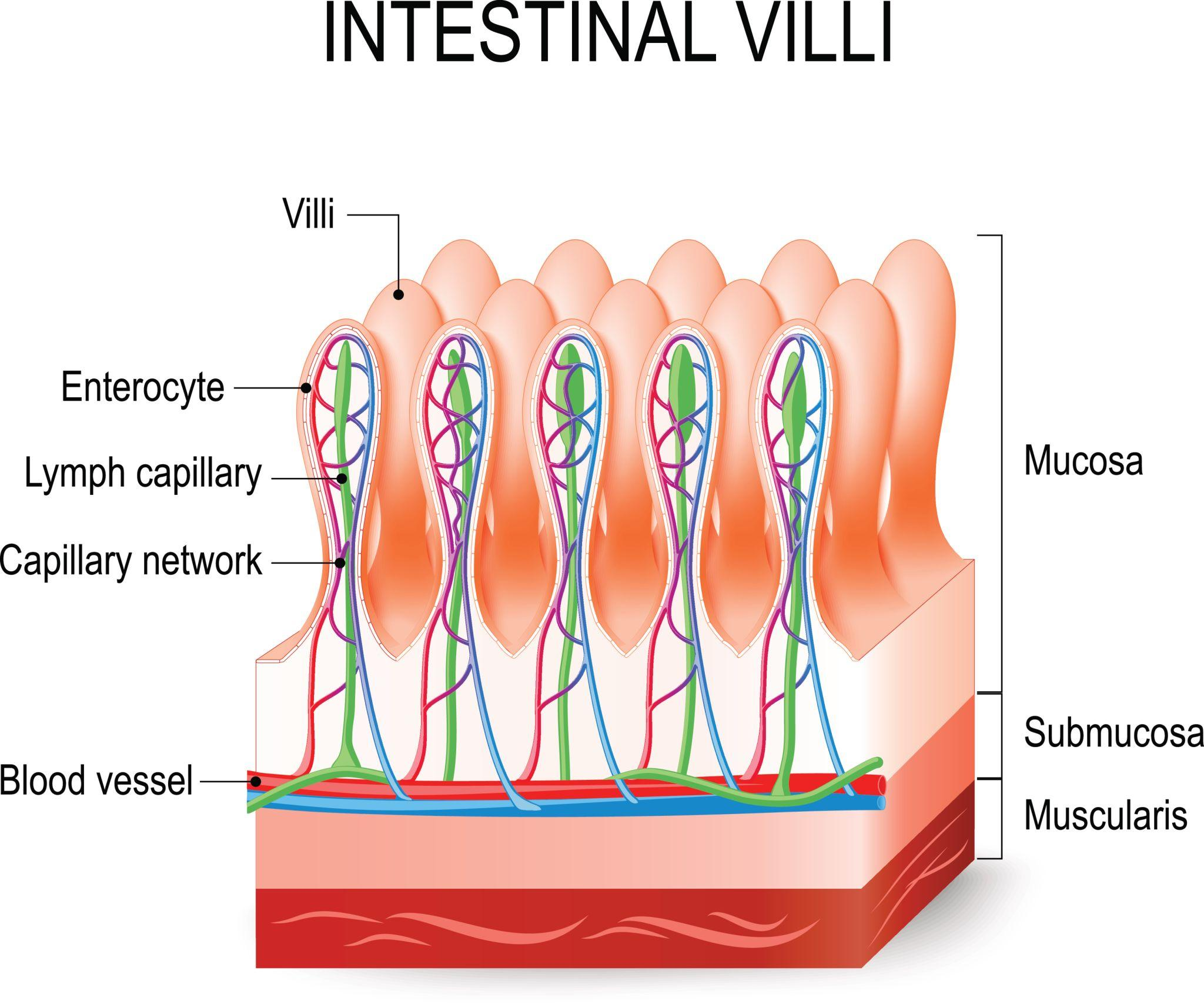
What are villi?
Villi are tiny, finger-like projections lining the small intestine.
They increase the surface area so more nutrients can be absorbed into the blood.
Think of them like lots of tiny fingers grabbing nutrients from digested food.
Important TEAS note: Your notes emphasize the duodenum's villi, but villi line the small intestine throughout, and the jejunum is a major site of nutrient absorption. The small intestine overall is the main place nutrients are absorbed .
🧠 Memory trick: “Villi = more surface, more absorption!”
4. What does diffusion mean?
Diffusion means particles move from an area of higher concentration to lower concentration .
For digestion, nutrients move from inside the small intestine across its lining and into the blood. Nutrients can also be absorbed by other processes, so not all absorption happens through diffusion.
Quick Teas cheat sheet
2
Term | Remember this |
|---|---|
Esophagus | Pushes food to stomach |
Cardiac sphincter | Stomach entrance |
Rugae | Folds that let stomach expand |
Pyloric sphincter | Stomach exit |
Duodenum | First part of small intestine |
Jejunum | Middle part |
Ileum | Last part |
Villi | Increase surface area for absorption |
Small intestine | Main site of nutrient absorption |
What pushes food down the esophagus?
Peristalsis
2. Which sphincter is the entrance to the stomach?
Cardiac
3. What are rugae?
Folds in the stomach
Which sphincter controls food leaving the stomach?
Pyloric
5. What is the correct order of the small intestine?
Duodenum → jejunum → ileum
What do villi do?
Increase surface area for nutrient absorption

1. What does the large intestine do?
Think of the large intestine as your body's water saver and waste packer .
After your small intestine absorbs most nutrients, the leftover material moves into the large intestine.
The large intestine:
Absorbs extra water so your body can reuse it.
Compresses waste into stool (poop).
Moves stool toward the exit.
🧠 Memory trick: “Large intestine = saves water and packs waste!”
2. The 4 parts of the large intestine
1. Cecum = the starting pouch
It's a pouch where the small intestine connects to the large intestine.

2. Colon = water saver
The longest part of the large intestine. It absorbs water and moves waste along.
3. Rectum = storage
Holds stool until it's ready to leave the body.

4. Anal canal = exit passage
The final passage that leads to the anus, where stool leaves the body.
🧠 Memorize the order: CCRA
C ecum → C olon → R ectum → A nal canal
Say it a few times: “Cecum, colon, rectum, anal canal!”
3. The 4 parts of the colon
The colon has four sections. Picture food waste traveling around a frame:
1. Ascending colon
Goes up on your right side.
2. Transverse colon
It goes across the abdomen.
3. Descending colon
Goes down on your left side.
4. Sigmoid colon
Curves toward the rectum.
🧠 Memory trick: ATDS
A scending = up → T ransverse = across → D escending = down → S igmoid = curve toward the rectum.
The colon is about 1.5–1.8 meters long according to your notes.
4. Quick TEAS cheat sheet
large intestine
Term | Easy meaning |
|---|---|
Cecum | Pouch where small and large intestines meet |
Colon | Absorbs water and moves waste |
Rectum | Stores stool |
Anal canal | Final passage for stool |
Large intestine's main job | Absorb extra water and form stool |
Remember: The small intestine absorbs most nutrients. The large intestine mainly absorbs leftover water and helps form stool.
1. What is the main job of the large intestine?
Absorb extra water and form stool
Where do the small and large intestines meet?
Cecum
Which part stores stool before it leaves the body?
Rectum
Which colon section goes across the abdomen?
Transverse
What is the correct colon order?
Ascending → transverse → descending → sigmoid
1. What are accessory organs?
1-3
Accessory organs help digest food, but food does NOT travel through them.
Examples include the liver, gallbladder, pancreas, and salivary glands.
🧠 Memory trick: “They help food, but food doesn't go through!”
2. Meet the liver
The liver is a large organ on the upper-right side of your abdomen. It does MANY jobs to help your body process food and stay healthy.
Think of the liver as your body's CHEF, STORAGE ROOM, and CLEANUP CREW!
3. The liver's 6 main jobs
. 1) Digestion = helps break down fat
The liver makes bile . Bile breaks big blobs of fat into tiny droplets so digestive enzymes can work on them more easily. This is called emulsification .
🧠 Remember: Bile breaks fat into tiny droplets.
2. Excretion = gets rid of waste
The liver puts certain waste products into bile. These include substances from the breakdown of old red blood cells.
🧠 Remember: Liver sends some waste out through bile.
3. Nutrient storage = saves supplies
The liver stores extra sugar as glycogen , along with certain vitamins and minerals such as iron and copper. It can release stored sugar when your body needs energy.
🧠 Remember: Liver = storage room!

1. What are accessory organs?
3. The liver's 6 main jobs
4-6
4. Nutrient conversion = changes supplies
The liver changes nutrients into forms your body can use or store. For example, it can make glucose from certain amino acids.
🧠 Remember: Liver changes nutrients into what the body needs.

5. Detoxification = makes harmful waste safer
When proteins are broken down, they can produce ammonia , which is harmful in high amounts. The liver converts ammonia into urea , which the kidneys remove through urine.
🧠 Remember: Ammonia → liver → urea → kidneys → urine.

6. Synthesis = makes important proteins
The liver makes blood proteins, including:
Albumin: helps keep fluid inside blood vessels.
Fibrinogen: helps your blood form clots when needed.
🧠 Remember: Liver builds blood proteins.
The liver makes blood proteins , and albumin and fibrinogen are two examples .
Super easy to remember:
Albumin = keeps fluid in your blood vessels.
Fibrinogen = helps your blood form clots when you get injured.
🧠 TEAS memory trick:
Liver SYNTHESIZES (makes) proteins.
Albumin = fluid balance
Fibrinogen = clotting
4. Quick TEAS memory chart
liver
Liver job | Easy way to remember |
|---|---|
Digestion | Makes bile to help digest fat |
Excretion | Puts certain wastes into bile |
Storage | Saves sugar, vitamins, and minerals |
Conversion | Changes nutrients into usable forms |
Detoxification | Converts ammonia into urea |
Synthesis | Makes blood proteins |
One big memory trick: The liver helps digest, removes waste, stores, changes, cleans up, and builds.
1. Why is the liver an accessory organ?
It helps digestion, but food doesn't pass through it
What does bile help with?
Breaking fat into tiny droplets
In what form does the liver store extra glucose?
Glycogen
What does the liver convert ammonia into?
urea
. What does albumin help do?
Help keep fluid inside blood vessels
Which liver-made protein helps blood clot?
Fibrinogen
Accessory Organs pt.2
1. Pancreas = the food helper + blood sugar controller
The pancreas has 2 big jobs : helping digest food and controlling blood sugar.
Job 1: Makes bicarbonate
Your stomach uses acid to break down food.
That acidic food moves into the small intestine.
The pancreas releases bicarbonate , which neutralizes some of that acid.
Think of bicarbonate like an acid extinguisher! 🧯
🧠 Memory trick: “Bicarbonate brings acid down!”
Job 2: Makes digestive enzymes
Enzymes help break food down into smaller pieces your body can absorb.
The pancreas makes enzymes to help digest:
Carbohydrates = sugars and stars
Proteins = meat, eggs, beans
Fats = oils, butter
🧠 Memory trick: “Pancreas enzymes tackle all 3: carbs, protein, fat!”
Job 3: Controls blood sugar
The pancreas makes two important hormones:
Insulin = brings blood sugar DOWN
When blood sugar is high, insulin helps glucose move from the blood into cells and encourages storage for later.
Glucagon = brings blood sugar UP
When blood sugar is low, glucagon tells the liver to release stored glucose into the blood.
🧠 Catchy phrase: “Insulin lowers, glucagon grows!”
TEAS tip: Insulin and glucagon have opposite jobs. Insulin lowers blood glucose; glucagon raises it.

accesory organs pt.3 gallbladder
the bile storage bag
The liver makes bile .
The gallbladder stores and concentrates bile .
When you eat fatty food, the gallbladder releases bile into the small intestine to help digest fats.
🧠 Memory trick: “Liver makes it; gallbladder saves it!”
Important: The gallbladder does not make bile. The liver does!
3. Tongue = the food mover
Your tongue is a strong muscle that helps you:
Move food around your mouth.
Keep food between your teeth while chewing.
Mix food with saliva.
Push food toward the throat when you swallow.
Taste food.
Mastication means chewing.
🧠 Memory trick: “Tongue turns, teeth tear, saliva softens!”
Quick Teas cheat sheet
Organ or substance | Main job |
|---|
Pancreas | Digestion + blood sugar control |
Bicarbonate | Neutralizes stomach acid |
Digestive enzymes | Break down carbs, proteins, and fats |
Insulin | Lowers blood sugar |
Glucagon | Raises blood sugar |
Liver | Makes bile |
Gallbladder | Stores and concentrates bile |
Tongue | Moves food during chewing and swallowing |
1. Which organ makes insulin and glucagon?
Pancreas
2. What does bicarbonate do?
Neutralizes acid
3. Which hormone lowers blood sugar?
Insulin
4. Which hormone raises blood sugar?
Glucagon
. Which organ stores bile made by the liver?
Gallbladder
6. What does mastication mean?
Chewing
1. What does saliva do?
Saliva is the liquid in your mouth. It has 3 main jobs:
Moistens your mouth so it doesn't get dry.
Softens food so it's easier to chew and swallow.
Starts chemical digestion using an enzyme called amylase .
🧠 Memory trick: “Saliva softens, moistens, and starts!”
What does amylase do?
Amylase starts breaking down starch (carbohydrates) into smaller sugars.
Think of eating a cracker. When you chew it, saliva mixes with the cracker, and amylase starts breaking down its starch.
🧠 Memory trick: “AMYlase attacks starch!”
TEAS tip: Amylase works on carbohydrates, not proteins or fats.
2. The 3 pairs of salivary glands
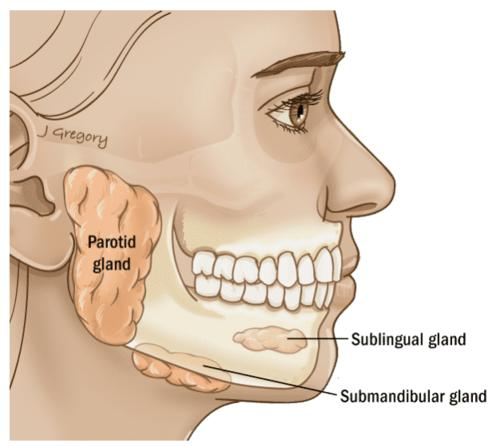
You have 3 pairs , meaning 3 types on both sides of your mouth.

1. Parotid = largest
Located in front of your ears.
🧠 Memory: “Parotid = by the ear.”

2. Submandibular = below the jaw
Located underneath your mandible (lower jaw).
🧠 Memory: “Sub = under; mandibular = jaw.”

3. Sublingual = under the tongue
The smallest of the three major salivary gland types.
🧠 Memory: “Lingual = tongue; sublingual = under tongue.”
3. What are serum and mucus fluids?
Saliva is a mixture of fluids:
Serous = watery and thin. Helps moisten food and contains enzymes.
Mucus = slippery and thicker. Helps lubricate food so it can slide down when you swallow.
🧠 Memory trick: “Serous = watery; mucus = slippery!”
Quick Teas cheat sheet
saliva/ mouth
Term | Remember this |
|---|---|
Saliva | Moistens food and starts digestion |
Amylase | Breaks down starch |
Parotid | Largest, in front of ears |
Submandibular | Below the jaw |
Sublingual | Smallest, under the tongue |
Serous fluid | Watery |
Mucus | Slippery |
1. What does salivary amylase begin breaking down?
Starch/carbohydrates
2. Which salivary gland is the largest?
Parotid
3. Where are the submandibular glands?
Below the lower jaw
4. What does sublingual mean?
Under the tongue
. Which fluid is watery?
Serous fluid