Stuff from after exam 3 until now
 Call Kai
 Learn
 Practice Test
 Spaced Repetition
 Match
 Flashcards
 Knowt Play
1/50

There's no tags or description
Looks like no tags are added yet.
51 Terms
Ambulacraria: Echinoderms + Hemichordates, why group them?
Tripartite coelom (not super helpful)
Phoronida (and other lophophorates)
The way they develop + their larva (telotrochal band of cilia on tornaria larva: a protostome characteristic)
Phylum Echinodermata
Class Crinoidea (sea lilies/feather stars)
Class Ophiuroidea (brittle stars/basketstars)
Class Asteroidea (sea stars)
Class Echinoidea (sea urchins/sand dolars)
Class Holothuroidea (sea cucumbers)
Phylum Echinoderm characteristics
water vascular system
pentameral symmetry as adults
bilateral symmetry as larvae
calcareous ossicles from mesoderm
mutable connective tissue
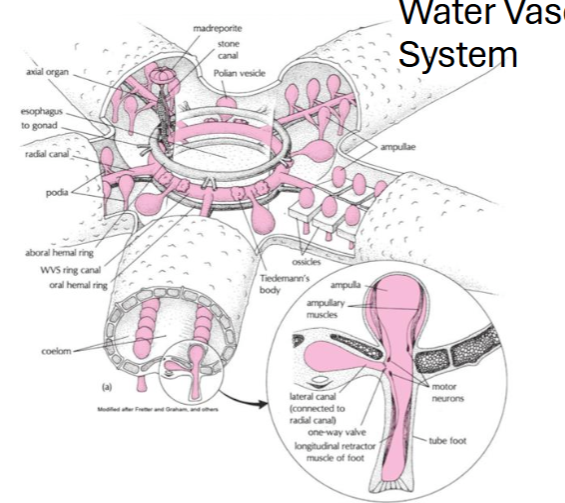
Water vascular system
Pink is hydrostatic skeleton inside
Tube feet can work independently

Water vascular system used for locomotion
Red indicates muscular contraction
Duo-gland system which we have seen before in flatworms
Adhesive and chemicals strong enough to where tissue on tube foot would rip if being taken off before it lets go
Echinoderm ossicles
Mesodermally derived, primarily CaCO3 ossicles from internal skeleton
Vary widely across classes (cf urchin test with sea cucumbers)
Unique stereom structure: porous structure filled with living tissue
Mutable connective (collagenous) tissue
MCT used for feeding in sea stars
MCT allows autonomy in seastars and brittlestars
Changes in MCT are under nervous control
Two nerve types present in extracellular matrix: one softens, one hardens
Either be super frail or super strong
Mechanism unknown related to Ca2+
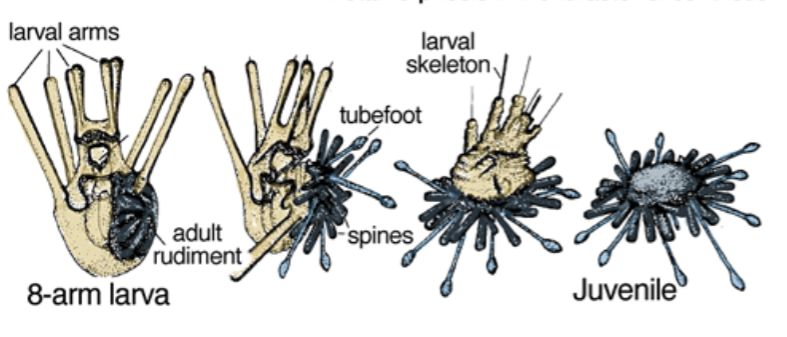
Development and symmetry switch in Echinoderms
Class Crinoidea
Sea lilies (deep sea) and feather stars (shallow tropical waters)
625 spp
Filter feeders
Generally sessile but can move when agitated
Generally considered primitive among the classes
For more numerous in fossil record than today
Amazing mobility for such delicate creatures
Most echinoderms are light-averse
Why might crinoids generally be more bold?
Doesn’t have a lot of tissue. Nothing wants to eat them.
Class Ophiuroidea characteristics
Highly developed arm ossicles form ‘vertebrate’
5 pairs of bursal slits for gas exchange and brood chambers
Brittlestars and basketstars
Most speciose class (> 2000 spp)
Arms slender and distinct from central disc
No suckers or ampullae on tube feet
No intestine/anus
Asteroidea
1500 species
Common intertidal and subtidal predators
Mouth located on underside of body
Ambulacrum runs from mouth to tip of each arm and bordered by tube feet
Typically 5 arms (or multiple of 5 like ophiuloidea)
True coelomates
Top predators
Pull muscle apart within tube feet
Bivalves try to contract adductor to close while sea stars try to pull shell apart with tube feet. When they wanna stop they can lock collagen and rest. They get food by putting out their cardiac stomach, slide it into mussel and digest it
Vision in asteroids and ophiuroids
Asteroidea passes eyespots at arm tips
Composed of 80-200 pigment-cup ocelli
Act as a crude compound eye, can detect reef from 3 feet
Ophiuroidea possess individual lenses acting (maybe) as a compound eye
Covered by chromatophores that adjust intensity of light; focal depth corresponds to nerve fibers

Echinoderm Phylogeny
Class Echinoidea
1000 spp
Exclusively marine
Ossicles joined to form a rigid test
Unique set of ossicles and muscles for feeding: Aristotle's lantern
Irregular Echinoidea
Sand dollars, sea biscuit, heart urchins
Bilateral symmetry
Anus posterior to mouth on the edge of the test
Regular Echinoidea
Sea urchins
Nearly spherical symmetry
Anus and mouth on opposite sides of body
Class Holothuroidea
1200 spp
Soft bodied and vermiform
Ossicles highly reduced
Highly branched respiratory trees connected to anus
Oral-aboral axis elongated
Locomotory tube feet limited to 2-3 ambulacra
Feeding in sea cucumbers
Maintenance of pentameral symmetry
Coordination of inner and outer tentacles
Holothuroidea - sea cucumbers as habitat and when disturbed
Pearlfish use sea cucumbers as a home to live in
Recall animals living in sponges, etc
When disturbed: evisceration and regeneration of internal anatomy
Echinoderm development
Separate sexes
Broadcast spawners
Bilateral symmetry in planktonic larval forms
Wide diversity in larval forms and strategies
Dramatic metamorphosis prior to return to benthos
Echinoderm development
Comprised of nerve ring surrounding gut
Radial nerves run along arms
Sensory neurons occur throughout ectoderm
Scattered ganglia along radial nerves, but no centralized brain
Phylum Hemichordata
100 spp
Three classes
-Enteropneusta (70 spp)
-Pterobranchia (29 spp)
-Planetosphaeroidea (150 spp)
Live in marine and bracksih habitats
Share synapomorphy of stomochord
1mm to 2.5m long
Class Enteropneusta (gut breathing)
Mud dwelling, largely sedentary, mucus burrowers
Deposit feeders
Highly muscular proboscis used for burrowing via peristaltic contractions
Hemichordata: Stomochord
Stomochord formerly thought to be homologous to chordate notochord
Gene expression data suggests its not
Projects from foregut into proboscis for support
Supports heart kidney located in proboscis
Dorsal, sometimes hollow, nerve chord may be homologous to chordata
Hemichordata: Deuterostomes
Radial cleavage
Blastophore forms anus
Mouth forms secondarily
Coelom forms via schizocoely (unlike other deuterostomes)
Tripartite coelom (protocoel, mesocoel, metacoel)

Enteropneusts live in U-shaped burrows
Phylum Chordata
Subphylum Urochordata
Subphylum Cephalochordata
Subphylum Vertebrata
50,000 spp (96% vertebrates)
Dorsal, hollow nerve chord
Anterior-posterior running, stiff notochord set ventral to nerve chord
Pharyngeal pockets/slits
Post-anal tail
Endostyle/thyroid gland
Non vertebrate phyla are entirely marine
Chordata: Notochord
All chordates possess a notochord at some stage of their life
Some lose it after metamorphosis (e.g. urochordates)
Others (like us) replace the notochord with vertebrae)
Still others (hagfish) keep the notochord throughout their life
What is the notochord?
Flexible rod extending the length of the body
A series of vacuolated (fluid filled) cells that act as a hydrostatic skeleton
Swollen vacoules create high internal pressure with collagen-wrapping preventing stretching
Alternating contractions of longitudinal muscles allows for movement
Contractile set of cells and muscles that let you move
All bilaterians have some kind of thing (contractile, sheath-secreting, mesodermal, midline cells)

Where did the notochord come from?
Vertebrates are upside down invertebrates
BMP determines D/V axis
-Ventrally for vertebrates
-Dorsally for inverts
‘Axochord’ in annelids homologous to notochord, based on gene expression data surrounding mesodermal midline cells
Changing hypothesis of how ancestral bilaterian looked; most likely possessing a precursor to the notochord (contractile mesodermal midline) that evolved into a ventral axochord in protostomes and dorsal notochord in chordate deuterostomes
Phylum Chordata: Dorsal hollow nerve chord
Invertebrates (with exceptions): ventral to gut and solid
Vertebrates: dorsal to gut and hollow
Further supports ‘inversion’ hypothesis of St. Hilaire

Phylum Chordata: Pharyngeal Gill Slits
Ectodermal invagination and endoderm evagination leads to pharyngeal pouches and, when the two meet, pharyngeal slits
Modified for filter feeding, respiration, ear bones etc.
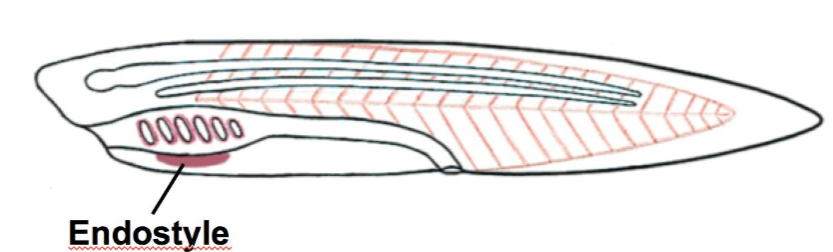
Phylum Chordata: Endostyle/Thyroid gland
Endostyle functions in non-vertebrate chordates to secrete mucous and trap food in pharyngeal slits
Functions in vertebrates to secrete iodine-containing hormones
In lampreys, larvae use endostyle to trap food in mucous net, then adults use same cells to build the thyroid gland

Phylum Chordata: Post-anal tail
Post-anal tail, along with somatic musculature and the support of the notochord,
evolved for swimming existence common to non-vertebrate chordates (and many vertebrates!)
Subphylum Urochordata
~2150 spp.
General characteristics:
• Notochord and nerve
cord found only in larval
stage
• Functions as skeletal
support for short larval
swimming stageClass Ascidiacea
Class Larvacea
Class Thaliacea
Notochord and tail are lost at metamorphosis
Adhesive papillae used to glue
larva to substrate
Subphylum Urochordata: Class Ascidiacea
Sea squirts
90% of all Urochordates
Benthic, sessile suspension feeders
Proteinaceous tunic surrounds body wall
Tunic infused with vanadium and sulfuric acid for chemical defense (morula cells)
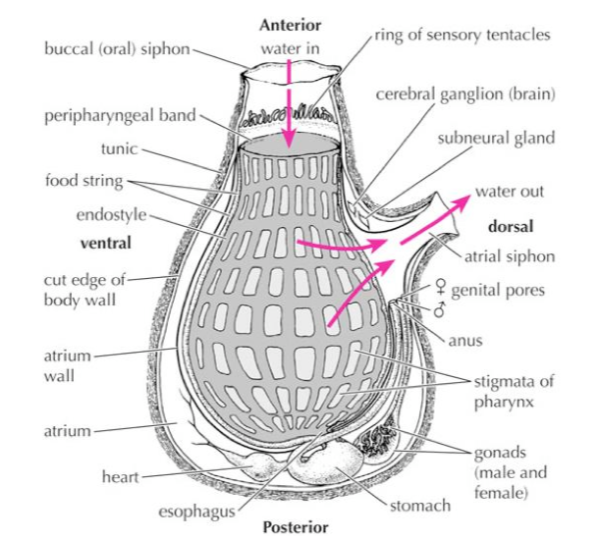
Class Ascidiacea: Internal Anatomy
Class Ascidiacea: Colonial vs Solitary
Ascidians may be solitary or
colonialIndividuals in colonies share similar morphology but are much reduced in size
Overall colony size can be quite large
Colonies form from a single
individual that buds via
asexual reproduction
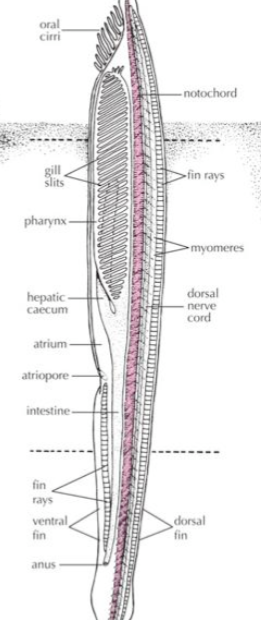
Subphylum Cephalochordata
Notochord extends into anterior end of animal
30 spp. entirely marine
Closest invertebrate relatives to Vertebrata
Ancient origins: 525 mya
Genes and development similar to vertebrates (e.g. Hox arrangement)
Feed in fashion similar to ascidians
Normally only head exposed
Can use paired lateral muscles
for swimmingChevrons of myomeres
Notochord serves as skeleton for swimming
Separate sexes, external fertilization
Development via Neurula larva into feeding stage
Phylum Chordata: Subphylum Vertebrata (a whirlwind tour)
General Characteristics
• Bony or cartilaginous cranium
• Usually (?) with vertebrae
• Heart with multiple chambers
• useful for distinguishing within Chordates, but not above, e.g. Molluscs have three chambered heart
Subphylum Craniata? (why is vertebrata misleading)
Hagfish (Class Myxini) lack vertebrae entirely
Lampreys (Class Petromyzontida) possess only rudimentary vertebrae
Instead the presence of a bony or cartilaginous cranium is used to unite ‘vertebrates
Hagfish have very tiny vertebrae
Lamprey vertebrae is dorsal
Hagfish, lampreys and gnathostomes (jawed vertebrates) all possess a cranium to varying degrees
Likely that both vertebrae and crania are suitable synapomorphies of the
subphylum…

Origins of Vertebrates
Garstang’s paedomorphosis hypothesis
• What would the Chordate phylogeny look like if this were true?Garstang’s hypothesis
supports a traditional
viewSome recent evidence suggests urochordates as the closest invertebrate relatives to Vertebrates
Larval lampreys (Ammocetes) are suggested as the living organisms that most closely resemble the LCA of vertebrates
Modes of feeding: misinformation (few animals can absorb nutrients directly from their environment)
Recall frenulate Annelids. Take up dissolved materials from seawater
What other organisms can take up DOM (dissolved organic material)
-Sponges
-Cnidarians
-Annelids
-Molluscs
-Arthropods
-Echinoderms
-Chrodates (fish)
Feeding, digestion and nutrition
Larval feeding
Opposed band feeding inn
Cilia to trap particular food (usually single cell in algae)
Reversal of ciliary beat in echinoderm larvae
Cilia driven water currents for locomotion and feeding. Beating cilia in one direction and when a bit hits their arm they reverse and take it into their mouth
Suspension/Filter feeding
Widespread across all sizes (larvae to adults) and taxa (inverts to whales)
Filter feeding is a subcategory of suspension feeding
Deposit feeding
Sand dollars, sea cucumbers, hemichordates, polychaetes
Consuming organic material on the bottom
Deposited sediment and eating it
Fluid feeding
Common in blood sucking parasites (mosquitos, ticks, leeches, etc)
Feeding and digestion in vertebrates
Bulk feeding
Common in vertebrates, but not exclusive (even brittlestars)
What is digestion?
Every part of the process from food capture to absorption that breaks the food down (mechanical and chemical)
Intracellular vs extracellular
Intracellular digestion in sponges and protists

Review: structure and function of vertebrate digestion system
Mouth/salivary glands for masticating (chewing) food and secretion of amylase to begin breakdown of carbohydrates
Esophagus transfer food from mouth to the stomach
Sphincters (cardiac and pyloric) regulate flow into and out of the stomach
Secretion of gastric juices especially pepsin to break down proteins
Why is the stomach poorly designed for absorbing nutrients
-Terrible surface area to volume ratio
Site of most absorption of molecules from food. Gives surface area
Duodenum receives bile from the liver (via from the gallbladder) to help break down fat and trypsin from the pancreas to help break down proteins (begun with pepsin in stomach)
Large intestine: consolidation of indigestible remains and removal of water
Colon houses large number of bacteria (good and bad) that break down remaining organic wastes; some reabsorption of vitamins K and B in colon as a result
Smorgasbord effect
Brain gets bored, but at Thanksgiving you’re getting bites of multiple things. You lose the experience of sensory specific satiation that you normally have. Trying a bit of everything tricks you into not feeling full
Does eating turkey make you sleepy?
No
The idea
-Turkey contains tryptophan (an amino acid that is a precursor of serotonin)
- Serotonin, in turn, causes drowsiness in mammals
Tryptophan occurs along with other AAs that prevent too much tryptophan from reaching the brain
But I’m so sleepy! Why?
• Dessert! Increases insulin secretion and allows other tissues to take up competing AAs, leaving tryptophan alone to cross blood/brain barrier and boost serotonin and ultimately drowsiness