UNIT 1 - Cells and Cell Growth
 Call Kai
 Learn
 Practice Test
 Spaced Repetition
 Match
 Flashcards
 Knowt Play
1/47

There's no tags or description
Looks like no tags are added yet.
48 Terms

phase 1
lag phase
cells are adapting to environment.
no net change in cells
some cells stop dividing, some dying, and some are dividing

phase 2
acceleration phase
plenty of nutrients + space for growth to occur
net growth in cells
carbon from glucose is rapidly being incorporated into macromolecules in cells
concentration of glucose in medium is rapidly decreasing
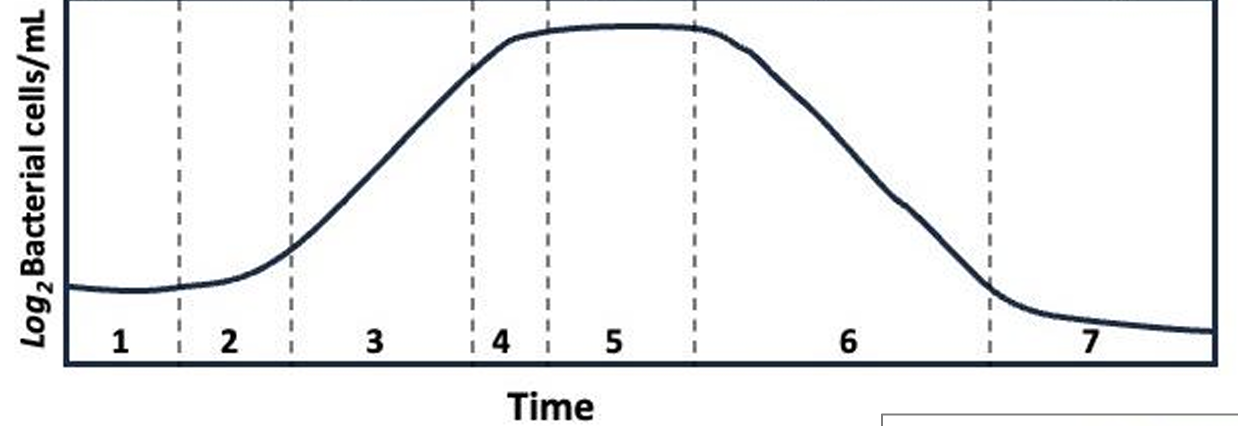
phase 3
log phase
net growth in cells
concentration of glucose in the medium is rapidly decreasing
carbon from glucose is rapidly being incorporated into macromolecules in cells

phase 4
deceleration phase
more cell death, more waste, and more nutrients running out
still net growth in cells
glucose concentration in medium is approaching 0g/L
the concentration of metabolic waste products (acetate) are contributing to reduced population growth

phase 5
stationary phase
no net change; cell growth rate = cell death rate
glucose concentration in medium is at/approaching 0g/L
concentration of metabolic waste products (actetate) are contributing to reduced population growth
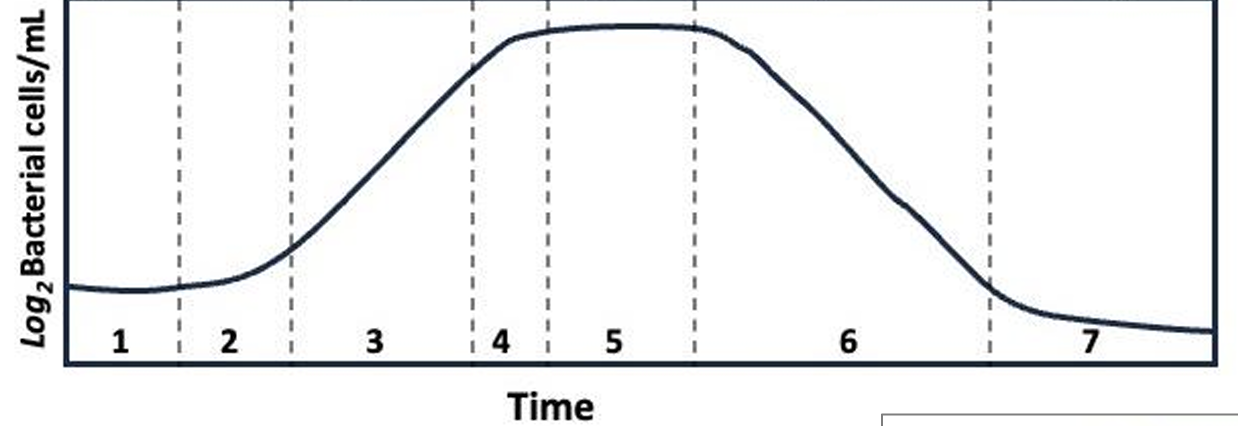
phase 6
death phase
more cells dying than growth
glucose concentration is at or approaching 0g/L
concentration of metabolic waste products (acetate) are contributing to negative population growth
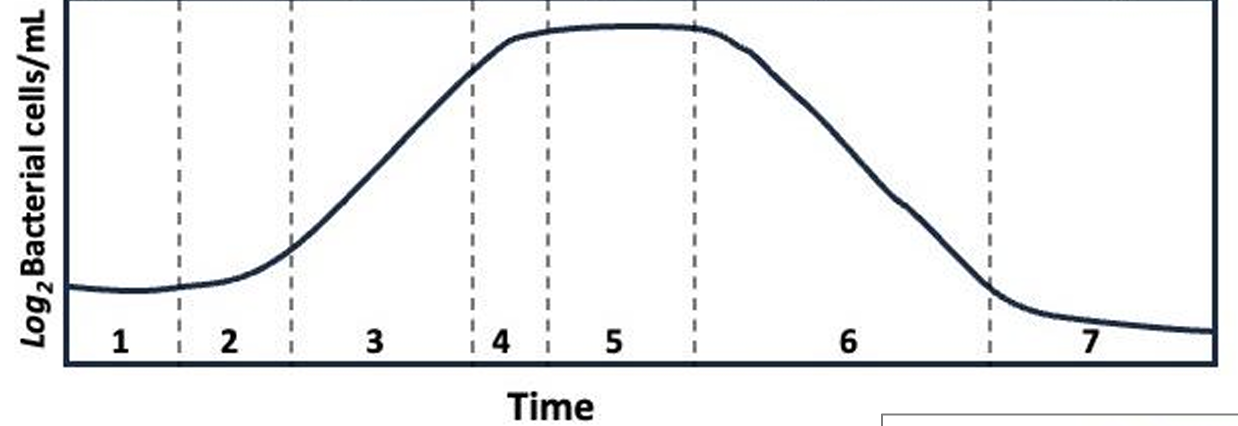
phase 7
long term stationary phase
net decrease in cells
glucose concentration is at/approaching 0g/L
concentration of metabolic waste products are contributing to reduced population growth

time 0-1
lag phase
cells are adapting to glucose

time 1-3.5
exponential/log phase

time 3.5-5.5
lag phase
swtiched from glucose to xylose, cells need time to adapt

time 5.5-7.5
exponential/log phase

time 7.5-10
stationary phase
cells ran out of nutrients
cell theory
all organisms are made of cells
the cell is the fundamental unit of life
all cells come from prexisting cells
prokaryotes
bacteria and archaea
without nucleus, instead has a nucleoid
cell wall
small, typically 1-2 micrometers
high ratio of SA to vol. for nutrient absorption
small cell = every part of interior is close to the membrane
most are single-celled, but some have simple multicellular forms
eukaryotes
has a nucleus
cell wall in plant cells
typically much bigger
has membrane-bounded organelles
evolved from prokaryotic ancestors (archaea)
animals, plants, fungi, and protists (single-celled)
**some eukaryotic cells have no nuclei as specialized cells lose it when they mature (RBCs). but they all started with nuclei
metabolism
chemical reactions in cells that build and breakdown macromolecules and harness energy
3 essential features of a cell
cell membrane that separates living material within the cell from the non-living environment
its ability to store and transmit information (DNA)
ability to harness energy from the environment (sun + chemical compounds)
central dogma
theory that genetic info flows in one direction
DNA → RNA → proteins
bacterial cell
DNA in a single, circular chromosome
has plasmids
no nuclear membrane → translation occurs immediately
lack sexual processes
why are bacteria so small?
diffusion: slowing diffusing molecules do not have to travel as far to reach every part of a small cell’s interior
most bacterial cells are tiny spheres, rods, spirals, or filaments
binary fission
asexual reproduction of prokaryotes
creates two identical daughter cells
horizontal gene transfer
movement of genetic material between organisms other than parent to offspring
conjugation, transformation, transduction
conjugation
a pilus tethers the donor to the recipient and brings the cells together, providing a migration route for the direction cell-to-cell transfer of DNA
commonly transfers plasmids
eg. antibiotic resistance genes

transformation
DNA released to the environment by cell breakdown can be taken up by other cells

transduction
DNA is transfered from a donor to a recipient cell by a virus

how are some organisms able to do more with the genes they have?
expression of protein-coding genes can be regulated in subtle ways
gene products can be made in different amounts in different cells at different times
protein are capable of combining in many different ways to perform different functions
c-value paradox
the apparent contradiction between genome size and organismal complexity
transposable elements
DNA elements that can replicate and insert themselves in new genomic positions
endomembrane system
network of membrane and organelles in eukaryotic cells that work together to modify, package, and transport lipids + proteins
nuclear envelope, endoplasmic reticulum, golgi apparatus, and cell membrane that surrounds the cytoplasm
endocytosis
substances (like nutrients) brought into the cell
phagocytosis
type of endocytosis in which cells surround food particles and package them in vesicles for digestion
exocytosis
cells package waste or other molecules into vesicles and transport them to the cell surface for release
endosymbiotic theory
certain organelles within eukaryotic cells resemble engulfed prokaryotic cells (endosymbionts)
chloroplasts + mitochondria are thought to have evolved from an endosymbiont because
they are surrounded by two membranes
their inner membranes have structures that resemble certain prokaryotic cells
they each contain circular genomes that code for genes very similar to bacterial genes
grow and divide by binary fission
have their own ribosomes and synthesize proteins
endosymbiont
organism that lives inside the body/cell of another organism
cell
the simplest entity that can exist as an independent unit of life
how is genome size measured?
in numbers of base pairs
a kilobase (kb)
a million base pairs (megabase, Mb)
a billion base pairs (gigabase, Gb)
supercoils
when a DNA molecule coils on itself to relieve underwinding of DNA caused by an enzyme, topoisomerase II
nucleoid
DNA structure with multiple loops
caused by supercoils of DNA
cytoskeleton
internal scaffolding of proteins
microtubules composed of the protein tubulin
microfilaments of actin
medium becomes ____ as the density of cells increases (more cells/mL)
cloudy
heterotrophic bacterial cells
cells that cannot produce their own food
what do heterotrophic bacterial cells need to grow and divide?
a source of carbon (ideally sugars and amino acids)
other nutrients: P, N, trace elements
membrane transport proteins
water (cells are full of water, and nutrients would be dissolved in it)
oxygen (unless anaerobic)
suitable conditions: temp, pH
polyploidy
multiple sets of chromosomes
three binding sites in ribosome
aminoacyl (A) site
peptidyl (P) site
exit (E) site

codon
each nonoverlapping group of three adjacent nucleotides
plasmids
small circles of DNA that replicate independently of the cell’s circular chromosome
negative supercoils
result from underwinding
positive supercoils
result from overwinding