ICT weel 1
 Call Kai
 Learn
Learn Practice Test
 Spaced Repetition
 Match
Match Flashcards
 Knowt Play
1/27

There's no tags or description
Looks like no tags are added yet.
Name | Mastery | Learn | Test | Matching | Spaced | Call with Kai | Chat |
|---|
No analytics yet
Send a link to your students to track their progress
28 Terms
4 main biomolecules & subunits
Polysaccharide (sugars), fats lipids membranes (fatty acids), proteins (amino acids), nucleic acid (nucleotides)
Sugars
Formula (CH2O)n, often in cyclic form. Two hydroxyl groups react and form disaccaride (condensation, water released)
Reverse reaction of condensation
hydrolysis, water is needed
Storage of fatty acids
In the form of triacylglycerol (TCA)
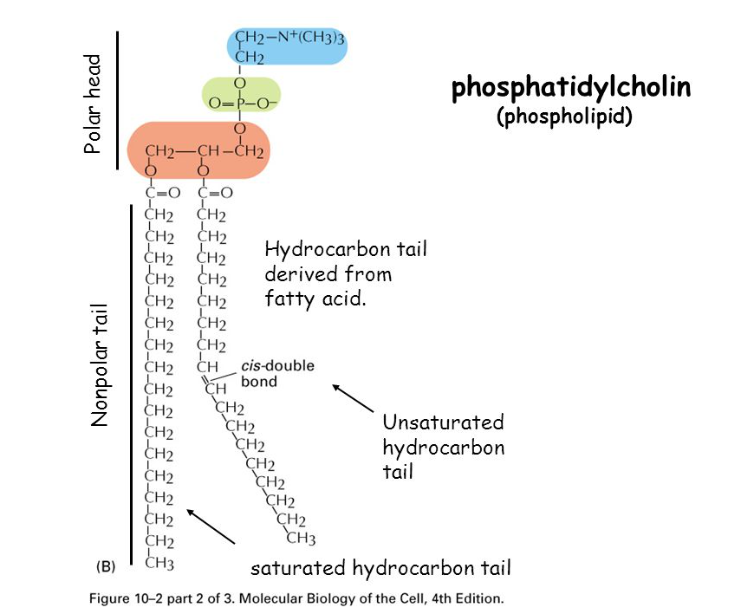
Phospholipid
Two fatty acids attached to a glycerol molecule, a phosphate and an additional polar molecule that togehter form the polar head
Nucleic acids
In DNA and RNA, used for storage of genetic information
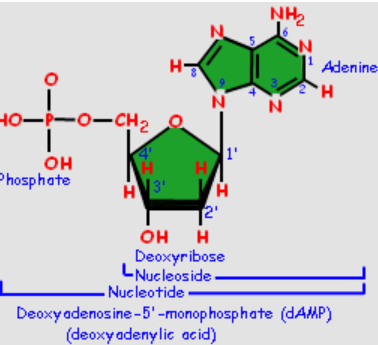
Nucleotide consist of
C5 sugar, cyclic base containing nitrogen and one or more phosphate groups. Nucleotide without phosphate group is nuleoside
Sugar component
Ribose for RNA (ribose nucleic acid), Deoxyribose for DNA (deoxyribose nucleic acid)
Base component
Cytosine - guanine
thymine (DNA) / uracil (RNA) - adeinine
C, T and U are build of pyrimine = ring with 4 carbon & 2 nitrogen
A & G have 6-ring pyrimidine bound to an extra 5-ring purine
Phosphate component
Nucleoside is bound to 1, 2 or 3 phosphate groups (adenosine diphosphate = ADP)
Side of coupling a nucleotide in DNA
3’-hydroxyl group of sugar of a nucleotide with the 5’-phosphate group of the next nucleotide
Five prime end vs three prime end
One side of a single strand DNA molecule contains a free phosphate group attached to carbon-5
free hydroxyl group attached to carbon-3
Peptide bonds between amino acids are made by
Ribosomes, in which translation of mRNA into proteins accurs
Sugars form branched structures because
they have many hydroxyl groups which can bind other saccharides
Storage of fatty acids
Often next to glycerol (hydrophillic head) in a cell
Peptide bonds are fromed during
protein synthesis by ribosomes
Determination of amino acid sequence
The triplets in mRNA determines the order of amino acids in a protein
Alpha helices
The backbone is inside the helice, the side chains are directed to the exterior of the helix. Hydrogen bonds between C=O groups and N-H group of amino acids that is 4 amino acids further up along the chain. Hydrogen bonds stabilise the helix
Beta sheets
Side chains are above and below the plane, alternatively. Hydrogen bonds between C=O and N-H groups
Beta turns
Two beta-sheets that are connected, for a compact structure. Hydrogen bond between C=O and N-H of an amino acids 3 residues further up along the polypeptide chain
Bonds in tertiary structure
Hydrogen bonds and hydrophobic effect stabilize the tertiary structure. For more stability, disulfide bonds between two sulfur atoms can help. They share an electron. Extracellular proteins have multiple disulfide bonds often.
Exonuclease activity of RNases
It can degrade RNA by removing nucleotides
Visualizing structure of three-dimensional proteins
X-ray crystallography, where individual atoms are determined via x-ray scattering. Visible that distance between covalent bonds are 0.1-0.22nm.
Difference between chemical catalyst and biocatalysts (enzymes)
Enzymes can couple energy requiring reactions with energy providing reactions, as long as the energy providing is more than the energy requiring
Active site of enzyme
Also called catalytic centre, is the binding site at the surface or in a groove
Induced fit
The enzyme changes his catalytic centre, to enable the reaction the enzyme catalyses
Factors influencing enzymatic activity
pH, at different pH the side chains can be charged and starting repelling each other
Temperature, enzymes have an optimum temperature range for their biocatalytic function
Protein folding happens when
Spontaneous, no ATP required