Lecture 3 reflection of light
 Call Kai
 Learn
 Practice Test
 Spaced Repetition
 Match
 Flashcards
 Knowt Play
1/20

There's no tags or description
Looks like no tags are added yet.
21 Terms
Q: What is reflection of light?
A: Reflection occurs when light travelling in one medium encounters a boundary and part of it returns into the original medium.
Q: Compare regular and diffuse reflection.
Regular (Specular)
Smooth surface
Parallel rays reflected in one direction
Diffuse
Rough surface
Rays scattered in many directions
Diffuse reflection allows us to see everyday objects.
Q: Define angle of incidence and angle of reflection.
Angle of incidence (i) = angle between incident ray and normal
Angle of reflection (i') = angle between reflected ray and normal
Q: State the two laws of reflection.
Incident ray, reflected ray and normal lie in the same plane.
Angle of incidence = angle of reflection.
i=i′
Q: How is an image formed by a plane mirror?
Reflected rays appear to diverge from a point behind the mirror, creating a virtual image.
Q: What are the characteristics of an image formed by a plane mirror?
Virtual
Upright
Same size as object
Laterally inverted
Same distance behind mirror as object is in front
Q: Why is a plane mirror used in an eye examination room?
A mirror creates a virtual image of the chart so a 6 m testing distance can be achieved in a shorter room. The chart letters must be printed in reverse.
Q: What are the two types of spherical mirror?
Concave mirror
Convex mirror
Q: Define the key parts of a spherical mirror.
A = Pole (vertex)
C = Centre of curvature
AC = Radius of curvature (r)
F = Principal focus
AF = Focal length (f)
AC = Principal axis
Q: What is the principal focus?
The point where reflected rays intersect, or appear to intersect, after reflection from a mirror.
Q: Compare the principal focus of concave and convex mirrors.
Concave mirror
Real focus
Rays actually meet
Convex mirror
Virtual focus
Rays only appear to meet
Q: What is the relationship between radius of curvature and focal length?
r=2f
Q: What are the four principal rays used for a concave mirror?
Parallel to axis → reflected through F
Through F → reflected parallel to axis
Through C → reflected back on itself
Through vertex → reflected with i = i'
Q: What are the principal rays for a convex mirror?
Parallel ray → appears to come from F
Towards C → reflected back on itself
Vertex ray follows law of reflection
Q: How does image formation change with object position in a concave mirror?
Beyond C
Real
Inverted
Between C and F
At C
Real
Inverted
At C
Between C and F
Real
Inverted
Beyond C
Between F and Mirror
Virtual
Upright
Behind mirror
Q: What image is always produced by a convex mirror?
Virtual
Upright
Smaller (diminished)
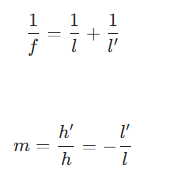
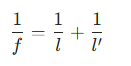
Q: What is the mirror formula?
f = focal length
l = object distance
l′ = image distance
Q: What is the magnification formula?
h = object height
h′ = image height

Q: What sign convention is used for mirrors?
Along axis
Same direction as light = positive
Opposite direction = negative
Heights
Above axis = positive
Below axis = negative
Mirror values
Concave mirror → f and r are negative
Convex mirror → f and r are positive
Q: Explain reflection and image formation by mirrors.
Reflection occurs when light returns to its original medium after striking a boundary.
Reflection may be specular (regular) or diffuse.
Laws of reflection:
Incident ray, reflected ray and normal lie in one plane.
Angle of incidence equals angle of reflection.
Plane mirrors form images that are:
Virtual
Upright
Same size
Laterally inverted
Same distance behind mirror as object is in front.
Spherical mirrors may be concave or convex.
Key terms:
Pole (A)
Centre of curvature (C)
Radius (r)
Principal focus (F)
Focal length (f)
Relationship:
Concave mirrors can form real or virtual images depending on object position.
Convex mirrors always form virtual, upright and diminished images.
Mirror formula: magnification
Sign convention:
With light = +
Against light = -
Above axis = +
Below axis = -
Concave: negative f and r
Convex: positive f and r