L32- Pathology of Thyroid and Parathyroid Disease
 Call Kai
 Learn
 Practice Test
 Spaced Repetition
 Match
 Flashcards
 Knowt Play
1/160

There's no tags or description
Looks like no tags are added yet.
161 Terms
What are the causes of thyrotoxicosis?
• Graves’ disease
• Toxic (hyperfunctional) multinodular goitre
• Toxic adenoma
• Thyroiditis
• Thyroid carcinoma
• TSH-oma
• Choriocarcinoma / Hydatidiform mole
• Struma ovarii
• Iatrogenic causes (e.g., Amiodarone, L-thyroxine)
What % of throtoxicosis is due to Graves disease?
85%
What are the thyroid function test patterns in primary vs secondary thyrotoxicosis?
• Primary thyrotoxicosis: ↓ TSH, ↑ T4 and T3
• Secondary thyrotoxicosis: ↑ TSH, ↑ T4 and T3
What are the 10 clinical features of thyrotoxicosis?
• Anxiety and irritability
• Fatigue
• Weight loss with good appetite
• Palpitations
• Heat intolerance
• Tremor
• Sweating
• Diarrhoea
• Proximal myopathy
• +/- Eye signs / Dermopathy
What are the 6 complications of thyrotoxicosis?
• Atrial fibrillation
• Dilated cardiomyopathy
• Osteoporosis
• Amenorrhoea
• Optic nerve compression
• Thyroid storm
What are the 3 characteristic manifestations of Graves’ disease?
Diffuse hyperplasia
Infiltrative ophthalmopathy
Dermopathy (15%)
What is the typical age and sex distribution of Graves’ disease?
Female:Male ratio = 10:1
Peak incidence between 20 and 40 years of age
What are the characteristic thyroid examination and radioisotope findings in Graves’ disease?
Modest, symmetric enlargement of thyroid
Increased radioactive iodine uptake
What 2 gene associations and autoimmune associations are found in Graves’ disease?
• Associated with HLA-B8 and HLA-DR3
• Associated with other autoimmune disorders
What 2 T-cell abnormalities are involved in the pathogenesis of Graves’ disease?
Thyroid-specific defect in suppressor T-cell function
Proliferation of CD4+ helper T cells targeting TSH-receptor epitopes
What 3 autoantibodies are involved in the pathogenesis of Graves’ disease?
TSH receptor IgG autoantibodies
Thyroid-stimulating antibodies
Thyrotropin-binding inhibitor immunoglobulin
Summarise the 5 immunological mechanisms involved in the pathogenesis of Graves’ disease
• Thyroid-specific defect in suppressor T-cell function
• TSH receptor IgG autoantibodies
• Proliferation of CD4+ helper T cells targeting TSH-receptor epitopes
• Thyroid-stimulating antibodies
• Thyrotropin-binding inhibitor immunoglobulin
What are the 3 characteristic follicular epithelial changes in Graves’ disease?
Tall columnar follicular epithelial cells
Increased number of epithelial cells (hyperplasia)
Pseudopapillary buds encroaching on colloid

What changes occur in the colloid in Graves’ disease?
Diminished colloid
What 2 stromal and vascular changes are seen in Graves’ disease?
Increased lymphoid tissue in the interfollicular stroma
Increased vascularisation of the thyroid
Summarise the 6 characteristic histological features of Graves’ disease?
• Tall columnar follicular epithelial cells
• Increased number of epithelial cells (hyperplasia)
• Pseudopapillary buds encroaching on colloid
• Diminished colloid
• Increased lymphoid tissue in the interfollicular stroma
• Increased vascularisation of the thyroid
What histological finding is associated with pretibial myxoedema in Graves’ disease?
Lymphocyte infiltration.
A thyroid histology specimen shows hyperplasia of follicular epithelial cells and pseudopapillary buds projecting into colloid. What disease does this indicate?
Graves’ disease.
What characteristic appearance does Graves’ disease produce on an isotope thyroid scan using radiolabelled 99mTechnetium?
Diffusely increased uptake of radiolabelled 99mTechnetium throughout the thyroid.
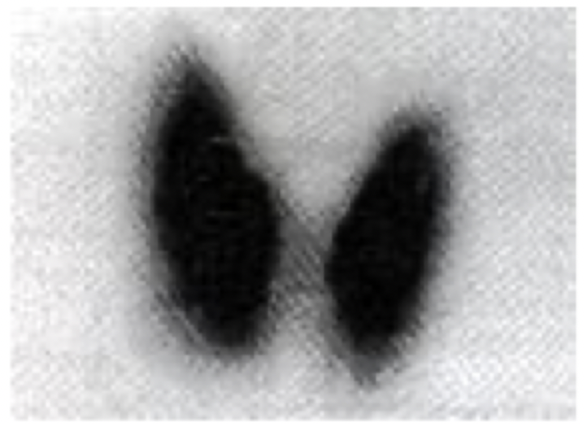
Which 4 thyroid disorders show increased uptake on a thyroid radioisotope scan?
Graves’ disease
Toxic multinodular goitre
Solitary toxic adenoma
Hot nodule
What are the characteristic patterns of increased uptake on a thyroid radioisotope scan?
Graves’ disease:
Toxic multinodular goitre:
Solitary toxic adenoma:
Graves’ disease: diffuse uptake
Toxic multinodular goitre: multiple discrete areas
Solitary toxic adenoma: single area
Which thyroid conditions show decreased uptake on a thyroid radioisotope scan?
Thyroiditis (subacute or postpartum)
Cold nodule
What is the risk of malignancy in hot versus cold thyroid nodules?
Hot nodule: malignancy is rare
Cold nodule: 20% risk of carcinoma
What are the 9 causes of hypothyroidism?
• Congenital (cretinism)
• Iodine deficiency (endemic goitre)
• Radioiodine ablation
• Thyroidectomy
• Hashimoto’s thyroiditis
• Subacute thyroiditis
• Drugs (e.g., lithium)
• Pituitary lesions
• Hypothalamic lesions
What are the thyroid function test patterns in primary vs secondary hypothyroidism?
• Primary hypothyroidism: ↑ TSH, ↓ T4 and T3
• Secondary hypothyroidism: ↓ TSH, ↓ T4 and T3

What physical change is illustrated by clinical photographs of hypothyroidism before and after treatment?
• Before treatment: facial puffiness and swelling, including around the eyes
• After treatment: reduction in facial puffiness and swelling

What are the 10 clinical features of hypothyroidism?
• Fatigue
• Depression
• Mental slowing
• Weight gain
• Cold intolerance
• Constipation
• Periorbital oedema
• Macroglossia
• Bradycardia
• Menorrhagia
What are the 8 complications of hypothyroidism?
• Congestive cardiac failure
• Pericardial effusion
• Dyslipidaemia
• Psychosis (‘myxoedema madness’)
• Carpal tunnel syndrome
• Infertility
• Hypothermia
• Myxoedema coma
What type of thyroiditis is Hashimoto’s thyroiditis?
Autoimmune thyroiditis
What are the two possible forms of Hashimoto’s thyroiditis?
Goitrous
Atrophic
What is the typical clinical course of Hashimoto’s thyroiditis?
Hashitoxicosis may occur initially
Most patients develop hypothyroidism
What 3 histological features identify Hashimoto’s thyroiditis?
• Chronic inflammatory cell infiltrate
• Infiltration by lymphocytes and plasma cells
• Lymphoid follicle formation


A thyroid histology specimen shows a chronic inflammatory cell infiltrate with a prominent lymphoid follicle. What is the likely diagnosis?
Hashimoto’s thyroiditis.
What 2 T-cell abnormalities are involved in the pathogenesis of Hashimoto’s thyroiditis?
Defective thyroid-specific suppressor T cells
Emergence of CD4+ helper T cells targeting thyroid antigens
What 3 autoantibodies are associated with Hashimoto’s thyroiditis?
Anti-thyroid peroxidase antibodies
Anti-thyroglobulin antibodies
Anti-TSH receptor antibodies
Summarise the 3 immunological mechanisms underlying Hashimoto’s thyroiditis
• Defective thyroid-specific suppressor T cells
• Emergence of CD4+ helper T cells targeting thyroid antigens
• Antibodies to thyroid peroxidase, thyroglobulin and TSH receptors
What is the sex distribution of Hashimoto’s thyroiditis?
Female predominance of up to 20:1
What associations are seen in Hashimoto’s thyroiditis?
Associated with other autoimmune conditions
What long term risk is Hashimoto’s thyroiditis associated with?
Small increased risk of B-cell Non-Hodgkin’s lymphoma
What is the typical age and sex distribution of granulomatous (De Quervain’s) thyroiditis?
4th–5th decades of life
Female:Male ratio = 4:1
What are the 2 aetiological associations of granulomatous (De Quervain’s) thyroiditis?
Associated with HLA-B35
Possible viral aetiology
What are the 3 clinical features of granulomatous (De Quervain’s) thyroiditis?
Fever
Tender neck
Malaise
What are the 3 characteristic investigation findings in granulomatous (De Quervain’s) thyroiditis?
Increased ESR
Increased T4 and T3
Decreased radioactive iodine uptake
What is the typical clinical course of granulomatous (De Quervain’s) thyroiditis?
Self-limiting course
What characteristic histological feature identifies granulomatous (De Quervain’s) thyroiditis?
Multinucleated giant cells.
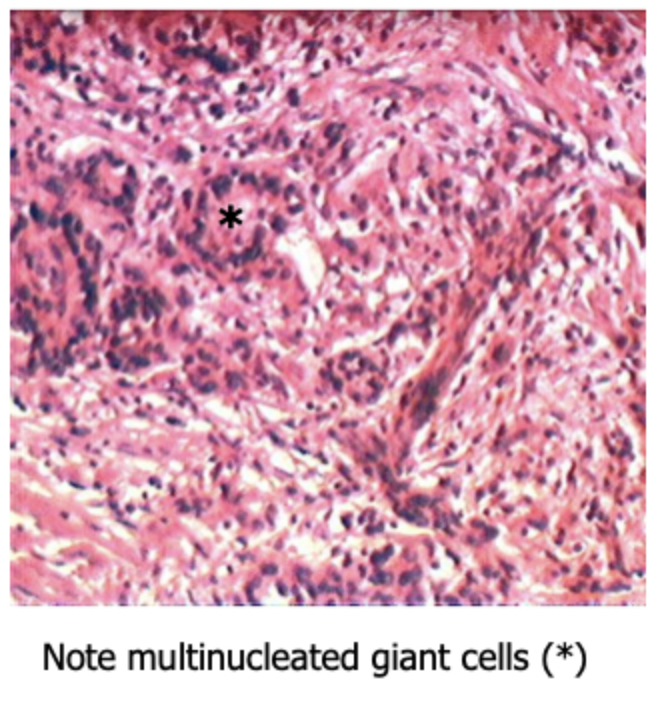
A patient in the 4th–5th decade presents with fever, a tender neck, malaise, raised ESR, increased T4 and T3, and reduced radioactive iodine uptake. What is the likely diagnosis?
Granulomatous (De Quervain’s) thyroiditis.
What is the typical thyroid functional status in diffuse non-toxic (simple colloid) goitre?
Usually euthyroid
In 2 which populations is endemic diffuse non-toxic (simple colloid) goitre seen?
Andeans
Tibetans
How common is sporadic diffuse non-toxic (simple colloid) goitre?
Nonendemic or sporadic cases are less common
What 2 factors contribute to the development of diffuse non-toxic (simple colloid) goitre?
Goitrogens (e.g., cabbage and cassava)
Rare hereditary defects in thyroid hormone synthesis
What are the 2 pathological mechanisms involved in diffuse non-toxic (simple colloid) goitre?
Compensatory increase in TSH
Follicular cell hypertrophy and hyperplasia
What are the characteristic histological features of diffuse non-toxic (simple colloid) goitre?
• Distension of thyroid follicles with colloid
• Flattening of follicular epithelial cells

A thyroid histology specimen shows markedly distended colloid-filled follicles with flattened epithelial cells. What is the likely diagnosis?
Diffuse non-toxic (simple colloid) goitre.
How does multinodular goitre develop?
Most simple goitres become transformed into multinodular goitres.
What are the 2 possible functional states of multinodular goitre?
Nontoxic
Toxic (induces thyrotoxicosis)
What 2 clinical manifestations can occur with multinodular goitre?
Cosmetic disfigurement
Retrosternal extension (‘plunging goitre’)
What 2 complications can occur with multinodular goitre?
Tracheal compression
Superior vena cava syndrome
What 2 clinical features distinguish multinodular goitre from Graves’ disease?
No ophthalmopathy
No dermopathy
What diagnostic difficulty can arise in multinodular goitre?
Differentiating a dominant nodule from a thyroid tumour may be difficult.
What is the characteristic gross appearance of multinodular goitre?
Visible nodular enlargement of the neck

What are the 2 characteristic histological features of multinodular goitre?
Fibrosis within thyroid tissue
Variation in follicular size

A thyroid specimen shows follicles of markedly varying sizes separated by areas of fibrosis. What is the likely diagnosis?
Multinodular goitre.
What 8 conditions can present as thyroid nodules?
• Adenoma
• Carcinoma
• Thyroid cyst
• Parathyroid cyst
• Thyroiditis
• Metastases
• Lymphoma
• Sarcoma
What proportion of thyroid nodules are malignant?
Less than 1%.
Which 2 thyroid nodules are indicated for fine-needle aspiration cytology?
• All palpable solitary thyroid nodules
• Dominant nodules in a multinodular goitre

What is the major diagnostic limitation of fine-needle aspiration cytology in follicular thyroid lesions?
It cannot differentiate follicular adenoma from follicular carcinoma.
What proportion of thyroid tumours are adenomas?
90%
What is the annual incidence of thyroid cancer?
Approximately 30 per million per year
How does the number of thyroid nodules affect suspicion of malignancy?
A solitary nodule is more likely malignant than multiple nodules.
How does patient age affect the likelihood of thyroid neoplasia?
Younger patients have a greater chance of neoplasia.
How does patient sex affect suspicion of thyroid malignancy?
A thyroid nodule in a male patient is more suspicious than in a female patient.
What does thyroid nodule function indicate about the likelihood of malignancy?
Functioning (‘hot’) nodules are more likely to be benign.
What is the most common type of thyroid adenoma?
Follicular adenoma
What is the risk of malignant transformation in thyroid adenomas?
Negligible
What are the 4 gross pathological features of thyroid adenomas?
Encapsulated
Homogeneous, fleshy cut surface
Foci of haemorrhage
Cystic degeneration

What is the relationship between thyroid adenomas and hyperthyroidism?
Thyroid adenomas rarely cause hyperthyroidism.
What is the typical appearance of thyroid adenomas on isotope scans?
Most are ‘cold’ on isotope scans.
A thyroid gross specimen shows a well-encapsulated nodule with a homogeneous fleshy cut surface, areas of haemorrhage and cystic degeneration. What is the likely diagnosis?
Thyroid adenoma, most commonly follicular adenoma.
What are the 6 main types of malignant thyroid tumours?
• Papillary carcinoma
• Follicular carcinoma
• Medullary carcinoma
• Anaplastic carcinoma
• Lymphoma
• Tumours metastatic to the thyroid
What is the most common malignant thyroid tumour, and what percentage does it represent?
Papillary carcinoma, accounting for 85%.
Is lymphoma a rare or common cause of malignant thyroid tumours?
Rare
What is the typical age and sex distribution of papillary thyroid carcinoma?
Most commonly occurs in the 3rd–5th decades of life
Female:Male ratio = 3:1
What are the characteristic growth patterns of papillary thyroid carcinoma?
Often multifocal
Infiltrates surrounding thyroid parenchyma
What is the characteristic route of spread of papillary thyroid carcinoma?
Lymphogenous spread.
What 2 molecular abnormalities are associated with papillary thyroid carcinoma?
• Activation of the RET/PTC oncogene
• Gain-of-function BRAF mutations
What is the prognosis of papillary thyroid carcinoma?
95% 10-year survival.
What are the 4 characteristic gross pathological features of papillary thyroid carcinoma?
• Grey-white, firm cut face
• Foci of calcification
• Cystic areas
• Infiltration of surrounding thyroid parenchyma
What are the characteristic histological features of papillary thyroid carcinoma?
• Branching papillae
• Concentric Psammoma bodies within papillary cores
• ‘Orphan Annie eyes’ nuclei (no nucleoli)
• Nuclear grooves

A thyroid tumour shows branching papillae, concentric Psammoma bodies, ‘Orphan Annie eyes’ nuclei and nuclear grooves. What is the diagnosis?
Papillary thyroid carcinoma.
How common is follicular thyroid carcinoma?
Accounts for 5–15% of thyroid cancers
At what age does follicular thyroid carcinoma typically occur?
Typically occurs in the 4th–6th decades of life
What is an important risk factor for follicular thyroid carcinoma?
Iodine deficiency
What is the typical encapsulation status of follicular thyroid carcinoma?
Usually encapsulated
What diagnostic difficulty can arise with follicular thyroid carcinoma?
May be misinterpreted as follicular adenoma
What is the characteristic route of invasion and what are the 3 metastatic sites of follicular thyroid carcinoma?
• Vascular invasion
• Metastases to bone, lungs and liver
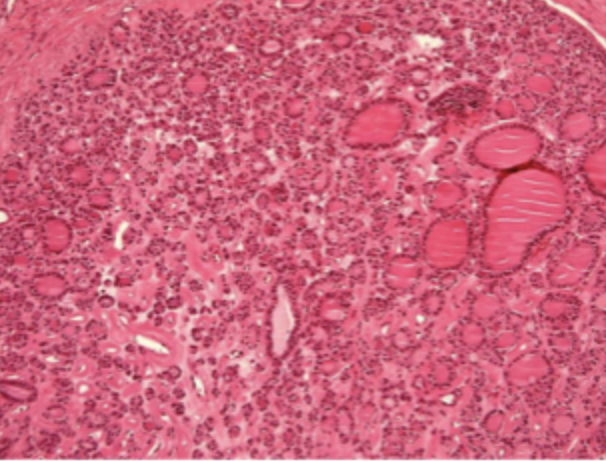
A thyroid tumour is encapsulated, resembles follicular adenoma and shows vascular invasion. What is the likely diagnosis?
Follicular thyroid carcinoma.
How do papillary and follicular thyroid carcinomas differ in their characteristic spread?
• Papillary carcinoma: lymphogenous spread
• Follicular carcinoma: vascular invasion with metastases to bone, lungs and liver
How common is anaplastic thyroid carcinoma?
Accounts for less than 5% of thyroid cancers
Which age group does anaplastic thyroid carcinoma typically affect?
Occurs in elderly patients
What is the typical clinical presentation of anaplastic thyroid carcinoma?
Rapidly enlarging thyroid mass