Educational Neuroscience: Methods, Language, Reading, Mathematics, and Scientific Reasoning
 Call Kai
 Learn
Learn Practice Test
 Spaced Repetition
 Match
Match Flashcards
 Knowt Play
1/30

Earn XP
Description and Tags
Vocabulary flashcards covering neuroanatomy, educational and neuroscience research methods, language acquisition, the reading circuit, dyslexia, numerical cognition (ANS/OTS), and scientific reasoning.
Name | Mastery | Learn | Test | Matching | Spaced | Call with Kai | Chat |
|---|
No analytics yet
Send a link to your students to track their progress
31 Terms
Medial / Lateral
Directional neuroanatomy terms indicating toward the brain's midline (medial) versus toward the outer sides (lateral).

Anterior / Posterior
Directional neuroanatomy terms indicating toward the front of the brain (anterior) versus toward the back (posterior).

Rostral / Caudal
Anatomical terms denoting toward the head, beak, or nose (rostral) versus toward the tail or posterior end (caudal).

Ventral / Dorsal
Directional terms denoting toward the bottom or belly side (ventral) versus toward the top or back side (dorsal).

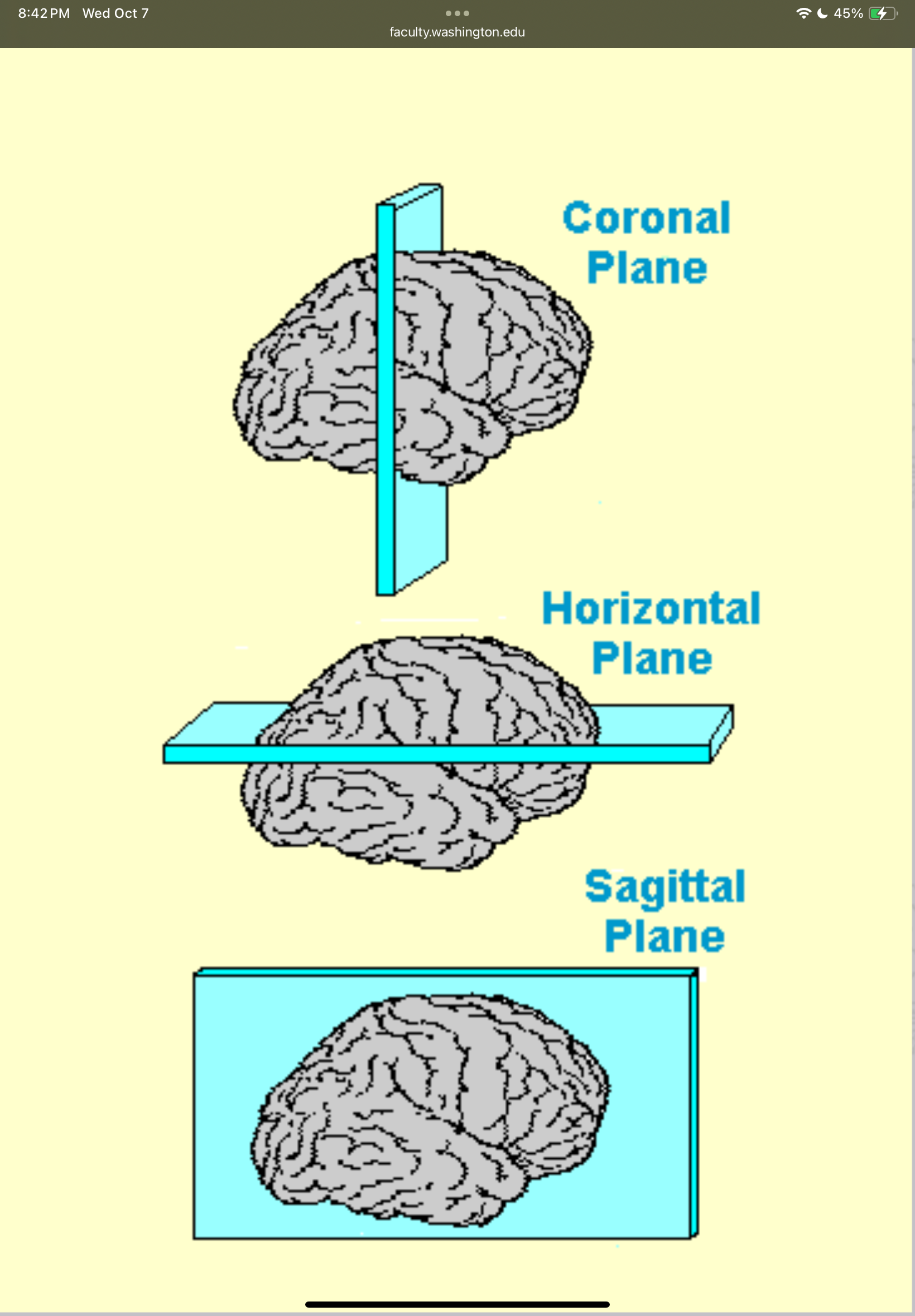
Horizontal / Axial Plane
A brain slicing plane oriented parallel to the ground that separates superior structures from inferior structures.

Sagittal / Lateral Plane
A brain slicing plane running vertically from front to back that divides the brain into left and right sections.

Coronal Plane
A vertical brain slicing plane running from ear to ear that divides the brain into anterior (front) and posterior (back) sections.
Classroom Observation
A behavioral education research method that monitors learning in real-world environments through event-sampling or time-sampling.
Quasi-experimental Design
A study design where an existing condition or variation naturally occurs in the world and researchers measure its outcomes without random assignment.
Randomized Control Trial (RCT)
An experimental intervention design considered the gold standard for inferring causation by randomly allocating participants to control and treatment groups.
Double Dissociation
A neuropsychological research technique establishing that two functions rely on distinct brain systems by showing lesion A impairs function X but spares Y, while lesion B impairs Y but spares X.
Neuromyths
Commonly accepted misconceptions and incorrect beliefs regarding the brain and learning that originate from misunderstandings or misinterpretations of scientific findings.
Sensitive Period for Language
A developmental timeframe during which acquiring language occurs most naturally and readily; unlike a strict critical period, acquisition remains possible outside this window.
Paradox of Literacy
The evolutionary puzzle of how humans have specialized neural machinery dedicated to reading despite writing systems developing too recently for dedicated genetic evolution.
Neuronal Recycling
The repurposing of phylogenetically older, evolutionarily pre-existing brain circuits to acquire modern cultural inventions such as reading and mathematics.
Visual Word Form Area (VWFA)
A functional region located in the fusiform gyrus that becomes specialized through expertise and instruction to recognize visual text, letter shapes, and printed words.
Temporoparietal Junction (TPJ)
A component of the reading circuit engaged in phonological processing and the mapping of printed symbols to corresponding sounds.
Inferior Frontal Gyrus (IFG)
An anterior hub of the reading circuit involved in speech production, phonological recoding, and semantic language processing.
Planum Temporale Asymmetry
A typical left-greater-than-right structural asymmetry in auditory-language cortex that is reduced or absent in the brains of individuals with dyslexia.
Ectopic Projections
Abnormal cortical neural migrations and disordered structural projections identified as neurobiological differences in dyslexia.
Approximate Number System (ANS)
An innate, non-verbal system supporting approximate quantity estimations; discriminates a 2:1 ratio at 6 months, a 3:2 ratio at 9 months, and up to a 9:10 ratio in adulthood.
Object Tracking System (OTS)
A non-verbal cognitive mechanism dedicated to tracking exact, discrete representations of small individual item sets, distinct from the ratio-dependent estimations of the ANS.
Numerical Distance Effect
The cognitive phenomenon wherein comparing numbers that are numerically farther apart is faster and more accurate than comparing numbers closer in magnitude.
Frontal to Parietal Shift
A developmental trajectory in mathematics wherein activation shifts from frontal working memory and executive systems toward dedicated parietal processing as math skills become automatic.
Angular Gyrus (AG)
A parietal region responsible for arithmetic fact retrieval, such as recalling memorized multiplication tables.
Intraparietal Sulcus (IPS)
A parietal structure specialized for online numerical problem solving and the direct representation and manipulation of quantities.
Dyscalculia
A specific learning disability in mathematics characterized by theoretical debates distinguishing a core deficit in quantity representation from an impairment in linking quantities to symbols.
Math Anxiety
A state of distress and tension surrounding mathematics caused by an interplay of genes, brain mechanisms, and environmental influences.
Causal Reasoning
A mode of scientific thinking directed at determining cause-and-effect relationships and mechanisms between variables.
Deductive Reasoning
A form of logical scientific reasoning that derives specific, logically necessary conclusions from general premises or defined rules.
Analogical Reasoning
A scientific reasoning strategy that projects structural relationships from a known domain onto an unfamiliar domain to generate new hypotheses and explain complex concepts.