M11 Fermentation
 Call Kai
 Learn
 Practice Test
 Spaced Repetition
 Match
 Flashcards
 Knowt Play
1/99

There's no tags or description
Looks like no tags are added yet.
100 Terms
What are the two major types of organisms that do fermentation?
Heterotrophic Aerobes
Fermentative Anaerobes
What type of fermentative organisms have a higher standard free energy potential per e- transferred (have high net ATP)
Heterotrophic Aerobes
What types of organisms only yield ATP by SLP in fermentation pathways?
Fermentative anaerobes
Do heterotrophic aerobes or fermentative anaerobes have a high cell count?
Heterotrophic aerobes have a high cell count while fermentative anaerobes have a low cell count.
What type of end products do heterotrophic aerobes have?
Oxidized end products
CO2
(NAD is re-oxidized by respiratory chain)
What type of end products do fermentative anaerobes have?
Reduced end products
H2, lactate
(NAD is re-oxidized by end products)
How do fermentative anaerobes maintain redox balance
They reduce the amount of NADH produced (only produce what’s necessary)
Use intermediates to channel e- into reduced end products
How do heterotrophic aerobes maintain redox balance
They funnel reduced cofactors (NAD(P)H and FADH2) into respiratory chain.
How do heterotrophic aerobes and fermentative anaerobes generate electrochemical gradient
Heterotrophic aerobes use respiratory chain to generate electrochemical gradient
Fermentative anaerobes use ATP synthase in reverse to generate electrochemical gradient
What method is used by heterotrophic aerobes and fermentative anaerobes to generate atp
Heterotrophic aerobes use OxPhos
Fermentative aerobes use SLP
What are the two major types of fermentative pathways
Linear fermentation
Branched fermentation

What’s the difference between linear and branched fermentation?
Linear fermentation produced a constant ATP and Product Yield
Branched fermentation produces variable ATP and Product Yield
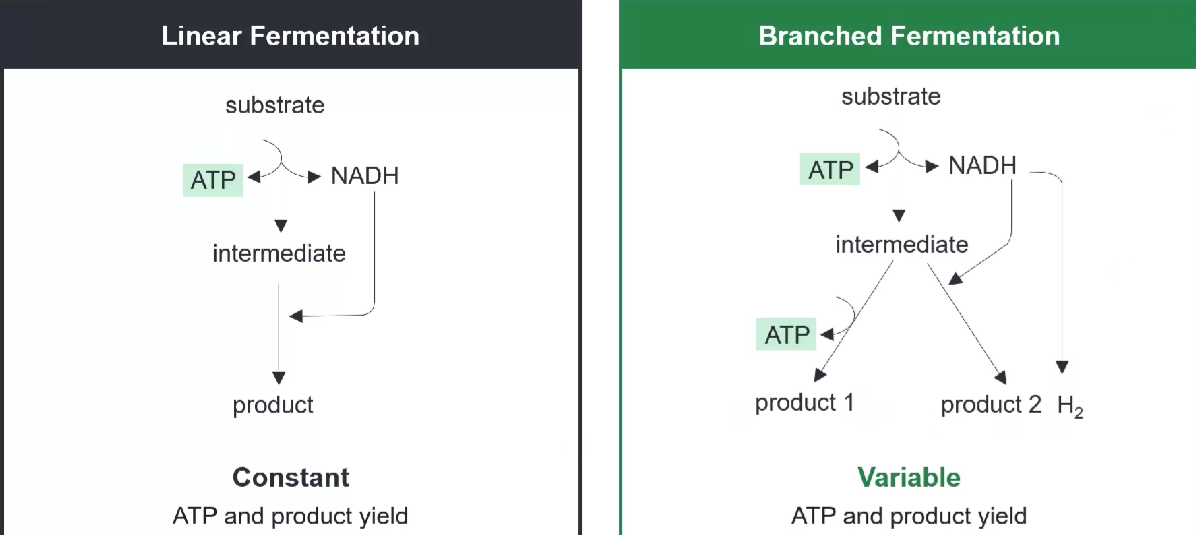
The concentration of this molecule in the environment often dictates whether product 1 or 2 is made in branched fermentation
Hydrogen Gas
What does high [H2] initiate in branched chain fermentation
High [H2] makes the organism preferer the less energy efficient product (less ATP) and prefer the product that maintains RedOx balance better. H2 is normally generated with the more enegy producing product as an e- sink for RedOx balance, but this can’t occur with high [H2].
CoA derrivatives are often used to make this molecule
ATP by SLP
What functional group is transfered from substrate to product to conserve energy
Carboxyl groups or CoA
This molecule is often used (by anaerobes*) as a high E molecule
PPi, phyrophosphate
Why might a TCA cycle become linear?
To reduce the production of reduced cofactors
What are the two branches of the linear TCA?
Reductive and oxidative branch

What does the oxidative branch of the linear TCA produce?
end products for nitrogen metabolism; alpha-kg and amino acids (Gln, Glu)
What is the major enzyme/step missing from linear TCA?
Alpha-KG dehydrogenase
What ez new to the linear TCA drives the pathway and reduces Fumarate to Succinate
Fumarate reductase
What enzymes in the linear TCA reductive branch use reduced cofactors (re-oxidize reduced cofactors)
Malate dehydrogenase and fumarate reductase
In what organisms is the Pohosphoroclastic reaction common
Anaerobes
Pohosphoroclastic reaction overall
PYR + CoA + 2Fd-ox → Acetyl-CoA + CO2 + 2Fd-red
What enzyme catylizes the Pohosphoroclastic reaction?
PFOR (Pyruvate, ferrodoxin oxidoreductase and Fd ferrodoxin)
What ez is the Pohosphoroclastic reaction linked to
HDR (Hydrogenase)
Why are Hydrogenases often associated with Pohosphoroclastic reactions?
Hydorgenases channel Fd-red’s e- onto H+ to create H2 and re-oxidize NAD+
What organisms are Strickland reactions found in?
Common in Anaerobes
Also in some obligate aerobes
What reaction is the coupled oxidation and reduction of two amino acids
Strickland reaction
What happens to the amino acid thats oxidized in a strickland reaction
The oxidized amino acid acts as an e- donor and becomes a carboxylic acid that’s one carbon shorter
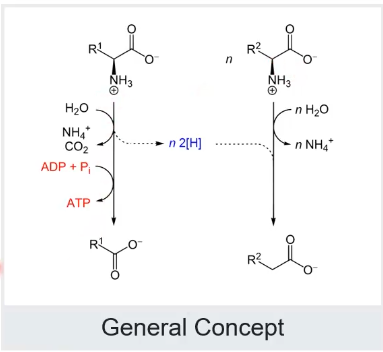
What happens to the amino acid thats reduced in a strickland reaction
The reudced amino acid acts as an e- acceptor and carboxylic acid thats the same carbon branch
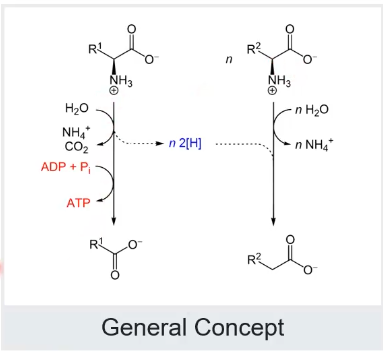
Which branch of the strickland reaction makes ATP and 2H
The oxidative branch
(the reductive branch may also generate ATP)
What pathway do ANAEROBES often use to glucose → PYR
EMP (glycolysis)
Why do anaerbobes prefer EMP over the ED pathwya
the EMP pathway produces 2NADH and 2ATP while ED produces 2NADH and only 1ATP
Interspecies ___ Transfer is often in volved in anaerobic systems
H2
Between what two types of organisms do syntropic relatioships form
Between different species or strains
What are the 2 roles for organisms involved in interspecies H2 transfer
Hydrogen produces (as metabolic biproduct)
Hydrogen consumers
Carbohydrates → (Group1: ____) → organic alchohols, H2, CO2 → (Group2: ___) → Acetate, H2, CO2 → (Group3: ___) → CH4, CO2
Group1 Fermenters
Group2 Acetogens (obligate H+ and sulfur reducers too)
Group3 Methanogens
When do HADH and FADH2 work best in H2 production
Under low H2 environments
microbes with endergonic metabolic pathways are thermodynamically reliant on either
1 Obligate Syntropy
2 External e- acceptors with branches alt pathways (Facultative syntropy)
What organisms do short chain fatty acid oxidizers obligately associate with?
Methanogens
What syntrophic relationship involves the conversion of butyrate to acetate (to formate) to CO2 and CH4
Syntrophomonas and Methanogens
In Syntrophomonas and Methanogens syntrophy, what serves as an E conserving molecule in Beta-ox
CoA-SH
This type of obligate syntropy produces biogas (CO2, H2, and O2) as products that are then used as interspecies e- transfer by the other organism
Ethanol-mediated anaerobic digestion (AD)
Overall reaction of Ethanol-mediated anaerobic digestion
2Et-OH + CO2 → 2Acetate + CH4
Why are methanogens good partners for syntropy?
They consume H2 Gas, lowering the [H2] in the environment, and enabling their syntrophic partners to pursue more E efficient pathways
What are the 4 mechanisms of e- transfer between cells?
1 Interspecies H2 or formate transfer
2 Biological structure mediating (DIET)
3 Conductive Carbon (DIET)
4 Conductive iron Materials (DIET)
What does DIET stand for?
Direct Interspecies e- transfer
What are conductive pili often lined with and why
They’re often lined with cyt C-type cytrocromes that help facilitate e- transfer
What type of e- tranfer mechanism can be made of both man made and natural sources
Conductive Carbon mediating e- transfer
What other mechanisms may combine with pili for e- transportation mechanisms
Conductive carbon and iron
What ez does Rumminococcus albus use when it switches to faculative syntropy with methanogens
Hydrogenase
Why can hydrogenases be used to switch over to faculative syntrophy
They can use cofactors generated ealerie in the pathwya to generate H2 for the methangen and carry out the pathway that generates more ATP
What pathway do HOMOethanol fermenters use to convert Glucose to PYR
EMP
What enzymes are used by homoethanol fermenters to produce ethanol
PDC - Pyruvate decarboxylase
ADH - Alcohol dehydrogenase
In what organisms is HOMOethanol fermentation and PDC (PYR decarboxylase) commonly found
Commonly found in fungi and rare in bacteria
What niche is Homoetanol fermentation with ED found in
In areas with high sugar concentrations
What microbe commonly performs the ED pathway in homoethanol fermentation
Zymomonas mobilis
What ez do HETEROetnanol fermenters use thats not present in HOMOethanol fermentation
PFOR (pyruvate ferrodoxin oxidoreductase) or PFL (pyruvate formate lyase)
and HYD
What product can HETEROetnanol fermenters produce that produces more ATP than ethanol?
Acetate (and H2)
PLF (PYR formate lyase)
Ez that forms acetyl-coA from PYR
With FHL (formate hydrogen lyase ) may produce 2H2 and 2CO2
(important )
What are the 3 types of formate metabolism conditions
1 Aerobic conditions
2 Anaerobic w/ e- acceptor
3 Anaerobic w/ no e- acceptor
under which conditions in formate metabolism would use FDH-Z
Aerobic conditions
under which conditions in formate metabolism would use FDH-N
Anaerobic conditions with e- acceptor
under which conditions in formate metabolism would use FDH-F
Anaerobic conditions with no e- acceptor
under which conditions in formate metabolism would O2 be the terminal e- acceptro
Aerobic conditions
under which conditions in formate metabolism would use Nitrate or formate as e- acceptros?
Anerobic conditions with e- acceptors
under which conditions in formate metabolism would use FHL and HYD to reduce protons for redox and oxidize formate
Anaerobic conditions without e- acceptors
(only pathway to generate H2 gas instead of H2O)
Formate metabolisms generates this as a form of energy in all environmental conditions
Electrochemical gradient
Why is E. coli used yo convert woody waste to ethanol in bioengineering
Its already flexible with sugar and can use both hexose and pentose sugars
Only needs to be directed a little bit
→ must be manipulated to become a homofermenter
What genetic modificaitons to E. coli make it a better fermenter (for human use)
Deleting genes that lead to non-ethanol producing pathways
Insert genes that channel PYR to ethanol production (though high affinity
What fermentation pathway/method is used to generate pure L-Lactic Acid
Homolactate fermentation
Polylactic acid is generated from what precursor
L-Lactic acid
Why can a high concentration of products be generate in homolactate fermentation
Because lactate is a strong acid, it can accumulate in higher concentrations outside the cell
What types of organisms mediate lactate fermentation
areo and acid tolerant
most OBLIGATE ANEROBES
auxotrophic (need vitamin/aa suplementation)
What lactate fermenters commonly use EMP
homofermentive lactate fermenters
What lactate fermenters commonly use phosphoketolase pathway
Heterofermentive lactate fermenters
What is the most commercially important genus for lactate ferementation
Lactobacillus
Whats the key enzyme of HETEROlactate fermetation
XPK (Xyulose-5P phosphoketolase)
What other end product do HETEROlactate fermetaters use to maintain RedOx balance
Ethanol
What sugars can be metabolized to generate more ATP in HETEROlactate fermetation
Pentose sugars
Why is pentose metabolismbenificial to HETEROlactate fermetation
Doesn’t generate reduced cofactors
So, it can generate 1 more ATP/sugar (2ATP/sugar in total)
What are the key characteristics of butyrate
Weak acid
Smelly
Benificial to human gut
How is butyrate bebificial to the human gut (4)
Inhibits growth of harmfull bacteria
Reduces inflamtion
Reduces bloating and constipation
Improves gut barrier
What ez mediates flavin-based e- biforcation in butyrate fermenation
Etf-BCD
What does Etf-Bcd do?
It conserves E in butyrate fermentation by coupling two reactions
1 using e- from NADH to make Butyl-CoA (favorable)
2 reduces Fd (not favorable)
What does the Fd-red produced by EFT-BCD in homobutyrate fermentation do?
Its used to generate an electrochemical gradient with Ech and Rnf
What enzymes are used to convert PYR to A-CoA in HOMObutyrate fermentation
NifJ and PFOR
When is Rnf prefered for Electrocemical gradients in HOMObutyrate fermrnatuib
Its prefered in conditions with alternative e- acceptors that are used as an alternative way to maintain redox balance
( → EFT-BCD still used, but all reduced cofactors will go to Rnf and none go to Ech)
What ez do mixed bytyrate-formate fermeters use instead of PFOR and NifJ
PfID (PYR formate lyase)
How much ATP do mixed bytyrate-formate fermeters produce in compatison to homobytyrate fermenters
They produce 3.5 atp while the homofermenters produce 4.5 ATP
When do mixed bytyrtate-acetate fermenters produce Bytyrate
When H2 concentrations are HIGH
and the cell needs to maintain redox balance
What types of microbes mediate Acetone-Butyrate-Ethanole (ABE) fermentation
Obligate ANAEROBES
What bioproducs to ABE fermenters produce
Bioacetone (solvent)
Biobutaniol (solvents and biofules)
When do ABE fermenters produce solvent butanols
they produce solvents when the pH is low and would disrupt the electrochemical gradient when acids are produced
Also drop H2 production
In Biobutanol production, what product is reduced to increase metabolic flux towards Biobutanol production
ATP
In Biobutanol production, what ez were introduced to inc flux/biobutanol production
Eft-Bcd
NADH requiring ez
Formate dehydrogenase that makes more NADH (uses formate to make NADH)
In what environments is 2,3-butandiol produced
In ANAEROBIC envirobments in the abasence of alternative e- acceptors W
what is the key ez in 2,3butandiol fermentation
alpha-allolacte synthase
(2PYR → acetolatcte → 2,3-butandiol)