APMA 0650 Terms Test One

0.0(0)
Studied by 0 people
call kaiCall Kai
learnLearn
examPractice Test
spaced repetitionSpaced Repetition
heart puzzleMatch
flashcardsFlashcards
GameKnowt Play
Card Sorting

1/24

encourage image

There's no tags or description

Looks like no tags are added yet.

25 Terms

1
New cards

Probability

How likely something is to happen

2
New cards

What is the range of probability?

Range of probability is from 0 to 1 (0 - 100%). When adding up probabilities, they must add up to one to be a valid probability model. It cannot be under or over one.

3
New cards

Outcome

One possible result

4
New cards

Event

A single outcome or specific group of outcomes from an experiment

5
New cards

Sample Space

A set of all possible outcomes

6
New cards

What symbol is used to denote a sample space

Curly Brackets - { }

7
New cards

Set

An unordered collection of distinct outcomes

8
New cards

Does it matter the order of outcomes in a set?

No! Ex: {2, 0 , 1} and { 1 , 2, } are the same set bc it contain the same numbers

9
New cards

Notation of probability of an event

P (A) where P = probability and A = event

10
New cards

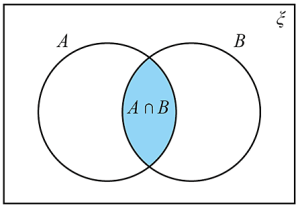
Intersection

  • "probability of A and B occurring” - P(A n B)

    • Both of the events need to happen


<ul><li><p><span style="background-color: transparent;">"probability of A <strong>and </strong>B occurring” - P(A n B)</span></p><ul><li><p><span style="background-color: transparent;"><strong>Both</strong> of the events <strong>need</strong> to happen</span></p></li></ul></li></ul><p></p>
11
New cards

Union

  • “probability of A or B occurring” - P(A u B)

    • At least one of the events will happen


<ul><li><p><span style="background-color: transparent;">“probability of A <strong>or </strong>B occurring” - P(A u B)</span></p><ul><li><p><span style="background-color: transparent;">At least <strong>one</strong> of the events will happen</span></p></li></ul></li></ul><p></p>
12
New cards

Complement

  • elements that are not in the given set

    • Notation - A^c OR A’

    • P(A^c) - “probability of everything not in A happening)


<ul><li><p><span style="background-color: transparent;">elements that are not in the given set</span></p><ul><li><p><span style="background-color: transparent;">Notation - A^c OR A’</span></p></li><li><p><span style="background-color: transparent;">P(A^c) - “probability of everything not in A happening)</span></p></li></ul></li></ul><p></p>
13
New cards

What is the probability of P(A u A^c)

Probability is one! It adds everything together in the sample space.

14
New cards


What is the probability of P(A n A^c)

Probability is equal to zero! A and A^c do not share anything together

15
New cards

(A u B)’ = …

(A u B)’ = A’ u B’

16
New cards

(A n B)’ ..

(A n B)’ = A’ n B’

17
New cards

Independence

Two events are independent if one event does not impact the other event 

<p><span style="background-color: transparent;">Two events are <strong>independent</strong> if one event <strong>does not</strong> impact the other event&nbsp;</span></p>
18
New cards

Conditional probability

  • “probability of A given that B” - P(A | B)

    • Prob of A given that we already know that event B happened


<ul><li><p><span style="background-color: transparent;">“probability of A given that B” - P(A | B)</span></p><ul><li><p><span style="background-color: transparent;">Prob of A given that we already know that event B happened</span></p></li></ul></li></ul><p></p>
19
New cards

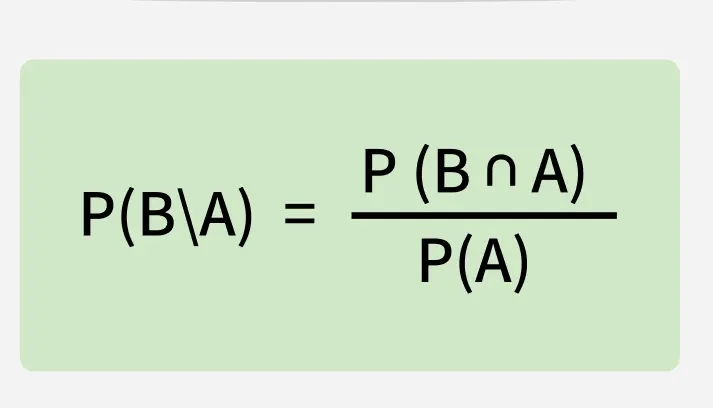
Bayes Theorem Equation

Equation for Conditional Probability

  • P(A | B) = P(A n B)/ P(B)

    • P(B | A ) = P (B n A)/ P(A)


<p>Equation for Conditional Probability </p><ul><li><p><span style="background-color: transparent;">P(A | B) = P(A n B)/ P(B)</span></p><ul><li><p><span style="background-color: transparent;">P(B | A ) = P (B n A)/ P(A)</span></p></li></ul></li></ul><p></p>
20
New cards

Subset

  •  Every outcome in set A is also in B

  • Notation = A ⊆ B -> “A is a subset of B”

  • Ex: A = {1,2,3}, B = {1,2,3,4,5} -> in this case, A is a subset!


<ul><li><p><span style="background-color: transparent;">&nbsp;Every outcome in set A is also in B</span></p></li><li><p><span style="background-color: transparent;"><strong>Notation</strong> = A ⊆ B -&gt; “A is a subset of B”</span></p></li><li><p><span style="background-color: transparent;">Ex: A = {1,2,3}, B = {1,2,3,4,5} -&gt; in this case, A is a subset!</span></p></li></ul><p></p>
21
New cards

If If A ⊆ B , then P(A) ??? P(B)?

  • If A ⊆ B , then P(A) ≤ P(B) for all events A and B in the sample space

    • A has less or equal elements than B


22
New cards

S^n

  • S^n is the set of all sequences of length n using the elements in S.

    • S2 for if you flip a coin twice = {HH, HT, TH, TT}


23
New cards

X c A

x is contained in A, meaning that x is one of the outcomes in set A 

24
New cards

Mutually Exclusive

Two or more outcomes that cannot happen at the same time

  • P(A or B) = P(A) + P(B)

  • Intersection is zero (A n B) = 0


<p><span style="background-color: transparent;">Two or more outcomes that cannot happen at the same time</span></p><ul><li><p><span style="background-color: transparent;">P(A or B) = P(A) + P(B)</span></p></li><li><p><span style="background-color: transparent;">Intersection is zero (A n B) = 0</span></p></li></ul><p></p>
25
New cards

Probability Distribution

Assignment of numerical probabilities to all the events in the sample space