Power Electronics Exam Review
 Call Kai
 Learn
 Practice Test
 Spaced Repetition
 Match
 Flashcards
 Knowt Play
1/103

There's no tags or description
Looks like no tags are added yet.
104 Terms
What direction does DC current flow?
DC current flows in one direction.
2. Why do DC motors need brushes and a commutator?
To help create the changing magnetic effect needed for rotation.
3. Why do AC motors generally not need brushes and a commutator?
AC naturally changes direction, allowing the magnetic field to change without a commutator.
What is the stator?
Non moving part of the motor
5. What are stator windings?
Coils of insulated copper wire that create a magnetic field.
6. What is the rotor?
The rotating part of a motor.
7. What are rotor windings?
Conductive material in the rotor that reacts to the magnetic field.
8. What is the function of the shaft?
Transfers the motor's rotation to the connected load.
11. What is the first step in how a single-phase AC motor works?
Electrical energy is supplied to the windings.
12. What happens when electrical energy reaches the windings?
A magnetic field is created.
13. What happens after the magnetic field is created?
The rotor moves.
15. What creates the magnetic field in an AC motor?
The Stator
16. What happens when the rotor reacts to the stator's magnetic field?
The rotor develops its own magnetic field and is attracted toward the stator's magnetic field.
17. What does the rotor do as the magnetic field changes?
The rotor follows
What happens when the AC supply changes polarity
the magnetic field changes, causing the rotor to be attracted toward the next opposite magnetic field.
Why can't a single-phase motor start by itself?
: It does not produce a rotating magnetic field that creates a preferred starting direction.
Why does a single-phase motor have no preferred starting direction?
Its magnetic field pulsates rather than naturally rotating in one direction.
What happens if a single-phase motor has no starting assistance?
It may sit still or just wobble instead of starting to rotate.
What happens when a single-phase motor has no starting torque?
The motor cannot start rotating on its own.
How do single-phase motors overcome their starting problem?
By using two windings to create two magnetic fields that are out of phase.
How far out of phase are the two magnetic fields?
90° apart.
Why are two magnetic fields needed in a single-phase motor?
o create a rotating magnetic effect that gives the rotor a starting direction.
What causes current to have different phase angles?
Resistance and inductance.
32. What is phase difference?
When two waveforms do not reach their peaks at the same time.
Why should a start winding not remain energized continuously?
It can overheat, potentially causing motor damage or fire.
What is the start winding designed to provide?
High starting torque to get the motor moving quickly.
Why does a motor need more torque when starting?
To overcome the initial resistance and get the rotor moving.
What is the main characteristic of a run winding?
It uses lower power than the starting circuit and is designed for continuous operation.
47. What is the purpose of the start winding in a split-phase motor?
Creates a phase difference to produce starting torque.
51. What does the capacitor allow in a capacitor-start motor?
A smaller start winding can be used.
What happens to the capacitor in a capacitor-start motor after starting?
disconnected from the circuit.
What happens to the capacitor in a capacitor-run motor?
stays connected during operation.
What are the advantages of capacitor-start/capacitor-run motors?
Higher starting torque. Higher efficiency
56. Why are capacitors useful in AC motors?
create phase shift
What is a major advantage of repulsion motors?
High starting torque
Can the brush position on a repulsion motor be adjusted?
Yes,
Can the speed and torque of a repulsion motor be adjusted?
Yes by adjusting brushes
What is a synchronous motor?
A motor where the rotor follows the rotating magnetic field exactly.
What is the formula for synchronous speed?
N = 120 x Frequency / Poles
Permanent magnet motors are almost always what type of motor?
Synchronous motors.
Which Motor has Low starting torque and efficiency?
Shaded Pole
All single-phase AC motors require a start winding.
False
83. In common usage, what makes a permanent magnet AC motor special?
It uses permanent magnets in its rotor.
What is the term used to describe the condition where a rotor's orientation flip-flops between windings, due to insufficient starting torque?
Wobbling / wobble.
85. Which of the following is the most common motor currently in use in industry for medium-to-heavy duty loads?
Capacitor Run motor
90. What is the most true advantage of three-phase motors over single-phase motors?
Three-phase motors run more efficiently than single-phase motors.
91. What is single phasing?
When a three-phase device, such as a motor, loses connection to one phase and behaves as if it is receiving only single-phase power.
94. What is an advantage of three-phase motors over single-phase motors?
Three-phase motors provide smoother power delivery than single-phase motors.
95. To wire a dual-voltage motor for high-voltage operation, how must the phase windings be connected?
: In series.
96. In a motor operating at rated voltage, how can we induce less voltage and therefore less current in the rotor?
Increase rotor speed.
98. What is the primary advantage of cast iron motor mounts compared to other metals?
Superior vibration dampening.
99. If 100 motors of varied and random types were subjected to adverse conditions, which condition would cause the most failures?
Unbalancing the load, such that one side is 10% heavier than the other.
100. How is wobbling typically eliminated when starting single-phase motors?
By using an auxiliary winding.
101. When spinning a properly maintained and functioning DC motor's rotor shaft by hand, how much physical resistance should you feel?
Very little to none.
copper/silver-infused brushes
Copper/silver-infused brushes have greater conductivity, allowing more current to flow
What does it mean to "jog" a motor?
Temporarily powering the motor so that it only spins a small amount.
When is "soft starting" a motor required?
When starting current causes excessive system voltage dips.
When an abrupt application of torque could damage the load.
111. How does a DC drive alter DC motor torque?
By controlling the current that the DC motor receives.
What is the primary intended purpose of an LED?
To generate light.
In a standard install, a typical DC motor's speed is more affected by __________ than __________.
Voltage, current.
If a DC motor has stalled trying to rotate a heavy load, what would be the best way to allow this DC motor to overcome the excessive weight, and spin?
Apply more current to the motor.
In a standard install, a typical DC motor's torque is more affected by __________ than __________.
Current, voltage

Is This a NPN or PNP?
NPN

Identify what 1 is?
Collector

Identify What 2 is
Base

Identify what 3 is:
Emitter
In a NPN:
BASE AND COLLECTOR ARE POSITIVE
IN A PNP:
Base AND COLLECTOR ARE NEGATIVE
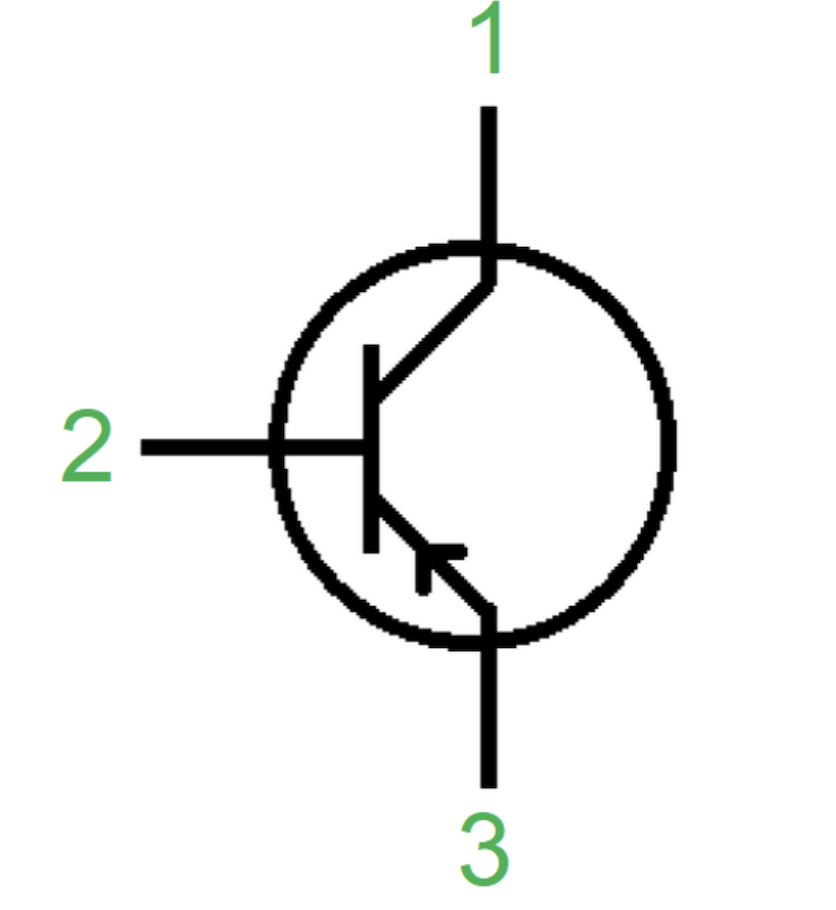
Is this a NPN or PNP?
PNP
What is a Mosfet?
How power transistor
What are 3 main purposes of 555 timer?
Oscillator
On delay timer
Bystable
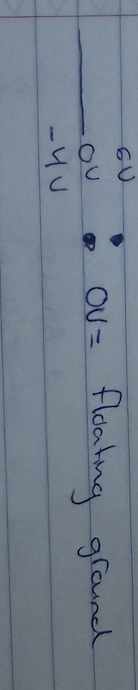
What is the 0v marker mean?
Floating ground
What are the three main stages of a VFD?
Input power
Rectification (AC to DC)
Inversion (DC to AC)
Q5. What is the purpose of power conditioning?
To smooth and condition the DC power before inversion.
Q7. What does an IGBT stand for?
Insulated Gate Bipolar Transistor.
Q8. What is the purpose of an IGBT in a VFD?
It switches DC power to produce a controlled AC output.
Q9. What is the basic power conversion sequence in a VFD?
AC → DC → Smooth DC → AC.
Q12. How many sets of poles does a 4-pole motor have?
2 sets of poles.
Q14. What happens to synchronous speed when frequency increases?
A: Motor speed increases.
Q15. What happens to synchronous speed when the number of poles increases?
A: Motor speed decreases.
Q16. What is the operating principle of a split-phase motor?
Phase shifting.
You use pulse Width Modulation in:
DC motors
In a diode what postion do you use to block current?
Reverse Bias
Voltage drop on a standard diode:
0.7V
Voltage drop on a LED:
1.7V
Whats the max amperage on a LED diode?
20mA
Reverse Bias on a gate limits?
Voltage
A SCR is…..
type of semiconductor device that acts like an electronic switch. It controls the flow of electrical current.