topic 1 - cell biolgoy
 Call Kai
 Learn
 Practice Test
 Spaced Repetition
 Match
 Flashcards
 Knowt Play
1/65

There's no tags or description
Looks like no tags are added yet.
66 Terms
What are the three main structures found in most animal and plant cells?
Cell membrane, cytoplasm and nucleus.
What is the function of the nucleus?
Contains genetic material (DNA) and controls the activities of the cell.
What is the function of the cell membrane?
Controls the movement of substances into and out of the cell.
What is the function of the cytoplasm?
Where most of the chemical reactions take place.
What is the function of mitochondria?
Site of aerobic respiration, where energy is released for cellular processes.
What is the function of ribosomes?
Site of protein synthesis.
Which structures are found in plant cells but not animal cells?
Cell wall, chloroplasts and a permanent vacuole.
What is the function of the plant cell wall?
Supports and strengthens the cell; it is made of cellulose.
What is the function of chloroplasts?
Contain chlorophyll, which absorbs light energy for photosynthesis.
What is the function of a permanent vacuole in a plant cell?
Contains cell sap and helps keep the cell rigid.
What is a prokaryotic cell?
A small, simple cell such as a bacterium, without a nucleus.
How is bacterial genetic material arranged?
A single circular DNA molecule is free in the cytoplasm; bacteria may also contain plasmids.
What are plasmids?
Small rings of DNA in bacteria that can contain additional genes.
How is a prokaryotic cell different from a eukaryotic cell?
Prokaryotes are smaller and have no nucleus; eukaryotes have a nucleus and membrane-bound organelles.
What is cell differentiation?
The process by which a cell changes to become specialised for a particular function.
When does most cell differentiation happen in animals?
At an early stage of development; some cells can still differentiate in adults, such as stem cells.
What is a specialised cell?
A cell adapted to carry out a particular function.
How is a sperm cell adapted to its function?
It has a tail to swim, many mitochondria to release energy, and an acrosome containing enzymes to help penetrate an egg.
How is a nerve cell adapted to its function?
It has a long axon to carry impulses over long distances and branched endings to connect with other cells.
How is a muscle cell adapted to its function?
It contains protein fibres that contract and many mitochondria to release energy.
How is a root hair cell adapted to its function?
It has a long extension that increases surface area for absorbing water and mineral ions from soil.
What is the function of xylem tissue?
Transports water and mineral ions from roots to the rest of the plant and helps support the plant.
What is the function of phloem tissue?
Transports dissolved sugars around the plant by translocation.
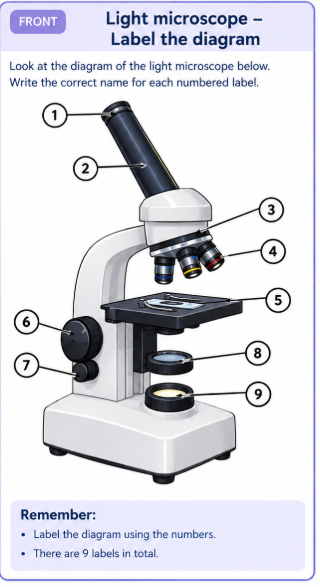
What is a light microscope used for?
To magnify cells and structures so they can be observed.
What is magnification?
How many times larger an image is than the real object.
What is resolution?
The ability to distinguish two close points as separate.
How does an electron microscope compare with a light microscope?
Electron microscopes have greater magnification and resolution, allowing smaller cell structures to be seen.
What is the magnification equation?
Magnification = image size ÷ real size.
How do you rearrange the magnification equation to find real size?
Real size = image size ÷ magnification.
What must you do before using the magnification equation?
Convert image size and real size to the same units.
How many micrometres are in one millimetre?
1000 micrometres (µm).
What are the main stages of mitosis?
The cell grows, increases its subcellular structures, replicates its DNA, then chromosomes are separated and the cell divides into two genetically identical daughter cells.
Why does a cell replicate its DNA before mitosis?
So each daughter cell receives a complete set of genetic material.
What is mitosis used for?
Growth, repair and replacement of cells, and asexual reproduction in some organisms.
How many daughter cells are produced by mitosis?
Two genetically identical daughter cells.
What is the cell cycle?
The sequence of growth, DNA replication and division that produces new cells.
What are stem cells?
Undifferentiated cells that can divide and differentiate into specialised cell types.
Where are stem cells found in animals?
In early embryos and in some adult tissues, such as bone marrow.
Where are stem cells found in plants?
In meristems, such as the tips of roots and shoots.
What is one potential medical use of stem cells?
Replacing damaged cells or tissues, although treatments may involve risks and ethical issues.
What is diffusion?
The net movement of particles from an area of higher concentration to an area of lower concentration.
What affects the rate of diffusion?
The concentration gradient, temperature, surface area and diffusion distance.
What is osmosis?
The net movement of water through a partially permeable membrane from a dilute solution to a more concentrated solution.
What does partially permeable mean?
The membrane allows some substances to pass through but not others.
What happens to an animal cell in a very dilute solution?
Water enters by osmosis; the cell may swell and burst because it has no cell wall.
What happens to a plant cell in a very dilute solution?
Water enters by osmosis; the cell becomes turgid because the cell wall prevents it bursting.
What happens to a plant cell in a concentrated solution?
Water leaves by osmosis; the cell becomes flaccid and may become plasmolysed.
What is active transport?
The movement of substances from a lower concentration to a higher concentration, against the concentration gradient, using energy from respiration.
Why does active transport require energy?
Substances are moved against their concentration gradient.
Give an example of active transport in plants.
Root hair cells absorb mineral ions from dilute soil when their concentration is lower in the soil than in the cells.
Give an example of active transport in humans.
Absorption of glucose from the gut into the blood can involve active transport.
What is the aim of the osmosis required practical?
To investigate how different concentrations of a solution affect the mass of plant tissue, commonly potato cylinders.
How should potato cylinders be prepared for the osmosis practical?
Cut equal-sized cylinders, blot them dry, and measure their initial mass.
What variables should be controlled in the osmosis practical?
Size and surface area of potato pieces, volume of solution, time immersed, temperature and method of blotting dry.
How do you calculate percentage change in mass?
Percentage change = (change in mass ÷ initial mass) × 100.
Why should potato pieces be blotted dry before weighing?
To remove solution from the surface so the measured mass is more accurate.
What result suggests water entered the potato by osmosis?
The potato's mass increases.
What result suggests water left the potato by osmosis?
The potato's mass decreases.
What is the independent variable in the osmosis practical?
The concentration of the solution.
What is the dependent variable in the osmosis practical?
The percentage change in mass of the potato pieces.