Sea level, proxies, archives
 Call Kai
 Learn
 Practice Test
 Spaced Repetition
 Match
 Flashcards
 Knowt Play
1/12

Earn XP
Description and Tags
- Analyze the factors contributing to sea level changes, such as eustatic, tectonic, isostatic, and local effects. - Diagram the impact of sea level change on sediment deposition patterns. - Discuss the methods used to reconstruct past sea level changes, including identifying useful proxies/archives
13 Terms
How to create relief in a landscape?
Uplift relative to sea level
Drop in sea level
Resistant rock layers
What defines relative sea level
Eustatic
Isostatic
Tectonics
Local Effects

Tectonic Effects on Relative Sea Level
Uplift from tectonic processes on active margins
Ex. Subduction of plates causing rise via volcanic mountains
Ex. Collision boundaries causing orogeny and mountains
Local Effects on Relative Sea Level
Non-tectonic Subsidence
Ex. Louisiana; groundwater withdrawal, drainage of organic soils, and underground mining of coal cited as reasons for land subsidence
Groundwater pumping generally a key source of subsidence
Causing the sinking of coastal Virginia by about 2mm per year
Isostatic Effects on Relative Sea Level
Reaction of the lithosphere to mass balance on surface, mainly affected by glacier presence
More glaciers —> Glacial forebulge in crust, leading to a sort of uplift raising elevation further from the glacier
Large difference between depressed land over glacier and upwarped land
Less glaciers —> Glacial forebulge fades; elevation drops locally
More balanced elevation all around
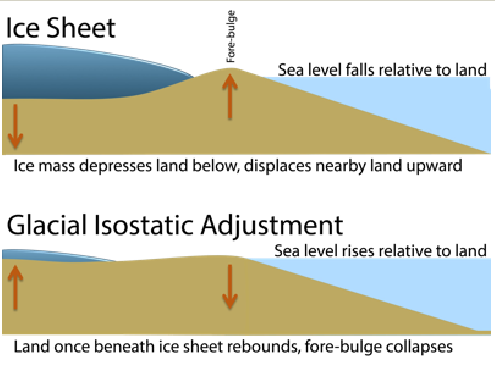
Eustatic Effects on Sea Level
“Eustatic processes describe changes in mass of water in the oceans. Melting of ice sheets and glaciers; increased runoff from lakes, rivers, and groundwater; and increased oceanic precipitation all lead to eustatic sea-level rise.”
Main Contributor — Glacial Melting and Formation
Can track with Oxygen-16 and Oxygen-18 isotopes in foraminifera
More glaciers —> More Oxygen-18 in silica shells because lighter isotope in glaciers
I’d also want to consider thermal expansion
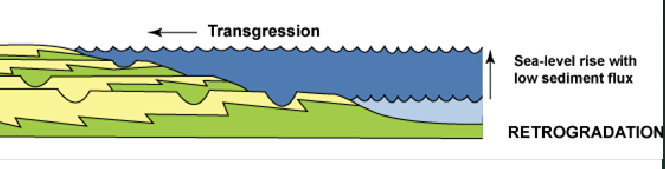
Retrogradation
Sea level rise with low sediment flux:
Ocean transgression inland
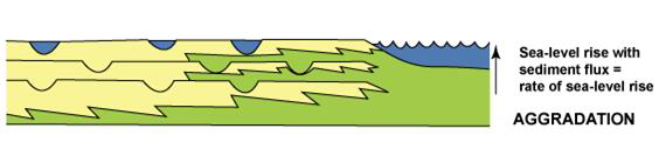
Aggradation
Sea level rise with sediment flux = Rate of sea level rise
Landscape rises with deposition at the same rate that sea level rises
Progradation
Sea level rise with high sediment flux
Deposition exceeds sea level rise rate, causing marine regression
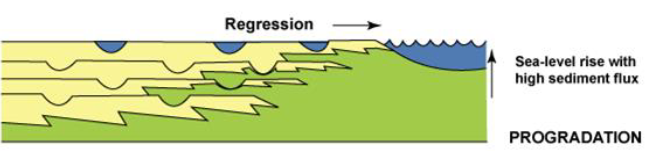
Sea level rise and sediment deposition (LEARNING TARGET)
Offshore deposits tend to be finer grained and form low-permeability rocks such as shale, while closer to the shore, sandier deposits form
Shale serves as cap rocks upon which offshore oil deposits can form, while coarser rocks serve as the reservoirs
Shales preserve organic material the best; still, relatively anoxic water offshore preventing oxidation (?)
Shale preserves organic material best as source rock —> Cooked into oil and stored in permeable reservoir rock —> Trapped by another layer of impermeable shale
This can be done with sea level rise, then fall, then rise again
Archives used for Climate Change History
Container and its contents:
Tree rings
Ice cores
Sediment cores
etc.
How it forms, maximum time duration, resolution, and geographic extent are all important factors for interpreting each of these
Biological, Chemical, and Physical Proxies of Climate Change
Biological:
Plants and animals that tolerate specific conditions preserved
Pollen records in sediment cores, for example
Physical:
Sea level, dust, ice rafted debris
Perhaps even ocean terraces
Ex. Dust from glacial loess in ice cores
Ex. Sediment or rock composition of cores from ocean or lakebeds
Chemical:
Isotopes that record ocean and surface temperature
Deuterium for surface temperature in ice cores
Oxygen 16 and 18 for sea level in ice cores
CO2 and CH4 in ice cores
Presence, quantity, and composition of chemicals controlled by climate-dependent reactions
Archives and proxies definitions
Archives are the sources that hold various proxies, which are thus used to determine climate change