Bio 97 Genetics Week #1 Reading Guide
 Call Kai
 Learn
 Practice Test
 Spaced Repetition
 Match
 Flashcards
 Knowt Play
1/32

There's no tags or description
Looks like no tags are added yet.
33 Terms
DNA nucleotide components
Deoxyribose sugar, phosphate group, nitrogen base

1' C on Pentose ring
Nitrogenous nucleotide base attachment site
3' C on Pentose Ring
Hydroxyl group (OH) attachment site
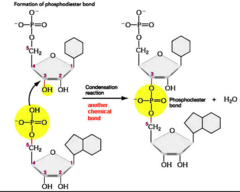
phosphodiester bond formation
-connects the 3 prime carbon on one nucleotide to a 5 prime carbon on the other nucleotide.

Pyrimidine
Single-ring structure of nitrogenous bases
Cytosine (C) and Thymine (T)
Purines
Double-ring structure of nitrogenous bases
Guanine (G) and Adenine (A)
deoxynucleotide monophosphates (dNMPs)
DNA nucleotides in their monophosphate form. Found inside a DNA strand after DNA Polymerase has joined nucleotides together by phosphodiester bonds.
Deoxynucleotide triphosphates (dNTPs)
Free, reactive DNA nucleotides with three phosphates on the 5' C. Substrates for DNA Polymerase during strand synthesis.
DNA Polymerase
Uses a template strand to add DNA nucleotides to a growing daughter strand in a complementary, antiparallel manner. Adds nucleotides only to the 3′ end, so elongation is 5′ → 3′
RNA primer (primase)
A short RNA segment (about 12-24 nucleotides) synthesized by primase. Provides the 3′ OH needed for DNA polymerase to start DNA synthesis. Contains uracil (U) instead of thymine, is temporary, and is removed and replaced with DNA before replication is completed.
Pyrophosphate Group
The group of 2 phosphates that break off from the triphosphates during strand synthesis.
DNA duplex
1.) Nucleotide bases of one strand are complementary to the corresponding nucleotide bases on the second strand
2.) The two strands are antiparallel in orientation
A-T base pair
2 hydrogen bonds
G-C base pair
3 hydrogen bonds

Semiconservative replication
Proven method of DNA replication in which parental strands separate, act as templates, and produce molecules of DNA with one parental DNA strand and one new DNA strand

Conservative replication
A disproved model of DNA synthesis suggested that one-half of the daughter DNA molecules should have both strands composed of newly polymerized nucleotides.

Dispersive replication
a disproved model of DNA synthesis suggesting more or less random interspersion of parental and new segments in daughter DNA molecules

Bidirectional replication
The process in which DNA replication proceeds outward from the origin in opposite directions
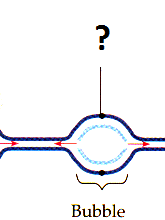
Origin of Replication
Site where the replication of a DNA molecule begins.

Replication bubble
a region of DNA, in front of the replication fork, where helicase has unwound the double helix

Helicase
An enzyme that untwists the double helix of DNA at the replication forks.
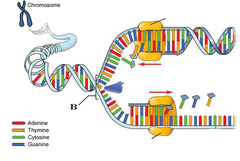
Replication forks
portions of DNA where the double helix separates during DNA replication
leading strand
The new continuous complementary DNA strand is synthesized along the template strand in the mandatory 5' to 3' direction.
lagging strand
A discontinuously synthesized DNA strand that elongates by means of Okazaki fragments, each synthesized in a 5' to 3' direction away from the replication fork.

single strand binding proteins
A protein that binds to the unpaired DNA strands during DNA replication, stabilizing them and holding them apart while they serve as templates for the synthesis of complementary strands of DNA.

okazaki fragments
Small fragments of DNA produced on the lagging strand during DNA replication are joined later by DNA ligase to form a complete strand.

DNA Ligase
A linking enzyme essential for DNA replication, it catalyzes the covalent bonding of the 3' end of a new DNA fragment to the 5' end of a growing chain.
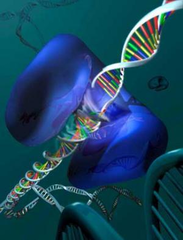
Topoisomerase
corrects "overwinding" ahead of replication forks by breaking, swiveling, and rejoining DNA strands

Telomeres
Repeated DNA sequences at the ends of eukaryotic chromosomes.

chromosomes
A threadlike structure of nucleic acids and protein found in the nucleus of most living cells, carrying genetic information in the form of genes.

T-loop
Lasso-like structure at the end of a telomere that serves to protect the termini of a chromosomal DNA molecule from enzymatic degredation

Shelterin
A protein complex helping to protect chromosome telomeric regions from damage during DNA replication.
Hayflick limit
The name given to the observation that normal human cells in cell culture usually experience a limited number of cycles of cell division before they die.