Ch. 6 Electronic Structure of Atoms
 Call Kai
 Learn
 Practice Test
 Spaced Repetition
 Match
 Flashcards
 Knowt Play
1/57

There's no tags or description
Looks like no tags are added yet.
58 Terms
Electronic structure
The arrangement and energy of electrons.
Electromagnetic radiation
•Electromagnetic radiation moves as waves through space at the speed of light.
Frequency
•The number of waves passing a given point per unit of time is the frequency (ν).
The more spread out the peaks, the less frequent
•For waves traveling at the same velocity, the ___ the wavelength, the smaller the frequency.
longer
As the wavelength, λ, ____, the frequency, ν, increases.
Decreases
Blackbody radiation
The emission of light from hot objects (blackbody radiation)
Photoelectric effect)
The emission of electrons from metal surfaces on which light is shone (the photoelectric effect)
Emission spectra
Emission of light from electronically excited gas atoms
Quanta
Singular: quantum
Packets
Quanta or photons
•Einstein
used quanta to explain the photoelectric effect.
Concluded that energy is proportional to frequency
E=hv
•At ____ energy, electrons are not emitted.
Lower
Continuous spectrum
•For atoms and molecules, one does not observe a continuous spectrum (the “rainbow”), as one gets from a white light source.
Line spectrum
•Only a line spectrum of discrete wavelengths is observed. Each element has a unique line spectrum.
•Neils Bohr
explained why this mathematical relationship works.
Wave length
Distance from peak to peak
Photon
Light
•Niels Bohr adopted Planck’s assumption and explained these phenomena in this way:
1)Only orbits of certain radii, corresponding to specific energies, are permitted for the electron in a hydrogen atom.
2)An electron in a permitted orbit is in an “allowed” energy state. An electron in an allowed energy state does not radiate energy, and, therefore, does not spiral into the nucleus.
3)Energy is emitted or absorbed by the electron only as the electron changes from one energy state to another. This energy is emitter of absorbed as a photon that has energy
Limitations of the Bohr Model
•It only works for hydrogen!
•Classical physics would result in an electron falling into the positively charged nucleus. Bohr simply assumed it would not!
•Circular motion is not wave-like in nature.
Important Ideas From the Bohr Model
1)Electrons exist only in certain discrete energy levels, which are described by quantum numbers.
2)Energy is involved in the transition of an electron from one level to another.
•Electrons in the lowest energy state are in the ____
Ground state.
Energy higher than the ground state
Excited state
•A positive delta E
Energy is absorbed
nf>nI
A negative delta E
Energy is released
nf<ni
Louis de Broglie
•theorized that if light can have material properties, matter should exhibit wave properties.
•He demonstrated that the relationship between mass and wavelength was:
^=h/mv
Heisenberg
showed that the more precisely the momentum of a particle is known, the less precisely its position is known:

Erwin Schrödinger
•developed a mathematical treatment into which both the wave and particle nature of matter could be incorporated.
•This is known as quantum mechanics.
wave function
•The solution of Schrödinger’s wave equation for hydrogen yields wave functions for the electron.
Electron density
•The square of the wave function gives the electron density, or probability of where an electron is likely to be at any given time.
orbitals
•Solving the wave equation gives a set of wave functions, or orbitals, and their corresponding energies.
•Each orbital describes a spatial distribution of electron density.
1 Principal Quantum Number (n)
•The principal quantum number, n, describes the energy level on which the orbital resides.
-The values of n >=1
-These correspond to the values in the Bohr model
Max Plank
Energy comes in packets called quanta
2 Angular Momentum Quantum Number (l)
•This quantum number defines the shape of the orbital.
•Allowed values of l are integers ranging from 0 to n-1
-•Letter designate the different values of l. This defines the shape of the orbitals.
Value of l 0
s
Value of l is 1
p
Value of I is 2
d
Value of I is 3
f
3 Magnetic Quantum Number
•The magnetic quantum number describes the three-dimensional orientation of the orbital.
-Allowed voalues of mI are integers ranging from -I to I including 0
•Therefore, on any given energy level, there can be up to 1 s orbital, 3 p orbitals, 5 d orbitals, 7 f orbitals, and so forth.
4 Spin Quantum Number
•In the 1920s, it was discovered that two electrons in the same orbital do not have exactly the same energy.
•The “spin” of an electron describes its magnetic field, which affects its energy.
•This led to the spin quantum number, ms
•The spin quantum number has only two allowed values, +(1/2) and -(1/2)
s Orbitals
•The value of l for s orbitals is 0.
•They are spherical in shape.
•The radius of the sphere increases with the value of n.
•For an n s orbital, the number of peaks is n.
•For an n s orbital, the number of nodes (where there is zero probability of finding an electron) is n-1
•As n increases, the electron density is more spread out and there is a greater probability of finding an electron further from the nucleus.

p Orbitals
•The value of l for p orbitals is 1.
•They have two lobes with a node between them.
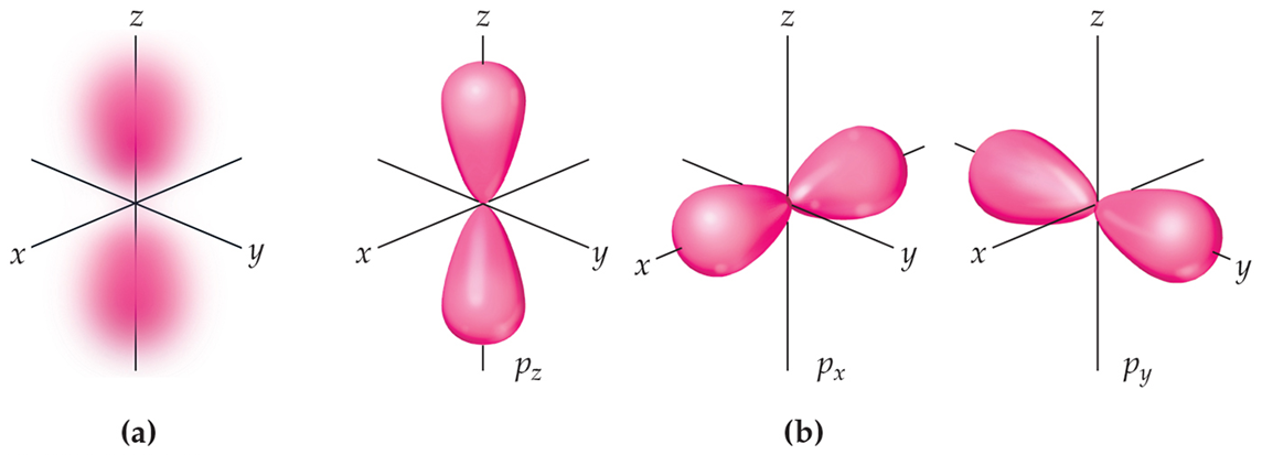
d Orbitals
•The value of l for a d orbital is 2.
•Four of the five d orbitals have four lobes; the other resembles a p orbital with a doughnut around the center.

f Orbitals
•Very complicated shapes (not shown in text)
•Seven equivalent orbitals in a sublevel
•l = 3
•As the number of electrons increases, the repulsion between them ____.
increases
•Therefore, in atoms with more than one electron, not all orbitals on the same energy level are degenerate.
Pauli Exclusion Principle
•No two electrons in the same atom can have the same set of four quantum numbers.
•Therefore, no two electrons in the same atom can have the exact same energy.
•This means that every electron in an atom must differ by at least one of the four quantum number values: n, l, mi and ms)
Electron configuration
•The way electrons are distributed in an atom is called its electron configuration.
•Each component consists of
a number denoting the energy level;
–a number denoting the energy level;
–a letter denoting the type of orbital;
–a superscript denoting the number of electrons in those orbitals.

Orbital Diagrams
•Each box in the diagram represents one orbital.
•Half-arrows represent the electrons.
•The direction of the arrow represents the relative spin of the electron.
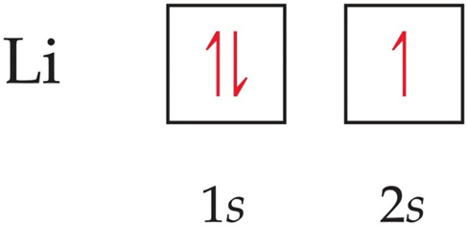
Hund’s Rule
•This means that, for a set of orbitals in the same sublevel, there must be one electron in each orbital before pairing and the electrons have the same spin, as much as possible.
Valence electrons
•Elements in the same group of the periodic table have the same number of electrons in the outer most shell. These are the valence electrons.
Core electrons
•The filled inner shell electrons are called core electrons. These include completely filled d or f sublevels.
•We fill orbitals in ____ order of energy.
increasing
Main-group elements.
•The s and p blocks are called the main-group elements.
•The periodic table is followed directly when determining the electron configuration for ___ elements.
Most
lanthanide elements
•The lanthanide elements (atomic numbers 57 to 70) have electrons entering the 4f sublevel.
actinide elements
•The actinide elements (including Uranium, at. n o. 92, and Plutonium, at. n o. 94) have electrons entering the 5f sublevel.
lowest frequency wave
radio
highest frequency wave
gamma
Wavelength and frequency relationship
indirectly related