F2 Osmoregulation och excretion; ion and osmoregulation
 Call Kai
 Learn
 Practice Test
 Spaced Repetition
 Match
 Flashcards
 Knowt Play
1/46

There's no tags or description
Looks like no tags are added yet.
47 Terms
what does osmoregulation?
osmoregulation regulates solute concentrations and balances the gain and loss of water
name three homeostatic processes
- osmotic regulation (pressure of body fluids)
- ionic regulation (concentrations of specific ions)
- nitrogen excretion (excretion of end-products of protein metabolism)
diffusion vs osmosis
diffusion = solute molecules move from high to low concentration
osmosis = solvent molecules move from low to high solute concentration
osmolarity defenition
the solute concentration of a solution. determines the movement of water across a selectively permeable membrane.
isoosmotic solutions
the movement of water is equal in both directions
what happens if two solution differ in osmolarity?
the net flow of water is from the hypoosmotic (low solute conc.) to the hyperosmotic (high solute conc.) solution.
ionic and osmotic challenges in marine vs freshwater vs terrestrial vs changing environments
marine: animals tend to gain salts and lose water
freshwater: animals tend to lose salts and gain water
terrestrial: animals tend to lose water
changing: some must be able to alter their homeostatic mechanisms.
osmoconformer's way to cope with ionic challenges
Exert little control over ion profile within the extracellular space. Exclusively found in marine animals. For example, many invertebrates.
Osmoregulator's way to cope with ionic challenges
Control ion profile of extracellular space. For example, most vertebrates
osmoconformer's way to cope with osmotic challenges
internal and external osmolarity similar (ex: marine invertebrates)
osmoregulator's way to cope with osmotic challenges
osmolarity constant regardless of externas environment (ex: most vertebrates)
energetics of osmoregulation
osmoregulators must expend energy to maintain osmotic gradients. the amount of energy differs based on:
- How different the animal's osmolarity is from its surroundings
- How easily water and solutes move across the animal's surface
- The work required to pump solutes across the membrane
epithelial cells use 2 main rountes of transport
1. transcellular transport = movement trough the cell across membranes
2. paracellular transport = movement in between cells.
types of transportes for solute movement
- ion channels (Cl-, K+, Na+) = transport of ions according to gradient with no ATP involved
- Na+/K+ ATPase pump = transport of both ions against gradient
- electroneutral cotransporters = coordination of ion exchange resulting in no net change of energy
most marine invertebrates are
osmoconformers, meaning the internal osmotic conc. colsely matches that of the surrounding seawater
Most marine vertebrates are
osmoregulators, meaning they maintaing a relatively constant internal osmotic conc. despite changes in seawater.
hypoosmotic to sea water means
they lose water by osmosis and easily gain salt by diffusion and from food. they replace water loss by drinking salty water, but that also increases alt content, so they have good mechanisms for excreting salts. ex: marine bony fish
Freshwater animals constantly take in water by ____ from their _______ environment
osmosis; hypoosmotic environment.
they lose salts by diffusion and maintain water balance by excreting large amounts of dilute urine. salts lost by diffusion are replaced in foods and by uptake across the gills.
Diadromous
Migrate between fresh and salt water. ion transport functions of epithelia must change during migration. that is controlled by hormones.
Catadromous
live in freshwater, breed in sea. ex: eels
anadromous
live in saltwater, migrate to freshwater to spawn. ex: salmon
land animals and urine volume
reduction of water loss is key to survival on land. body coverings help prevent dehydration. simple anatomical features and behaviors, such as a noctural lifestyle, help reduce water loss in arid environments. land animals mintain water balance by drinking, eating moist food and producing water metabolically by cellular respiration.
water balance and urine volume for freshwater fish, marine fish and land vertebrates
freshwater fish: live in dilute water (less conc. than body fluids) -> have large volume of dilute urine
marine fish: live in conc. water (more conc. than body fluids) -> small volume of dilute urine
land vertebrates: live in a dry environment (tend to lose water to air) -> moderate volume of conc. urine.
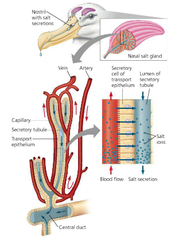
salt glands
reptiles and birds posses salt glands that are located near the eye, drain into ducts that empty near nostril. excrete hyperosmotic solutions of Na+ and Cl-. Large amount of salt excreted in small volume of water.
nitrogen excretion
ammonia produced during amino acid breakdown is toxic and must be excreted. ammonia nitrogen excreted in 3 forms:
- ammonia (ammonioteles) -> the most toxic
- uric acid (uricoteles) -> the least toxic
- urea (ureoteles)
what ammonia nitrogen form do most aquatic animals, including most bony fish excrete?
ammonia
what ammonia nitrogen form do mammanls, most amphibians, sharks and some bony fish excrete?
urea
what ammonia nitrogen form do many reptiles including birds, insects and land snails excrete?
uric acid
why do different animals excrete ammonia nitrogen differently?
The type of nitrogenous waste excreted depends on the type of animal and habitat, especially water availability. Another factor is space limitation for excretion. In an egg acid uric is accumulated as nitrogenous waste, which occupies little space, doesn't dissolve in water, and is less toxic.
the flame buld excretion system of a planaria
protonephridium - a network of dead-end tubules connected to external openings. the smallest branches of the network are capped by a cellular unit called a flame bulb. these tubules excrete a dilute fluid and a function in osmoregulation.

metanephridia in earthworms
each segment of an earthworm has a pair of open-ended metanephridia. Metanephridia consist of tubules that collect coelomic fluidand produce dilute urine for excretion. Surrounding capillary network reabsorbs some nutrients.

malpighian tubules of insects and terrestrial arthropods
Malpighian tubules remove nitrogenous wastes from hemolymph, providing a function in osmoregulation. Insects produce a relatively dry waste, mainly uric acid. Some terrestrial insects can also take up water from the air
kidney structure and excretion by the kidney
Blood enters the kidney at a high pressure (50-60 mmHg). Cleans the body of metabolic residues suchas ammonia, urea, uric acid, creatinine, water soluble toxins, and of heavy metals. Filters the blood 60 times per day. Regulates blood pressure by pumping out excess fluids and salts.
There are 2 phases in urine formation:
- filtration (in the glomerulus)
- reabsorption (by the proximal tubule)
Small molecules are easily filtered through the glomerulus into the proximal tubule

formation of primary urine. bowman's capsule
The filtrate produced in Bowman's capsule contains salts, glucose, amino acids, vitamins, nitrogenous wastes, and other small molecules.


podocytes
Specialized epithelial cells that surround glomerular capillaries and prevent plasmaproteins from entering the urine.
phases of renal excretion
Urine is produced by refining a filtrate derived from bodyfluids. Key functions of mostexcretory systems:
- Filtration: Filtering of body fluids
- Reabsorption: Reclaiming valuable solutes. can be active and passive. active = salt being pumped out back to the body. passive = loss of water that happens due to the pressure.
- Secretion: Adding nonessential solutes and residues from the bodymfluids to the filtrate
- Excretion: Processed filtrate containing nitrogenous wastes, released from the body

nephrons variability in different vertebrate classes (mammals, birds and replites, freshwater fish and amphibians, marine bony fish)
The form and function of nephrons in different vertebrate classes vary in relation to challenges for osmoregulation posed by the habitat.
- mammals: The kidney with their juxtamedullary nephron are key to water conservation in terrestrial animals. Mammals in dry environments have long Henle loops. Mammals in fresh water have relatively short Henle loops;
- birds and other reptiles: birds have shorter loops of Henle but conserve water by excreting uric acid instead of urea. Reptiles have only cortical nephrons but also excrete nitrogenous waste as uric acid.
- freshwater fish and amphibians: Freshwater fish conserve salt in their distal tubules and excrete large volumes of dilute urine. Kidney function in amphibians is similar to freshwater fishes. Amphibians conserve water on land by reabsorbing water from the urinary bladder.
- marine bony fish: Marine bony fishes arehypoosmotic compared with their environment. Their kidneys have small glomeruli and some lack glomeruli entirely. Filtration rates are low, and very little urine is excreted.

hormones link kidney function, water balance, and blood pressure. vampire bat.
vasopressin (antidiuretichormone, ADH)
renin-angiotensin-aldosterone (RAA) pathway
atrial natriuretic peptide (ANP)
all three work together.
Mammals control the volume and osmolarity of urine. The kidneys of the South American vampire bat can produce either very dilute or very concentrated urine. This allows the bats to reduce their body weight rapidly or digest large amounts of protein while conserving water.
what does ADH (vasopressin) do?
increases reabsorption of water by regulating production of aquaporines
what does RAAS do?
JGA that is composed of 2 parts: capilar cells touching mascula densa tubes. senses a change in blood pressure. renin hormone triggers
what does ANP do?
the opposite of RAAs. it reduces blood pressure and inhibits renin.
antidiuretic hormone
The osmolarity of the urine is regulated by nervous and hormonal control. An increase in osmolarity (detected by osmoreceptors in the hypothalamus) triggers the release of Antidiuretic hormone (Arginin-Vasopressin = ADH). ADH makes the collecting duct epithelium more permeable to water, which helps to bring water back to the body.
ADH leads to a temporary increase in the number of aquaporin proteins in the membrane of collecting duct cells. Aquaporins: membrane channels that transport water.
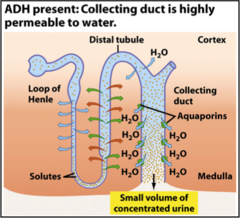
the hypothalamic control of osmolarity
osmoreceptors in hypothalamus trigger release of ADH as a result of blood osmolarity increase (after sweating). hypothalamus generates thirst. The posterior pituitary releases ADH (antidiuretic hormone), which increases water reabsorption in the distal tubule and collecting duct of the nephron. both processes lead to normal blood osmolarity.
the renin-angiotensin-aldosterone system (RAAS)
the renin-angiotensin-aldosterone system corrects low extracellular fluid volume and low blood pressure.
Part of a complex feedback circuit that functions in homeostasis. An important component of the RAAS is the juxtaglomerularapparatus (JGA), which helps to maintain blood pressure, to ensure proper glomerular flow rate, and efficient sodium reabsorption.
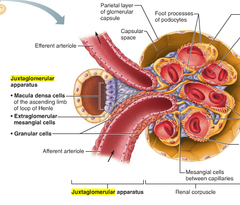
--- triggers the formation of the peptide ---, which is then converted to ---, which acts in two ways to increase blood pressure: vasoconstriction and alosterone (adrenal)
renin; Angiotensin I; Angiotensin II.
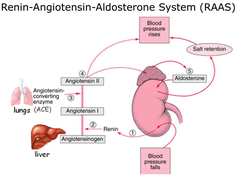
what happens when blood pressure or blood volume drops due dehydration or blood loss?
A decrease in blood pressure, blood volume, or NaCl delivery is detected by the juxtaglomerular apparatus (JGA), causing juxtaglomerular cells to release renin. Renin converts liver-derived angiotensinogen into angiotensin I. Angiotensin-converting enzyme (ACE), mainly in the lungs, converts angiotensin I into angiotensin II. Angiotensin II causes vasoconstriction and stimulates the adrenal cortex to release aldosterone. Aldosterone increases Na⁺ reabsorption (and thus water retention) in the distal tubule and collecting duct, helping restore blood pressure and blood volume.
coordinated osmoregulation by the ADH and RAAS systems
ADH and RAAS both increase water reabsorption, but only RAAS will respond to a decrease in blood volume. Another hormone, atrial natriuretic peptide (ANP), opposes the RAAS. ANP is released by atrial cardiomyocytes in response to an increase in blood volume and pressure, inhibiting the release of renin.