chp 9 - audit risk model
 Call Kai
 Learn
 Practice Test
 Spaced Repetition
 Match
 Flashcards
 Knowt Play
1/18

There's no tags or description
Looks like no tags are added yet.
19 Terms
phase 1 of audit planning
plan and design an audit approach based on risk assessment procedures
what part of phase 1 deals with audit risk
set materiality and assess acceptable audit risk and inherent risk
understand internal control and assess control risk
gather information to assess fraud risks
develop overall audit strategy and audit program
risk of material misstatement
While planning procedures to obtain audit evidence, auditors consider risk at both the overall F/S and relevant assertion level
(i.e. classes of transactions, account balances, and presentation and disclosures)
overall financial statement level
issues with management integrity or competence
ineffective BOD oversight
ineffective internal control systems
assertion level
think about assertions and audit objectives from chapter 6
we identify a risk for each assertion for each balance, transaction, and disclosure
each risk is comprised of two components: inherent risk and control risk
Example: Sales
Assertion – Occurrence
Risk - Sales transactions that are recorded are to fictitious customers
To determine how much work we need to do related to that assertion and risk, we assess both Inherent Risk & Control Risk
acronyms for the audit risk model
PDR = Planned Detection Risk
AAR = Acceptable Audit Risk
IR = Inherent Risk
CR = Control Risk
PDR formula & AAR formula
PDR = AAR/(IR x CR)
AAR = (IR x CR) x PDR
definitions of risk types
acceptable audit risk: likelihood that material misstatement exists after audit and auditor issued unqualified opinion (i.e., audit failed to detect MM)
inherent risk: likelihood of material misstatements generated, before considering client’s internal controls
control risk: likelihood of material misstatements will not be prevented or detected by client’s internal controls
IR x CR = Risk of Material Misstatement
planned detection risk: likelihood that audit procedures fail to detect material misstatement
acceptable audit risk
measure of how willing the auditor is to accept that the F/S may be materially misstated after the audit and an unqualified opinion was issued (i.e., the risk that auditors issue a clean opinion when they shouldn’t have)
the assessment of AAR is based on:
engagement risk: the risk that the auditor will suffer harm after the audit is finished, even though the audit report was correct (i.e., the likelihood that the auditor will have to defend their work)
AAR = 0% is CERTAINTY; AAR = 100% is TOTAL UNCERTAINTY
terms audit assurance, overall assurance, or level of assurance all represent 1-AAR
AAR is POSITIVELY related to PDR (inversely related to planned evidence)
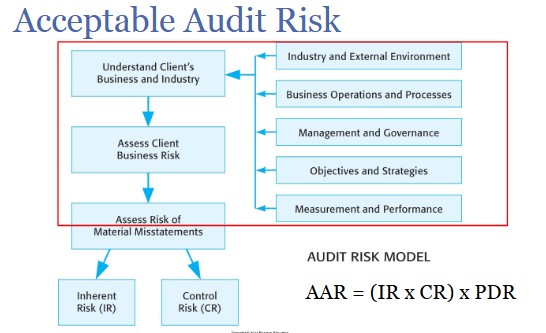
acceptable audit risk diagram
usually assess during planning for entire audit
auditors usually want to keep AAR low
inherent risk
auditor’s assessment of the susceptibility of an assertion to material misstatement, before considering the effectiveness of internal controls
where are misstatements most likely to occur, just BECAUSE?
INVERSELY related to PDR (positively related to planned evidence)
assessed for each cycle, account, and often assertion
assessing inherent risk
auditor tries to predict which segments within the company are likely to be misstated
IR does not change based on what the auditor does
the auditor assesses and considers effect on evidence, but DOES NOT and CANNOT alter the risk that is inherent to the client
assessment begins during the planning and is updated throughout the audit
factors that affect the assessment of IR
nature of client’s business (electronics company w/ obsolete inventory)
results of previous audits (any misstatements in prior years?)
initial v. repeat engagement (higher risk in first year of audit)
complex or nonroutine transactions (complex investments, restructuring)
accounts requiring judgment (asset impairment, allowance for A/R)
makeup of the population (A/R with old balances or new?)
control risk
auditor’s assessment of the risk that a material misstatement could occur in an assertion and not be prevented or detected by the client’s internal controls
assessed (not set! unless auditor is not relying on IC) based on auditor’s understanding of how well the client’s internal controls are designed and operating
degree of auditor’s reliance on controls:
assess CR as HIGH (100%) if auditor does not want to rely on client’s IC at all — small public and private companies
reduce CR assessment if auditor wants to rely on client’s IC to reduce audit work
INVERSELY related to PDR (Positively related to planned evidence)
assessing control risk
initial assessment of control risk:
obtained through gaining an understanding of the entity and their control environment
assessing the control environment
evaluating design and implementation of controls
updated assessment of control risk:
updated throughout the audit based on results of control procedures
it may change, it may not, but we should reassess in light of any new information
ineffective control design? reassess control risk
effectively designed but not implemented? reassess control risk
effectively designed and implemented but not operating as intended? reassess control risk
IR x CR = Risk of Material Misstatement
the auditor may make a combined assessment of inherent risk and control risk which is known as the risk of material misstatement
you can think of the risk of material misstatement as the risk that the financial statements are materially misstated prior to the audit
planned detection risk
the risk that audit evidence for an audit objective will fail to detect misstatements exceeding performance materiality
PDR is determined by other factors (AAR, IR, CR)
PDR has an inverse relationship with the amount of evidence auditors plan to accumulate
so a lower planned detection risk means more audit evidence will need to be accumulated (to achieve AAR)
responding to assessed risks chart

limitations of the audit risk model
the desired level of audit risk may not actually be achieved (will we ever know the achieved levels?)
it does not consider potential auditor error
there is no way of knowing what the preliminary level of risk actually was