carbohydrates
 Call Kai
 Learn
 Practice Test
 Spaced Repetition
 Match
 Flashcards
 Knowt Play
1/14

There's no tags or description
Looks like no tags are added yet.
15 Terms
what are the three types of carbohydrates
monosaccharides
disaccharides
polysaccharides
explain the types of carbohydrates
monosaccharides - simple sugars (glucose)
disaccharides - two monosaccharides (sucrose)
polysaccharides - when many monosaccharides join in condensation reactions (glycogen)
how are monosaccharides categorised
into how many carbon atoms they contain, for example pentose sugars or hexose sugars.
how to draw carbohydrates
often carbon atoms are left out to simplify the structure and make the other atoms easier to see. however, carbon atoms are implied at the corners of the ring.
what is an isomer
the same molecule but with a different shape/ form
what is glucose
hexose sugar
2 isomers - alpha and beta
used in respiration to release energy
monomer from which most polysaccharides are built.
Reactions involving 2 monosaccharides
When two monosaccharides join to form a disaccharide a glycosidic bond is formed.
Disaccharides formations
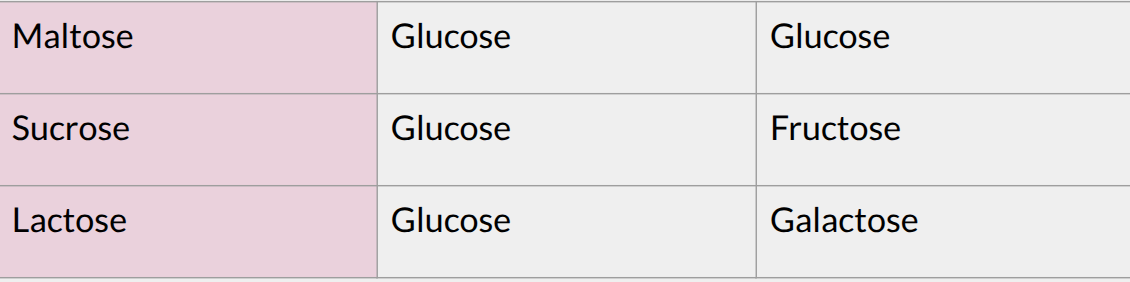
what happens when an enzyme breaks down sucrose
The glycosidic bond breaks
Glucose is produced
key info for starch
Where it’s found: | Plants |
Monosaccharide subunits: | Alpha glucose |
Branching: | Branched or Unbranched (2 forms) |
Role: | Energy store |
how is starch adapted to store energy
Insoluble and so does not affect water potential of cell
large and insoluble it does not diffuse out of cells
coiled form is compact and so lots of it can be stored in a small space
when broken down forms alpha glucose which is used in respiration
branched form has many ends, which are acted on by enzymes simultaneously and so glucose monomers are released very rapidly
key info about glycogen
Where it’s found: | Animals and bacteria In animals mainly found in muscles and liver |
Monosaccharide subunits: | Alpha glucose |
Branching: | Highly branched |
Role: | Energy store |
how is glycogen adapted to store energy
insoluble and so does not affect water potential of cell
large and insoluble it does not diffuse out of cells
when broken down forms alpha glucose which is used in respiration
highly branched than starch and so has more ends that can be acted on simultaneously by enzymes - more rapidly broken down to form glucose for use in respiration (important as animals have a higher metabolic rate than plants)
key info on cellulose
Where it’s found: | Plants (cell walls) |
Monosaccharide subunits: | Beta glucose |
Branching: | Unbranched |
Role: | Structural support |
how does cellulose provide support
makes it rigid and prevents the cell from bursting by exerting an inward pressure that prevents a further influx of water.
beta glucose allows straight, unbranched chains to form
unbranched chains run parallel to one another, allowing hydrogen bonds to form cross linkages between chains - collective strength