chapter 16: blood pressure
 Call Kai
 Learn
 Practice Test
 Spaced Repetition
 Match
 Flashcards
 Knowt Play
1/25

There's no tags or description
Looks like no tags are added yet.
26 Terms
arteriole**
When the ventricle relaxes and the aortic valve closes, the elastic arterial walls recoil, propelling the blood forward into smaller arteries and arterioles
venule**
Blood flows from the capillaries into small vessels called venules.
At the distal end of capillaries, blood flow converges into venules to enter the venous side of the circulation.
capillary**
endothelium**
The inner lining of all blood vessels is a thin layer of endothelium, a type of epithelium
endothelial cells secrete many paracrine signal molecules and play important roles in the regulation of blood pressure, blood vessel growth, and absorption of materials.
vasoconstriction/vasodilation**
angiogenesis
angiogenesis is the process by which new blood vessels develop, especially after birth
In adults, angiogenesis takes place as wounds heal.
Angiogenesis also occurs with endurance exercise training, enhancing blood flow to the heart muscle and to skeletal muscles.
Growth of the uterine lining after menstruation and development of the placenta during pregnancy require angiogenesis.
coronary heart disease
In coronary heart disease, blood flow to the myocardium is decreased by fatty deposits that narrow the lumen of the coronary arteries.
in some individuals, new blood vessels develop spontaneously and form collateral circulation that supplements flow through the partially blocked artery.
systolic pressure/diastolic pressure**
Aortic pressure reaches an average high of during ventricular systole (systolic pressure),
then falls steadily to a low of during ventricular diastole (diastolic pressure).
mean arterial pressure
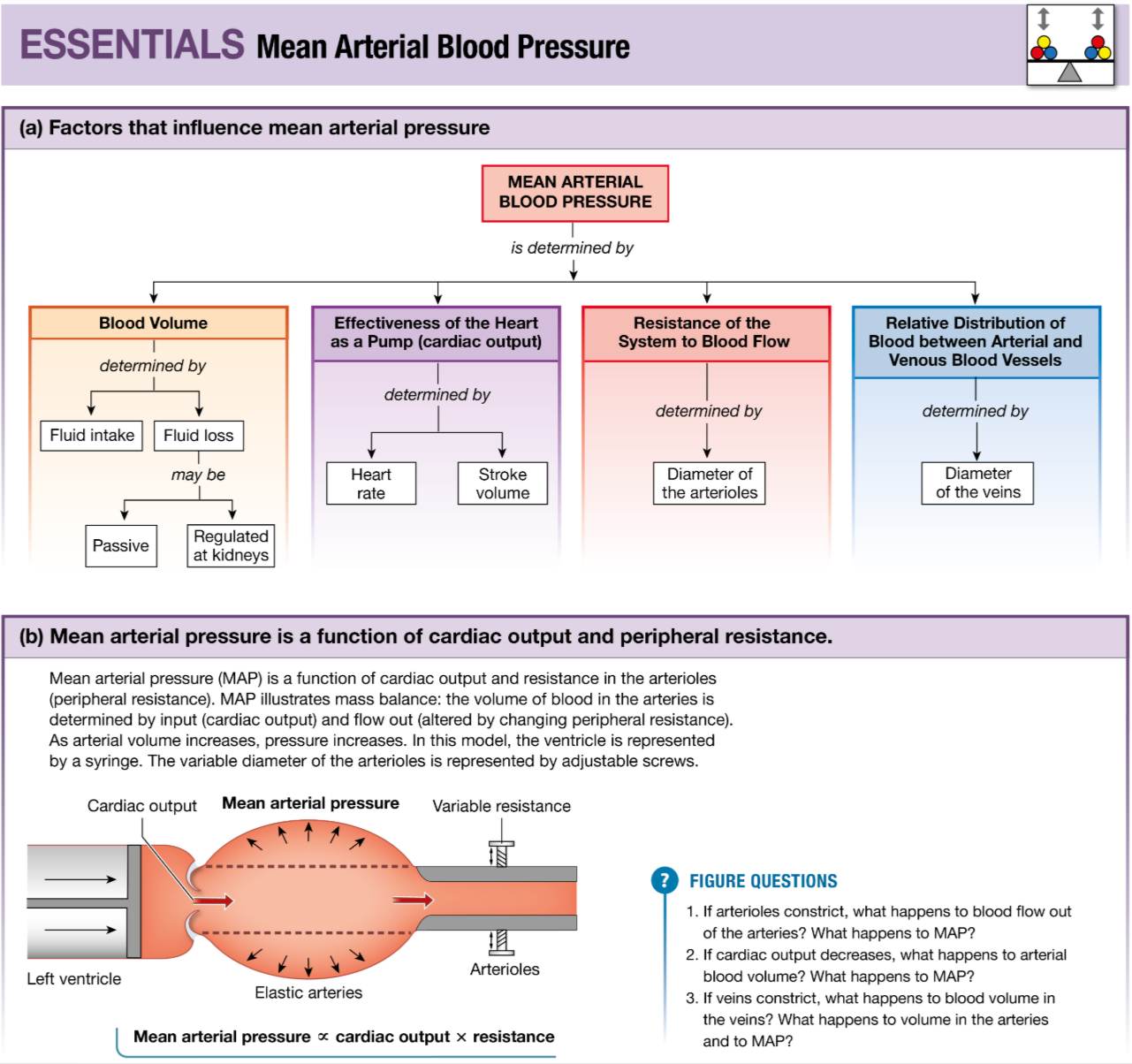
As you just learned, arterial pressure is pulsatile, so we use a single value—the mean arterial pressure (MAP)—to represent driving pressure.
Mean arterial pressure is closer to diastolic pressure than to systolic pressure because diastole lasts twice as long as systole.

peripheral resistance
Blood flow out of the arteries is influenced primarily by peripheral resistance, defined as the resistance to flow offered by the arterioles. Blood flow into the aorta is equal to the cardiac output of the left ventricle.
Mean arterial pressure thus is proportional to cardiac output (CO) times resistance (R) of the arterioles

baroreceptor
The primary reflex pathway for homeostatic control of mean arterial blood pressure is the baroreceptor reflex.
Stretch-sensitive mechanoreceptors known as baroreceptors are located in the walls of the carotid arteries and aorta, where they continuously monitor the pressure of blood flowing to the brain (carotid baroreceptors) and to the body (aortic baroreceptors).

fenestrated capillary
Fenestrated capillaries {fenestra, window} have large pores (fenestrae or fenestrations) that allow high volumes of fluid to pass rapidly between the plasma and interstitial fluid

atherosclerosis
Plaque formation is also called atherosclerosis (“hardening of the arteries”) because the deposits calcify and stiffen the arterial walls.
if plaques grow in size, they can decrease blood flow (ischemia) and can also trigger blood clots that completely block blood flow to a region of tissue, resulting in a myocardial infarction (heart attack)
Risk factors for the development of atherosclerosis include high blood pressure, smoking, diabetes mellitus, obesity, and physical inactivity.
vascular
Recognize that blood flow is “directed” to different tissues by constricting and
dilating arteries and arterioles; understand that vasoconstriction decreases blood
flow and vasodilation increases it, and recall from Ch 15 that this is a 4th-power
relationship**
ok
Identify the relationship between blood vessel diameter and peripheral resistance**
Blood flow out of the arteries is influenced primarily by peripheral resistance, defined as the resistance to flow offered by the arterioles
chat: Inversely Proportional: As vessel diameter decreases, peripheral resistance increases (and vice versa).
The Power-of-Four Rule (1/r^4): Resistance is inversely proportional to the fourth power of the vessel radius:
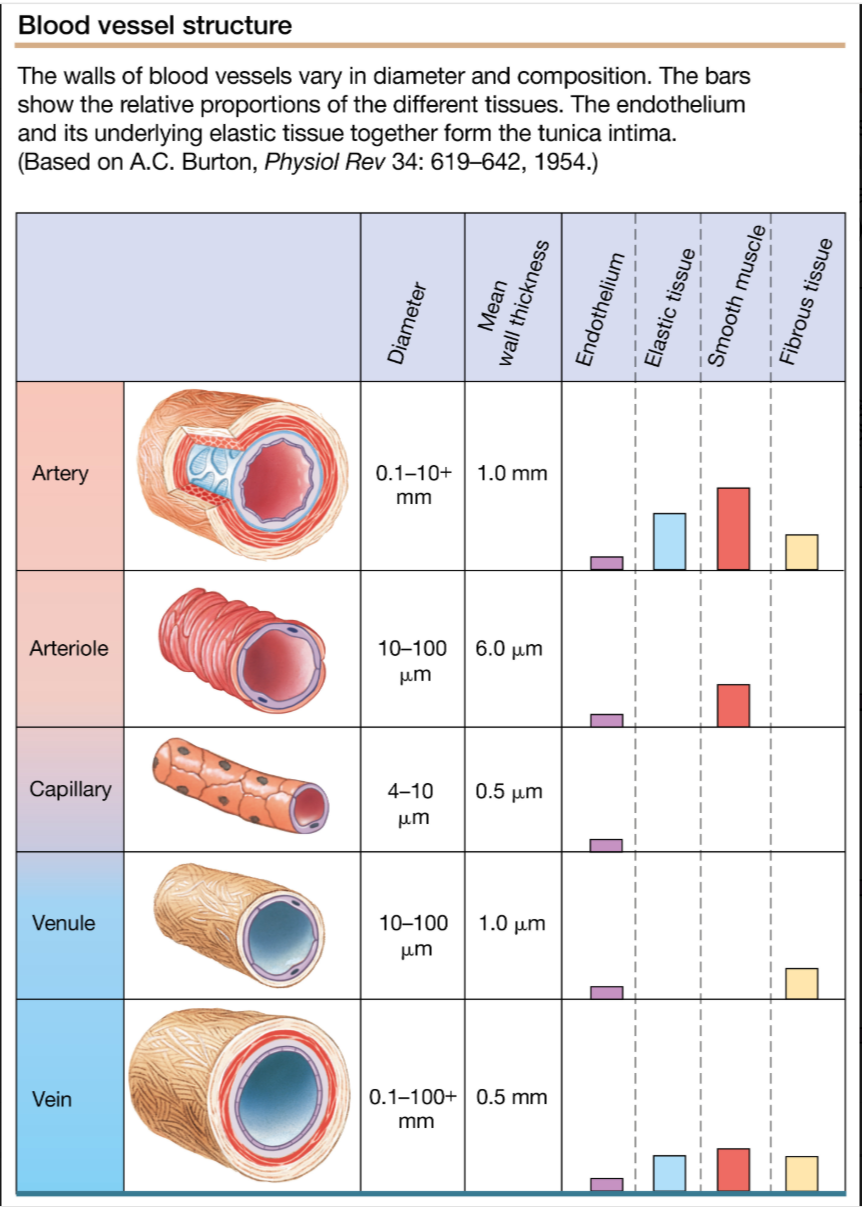
Describe or identify how the different kinds of blood vessels vary in structure
and composition
Put the different types of blood vessels “in order” of blood flow (heart
→
arteries
→ arterioles
→ etc.)**
Calculate the mean arterial pressure given the systolic and diastolic pressures

Predict AND explain how changes in venous return, blood volume, heart rate,
stroke volume**, and blood vessel diameter (vasoconstriction or vasodilation)
qualitatively affect blood pressure (e.g., if heart rate increases, does blood
pressure increase or decrease?)**
Mean Arterial Pressure (MAP)=Cardiac Output (CO)×Total Peripheral Resistance (TPR)
where Cardiac Output (CO)=Heart Rate (HR)×Stroke Volume (SV)
venous return inc = BP inc
blood volume inc = BP inc
HR inc = BP inc
stroke volume inc = BP inc
vasoconstriction = BP inc
Predict whether the arterioles delivering blood to a particular organ are dilated
or constricted by the sympathetic nervous system**; give examples of locations at
which each there will be vasodilation and vasoconstriction when the sympathetic
nervous system is active **
chat:
Simply, when the sympathetic nervous system (SNS) is active, it redirects blood toward organs that need it most for “fight or flight.”
- Vasoconstriction: Arterioles narrow to reduce blood flow to certain areas.
Examples: Digestive organs, kidneys, and skin.
Why? Blood is redirected away from these areas.
- Vasodilation: Arterioles widen to increase blood flow to certain areas.
Examples: Skeletal muscles and the heart.
Why? These organs need more blood to support physical activity.
Memory trick: SNS = fight or flight → less blood to digestion, more blood to working muscles and the heart.
Explain the processes by which low or high (mean arterial) blood pressure is
detected and corrected by the body
If blood pressure falls too low (hypotension), the driving force for blood flow is unable to overcome opposition by gravity.
if blood pressure is chronically elevated (a condition known as hypertension, or high blood pressure), high pressure on the walls of blood vessels may cause weakened areas to rupture and bleed into the tissues
look @ maggies!!
Explain or identify how the kidney can adjust blood pressure (over minutes to
hours)
Regulation of blood pressure in the cardiovascular system is closely tied to regulation of body fluid balance by the kidneys
If blood volume increases, the kidneys restore normal volume by excreting excess water in the urine
If blood volume decreases, the kidneys cannot restore the lost fluid. The kidneys can only conserve blood volume and thereby prevent further decreases in blood pressure.
Identify or describe where fenestrated capillaries are found, and explain why
they are found there
These capillaries are found primarily in the kidney and the intestine, where they are associated with absorptive transporting epithelia.
filtering blood in the kidneys, absorbing nutrients in the intestines, and allowing hormones to enter the bloodstream.
Explain or identify in what parts of the system blood flow is fast vs. slow, and
why slow flow in the capillaries is a good idea
The fastest flow is in the relatively small-diameter arterial system. The slowest flow is in the capillaries and venules, which collectively have the largest cross-sectional area. The low velocity of flow through capillaries is a useful characteristic that allows enough time for diffusion to go to equilibrium
Provide or identify the major functions of the lymphatic system
functionally, the lymphatics are part of three different physiological systems: the cardiovascular system, the digestive system, and the immune system. Functions of the lymphatic circulation include
returning fluid and proteins filtered out of the capillaries to the circulatory system,
picking up fat absorbed at the small intestine and transferring it to the circulatory system, and
serving as a filter to help the immune system capture and destroy foreign pathogens [Fig. 7.2]. In this discussion, we focus on the role of the lymphatics in fluid transport.