CPSC 4200 Midterm
 Note
Note Call Kai
 Learn
Learn Practice Test
 Spaced Repetition
 Match
Match Flashcards
 Knowt Play
1/82

There's no tags or description
Looks like no tags are added yet.
Name | Mastery | Learn | Test | Matching | Spaced | Call with Kai | Chat |
|---|
No analytics yet
Send a link to your students to track their progress
83 Terms
Adversary
An intelligence that actively tries to cause a system to misbehave
aka the attacker or the bad guy
Security Mindset - Attacker
look for weakest links (easy to attack)
identity assumptions that security depends on (are they false, can they be made false)
think outside the box (not contained by system designer’s worldview)the
Security Mindset - Defender
security policy
what assets are we trying to protect
what properties are we trying to enforce
threat model
who’s the attacker? capabilities? motivations?
what kind of attack are we trying to protect?
risk assessment
what are the weaknesses of the system?
what will successful attacks cost us?
how likely?
countermeasures
cost vs benefits
technical vs non-technical
Security Policies
What asset are we trying to protect?
asset - any data/device/component that supports info-related activities
What properties are we trying to enforce?
CIA (Confidentiality, Integrity, Availability)
and other AAA
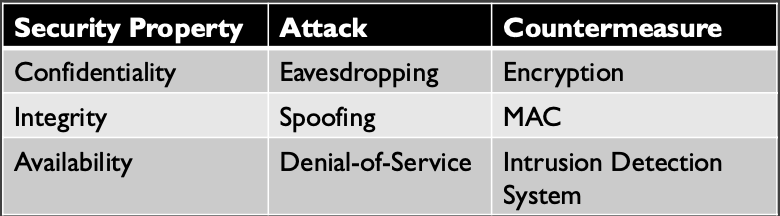
Confidentiality
ensure information has not been disclosed in an unauthorized way
problem: ensure only Bob can read the message from Alice
attack: eavesdropping (passively listening to communication)
countermeasure: encryption
keep this conversation confidential (between you and me)
Integrity
ensures information has not been altered in an unauthorized way
problem: ensure the message received by Bob is a message sent by Alice
attack: spoofing (altering original message)
countermeasure: message authentication code (MAC)
keep this conversation strong (no changes)
Availability
assures systems work promptly and service is not denied to authorized users
problem: Alice needs to access her email server at all times
attack: denial of service attack
countermeasure: intrusion detection system
keep this conversation available at all times
CIA
Terminology: Threat
any potential occurrence, malicious or not that could harm an asset
can be a SW bug
Terminology: Vulnerability
A weakness that makes a threat possible is often due to poor design or insecure coding techniques
ex. poor design, config mistakes, insecure coding techniques
Terminology: Attack
An action that exploits a vulnerability or enacts a threat, implying intent.
implicit concept of intent (intentional threat)
server crash can also cause loss of availability, but not an attack
Terminology: Authenticity
The ability to determine that statements, policies, and permissions issued by persons or systems are genuine.
Terminology: Anonymity
The characteristic that ensures certain records or transactions cannot be attributed to any individual.
Terminology: Accountability
The requirement for actions of an entity to be traced uniquely to that individual.
Terminology: Passive vs Active Attack
passive - an attack that involves eavesdropping or monitoring messages without altering them
active - n attack that involves modification of messages
ex. masquerading, replaying, or spoofing.
Terminology: Inside vs Outside Attack
Inside - initiated by authorized entity inside security perimeter
Outside - initiated by unauthorized entity outside the perimeter
Terminology: Attack Surface
The different vectors through which an attack can occur
network (weak crypto for digital signature)
software (buffer overflow)
human components (social engineering)
Why are there security vulnerabilities?
lots of buggy software (programmers are unaware)
contributing factors
C is unsafe language (memory issue)
legacy software
consumers don’t care about security (not a selling point)
security is expensive
State of Security
never ending war between good and bad guys
every asset has at least one vulnerability
no such thing as bullet proof barrier
only a multi-layered approach has a change of success
Cryptography
core building block of cyber security (basis for security mechanisms)
CIA and AAA properties are provided using cryptography
cryptography is not:
solution to all security problems
reliable unless implemented/used properly
something you should invent yourself
bitcoin
Never do what with crypto?
Do NOT roll your own crypo
Message Integrity with Functions
goal: ensure the message received by Bob is a message sent by Alice (m = m’)
approach: send a message-dependent message along with the original message
v = f(m)
bob checks that f(m’) == v’, otherwise m’ untrusted

Function Properties
generate consistent output (with no collisions)
1-to-1 mapping between m and f(m) (bijection)
unknown to Mallory

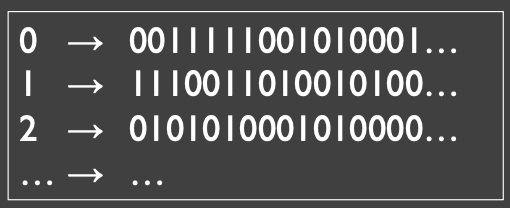
Random Function
input: arbitrary size (up to huge max)
output: fixed size (256 bits)
defined by a large lookup table that’s filled with flipping coin
mapped each input independently at random at any of the possible outputs
idealization of a cryptographic hash function
Random Function: is it secure?
Yes
mallory’s best chance is to guess
caveat: lookup table needs to be exchanged securely in advance
Random Function: is it practical?
No
both sides have other know entire table beforehand
table might be to large to conveniently share between parties
Pseudorandom Function (PRF)
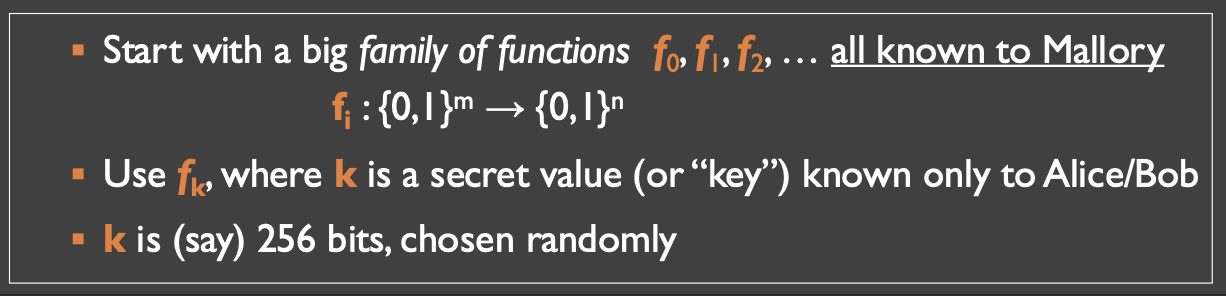
set of functions that “look“ random but are practical
“looks“ random: two inputs that differ by 1, likely to produce different outputs
practical: computable (no need to pre-share all possible input to output pairing/lookup table)
properties
family of function can be public
k is a secret only known to Alice/Bob
randomly chosen (256 bits)
follows Kerckhoff’s Principles
Length of key k
the length of key k determines how many functions they have to check for the right one
ex. |k| = 8, f0 → f28(f256)
Function keys should be how long?
128 bits
at least 80
Kerckhoff’s Principles
system must be practically, if not mathematically, indecipherable;
it should not require secrecy, and I should not be a problem if it fall into enemy hands;
must be possible to communicate and remember the key without using notes, and parties must be able to change/modify it at will;
It must be applicable to telegraph communications;
It must be portable, and should not require several persons to
handle or operate;
It must be easy to use and should not be stressful to use or
require its users to know and comply with a long list of rules.
Advantage of PRFs
PRFs depend on secret of key, not knowledge of the system
system: random function f
advantage: good, secure functions f can be public
NO security of obscurity
key k must be exchanged between Alice and Bob
k us much smaller than f
Message Integrity Using PRFs
goal: message received by Bob is a message sent by Alice
PRF approach
let f be a secure PRF
in advance, choose a random k known only by Alice and Bob
let v = fk(m)
Bob checks that fk(m’) == v’

Message Integrity Using Multiple PRFs
goal: multiple messages received by Bob are messages sent by Alice
problem:
replay attack - Mallory resends message from earlier communication
reordering attack - Mallory sends a message out of order
countermeasure
add sequence number (“freshness value“/sequence number)
use a different key k each time
Do PRFs Exist?
we don’t know
best we can do: well studied function we havn’’t spotted issues with yet
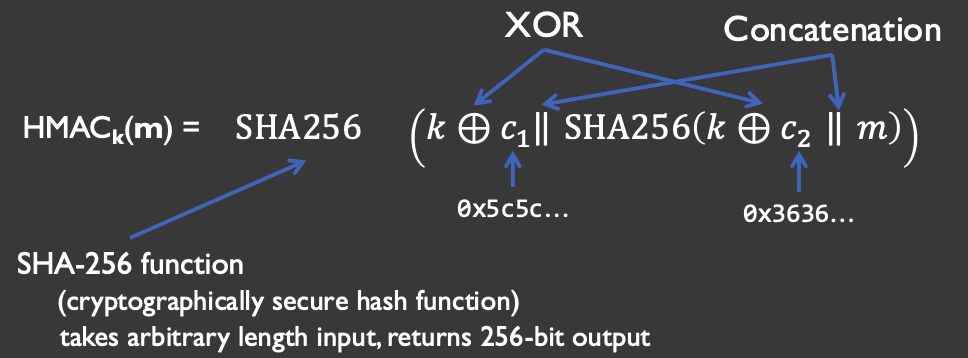
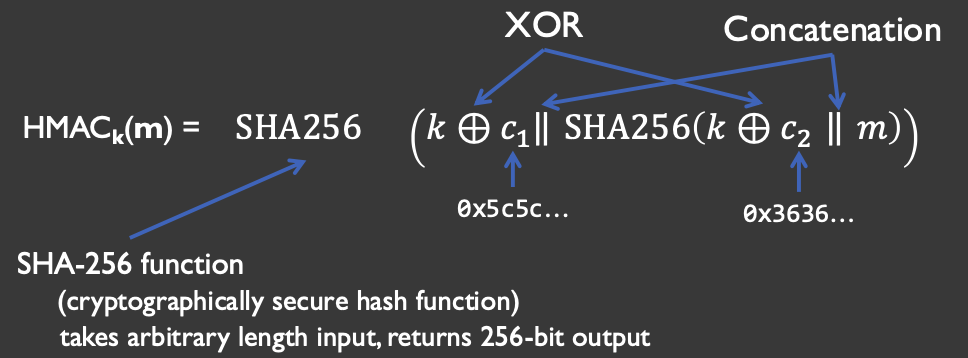
HMAC-SHA256
Message Authentication Code (MAC)
essentially the same as PRF
currently popular PRF: HMAC-SHA256
hash-based message authentication code (HMAC)
Hash Functions
input: arbitrary length data
output: fixed size digest (n bits)
no key, fixed function
properties:
collision resistance (hard to find x ≠ y such that h(x) = h(y))
pre-image resistance (given y, hard to find x such that f(x) = y)
second pre-image resistance (given fixed x, should be hard to find x’ ≠ x such that h(x) = h(x’))
Hash Functions: Good vs. Broken
good functions:
SHA-2 (include SHA-256)
SHA - 3
SHA-5 (include SHA-512)
broke functions (DO NOT USE):
SHA-1
MD5
Hash Function Rule of Thumb
hash output should be at least 256 bits long
MAC vs Hash
use a MAC instead of a hash
message authentication code (MAC)
think of as synonymous with PRF
ex. HMAX-SHA256
cryptographic hash function
not a strong PRF
ex. SHA256
have a weakness
Hash Function Vulnerability
hash function vulnerable to length extension attacks
given z = H(m) for some unknown m, can construct H(m || padding || v) for v we choose.
aka HW1
Goal of Cryptography
approaching true randomness practically
Pseudo Randomness
true randomness
output of a physical process that is inherently random
scarce and hard to get
slow
pseudorandom generator (PRG)
takes small seek (key k) that is really random
generates long sequence of numbers that “appear random“
different from PRF
Source of Randomness
coin flip
human behavior
atomic decay
thermal noise
electromagnetic noise
physical variation
clock drift
DRAM decay
image sensor error
SRAM startup state
lava lamps
Where do we get true randomness?
key k needs to be truly random (with secure PRF f)
adversary can’t guess it
gather details about computer that’s hard for adversary to guess
modern OSs collar randomness and provide API to access it
/dev/random
/dev/urandom
Message Confidentiality with Encryption
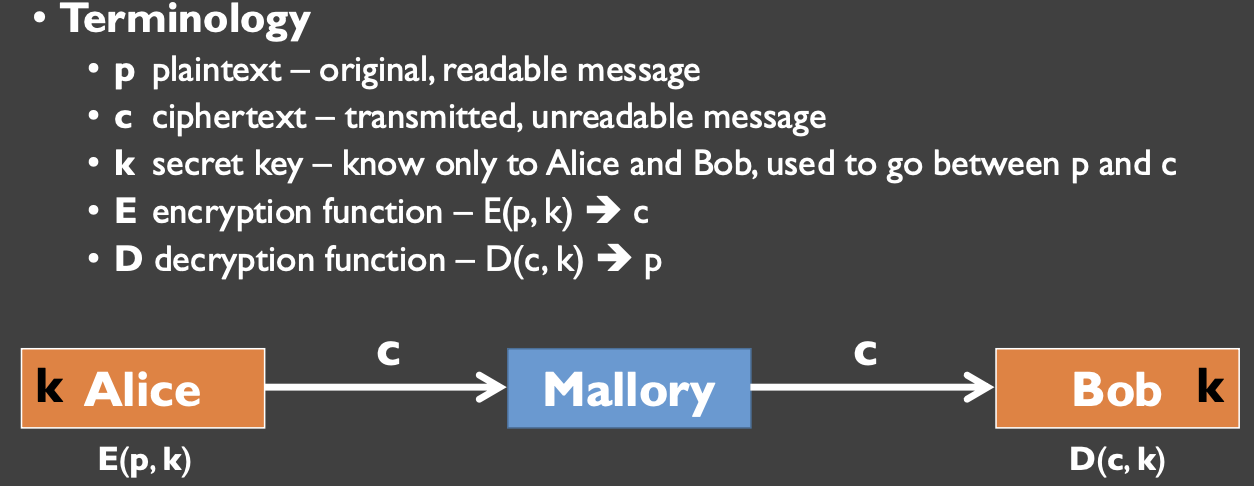
Ciphers
Caesar Cipher
Vigenère Cipher
One-Time Pad (OTP)
Stream Cipher
Block Ciphers
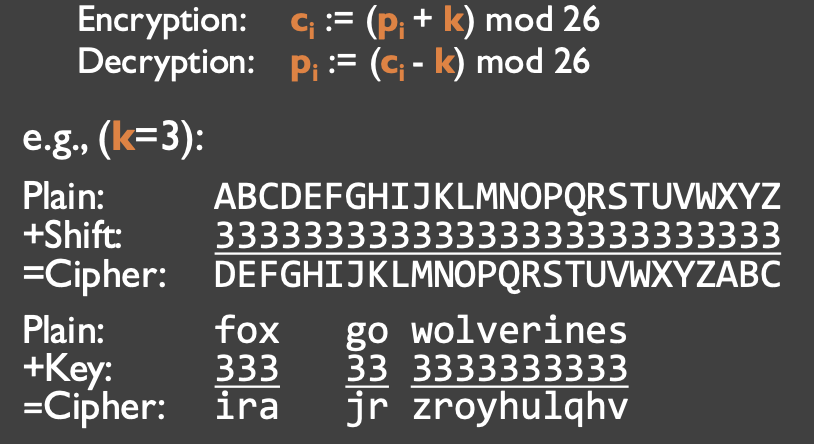
Caesar Cipher
replaces each plaintext letter with one a fixed number of places down the alphabet
Caesar Cipher Cryptanalysis
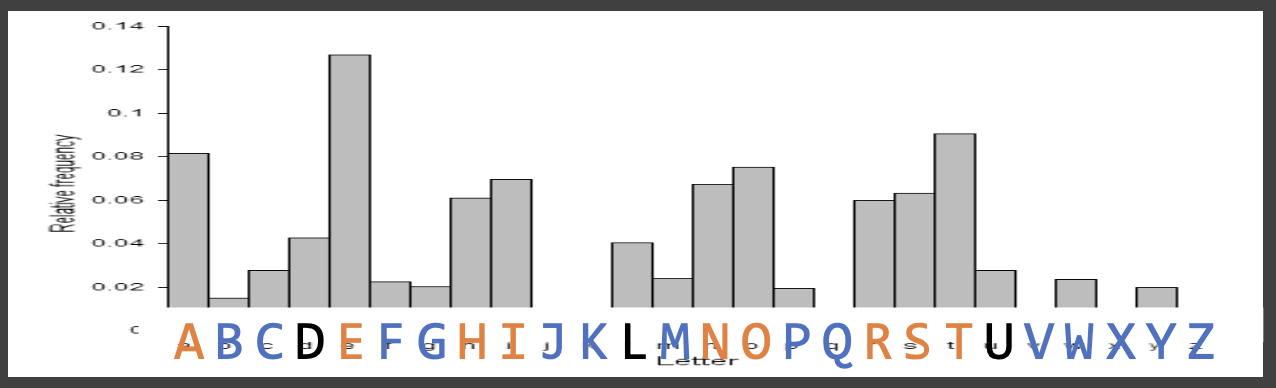
how to break it:
only 26 possible keys (“brute force“ every possible k)
how can a computer recognize the right one?
English has distinctive letter frequency distribution (use X2 test)
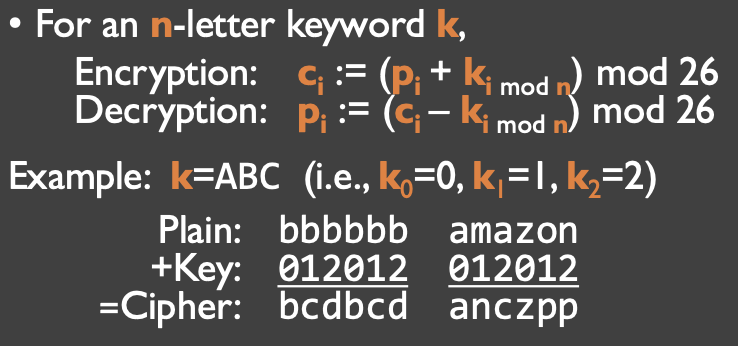
Vigenère Cipher
encrypts successive letters using a sequence of Caesar ciphers determined by the letters of a keyword
Vigenère Cipher Cryptanalysis
how to break it:
simple if we know the keyword length, n
break cipher text into n slices
solve each slice as caesar cipher
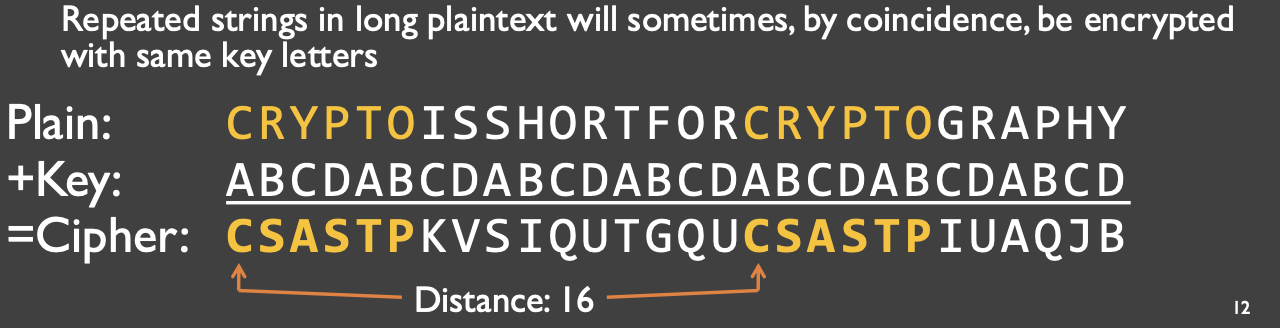
distance between repeated strings in cipher tests (likely) a multiple of key length n
ex. distance 16 implies n is 16, 8, 4, 2, 1 (find multiple repeat to narrow down)
how to find n?: Kasiski method
One-Time Pad (OTP)
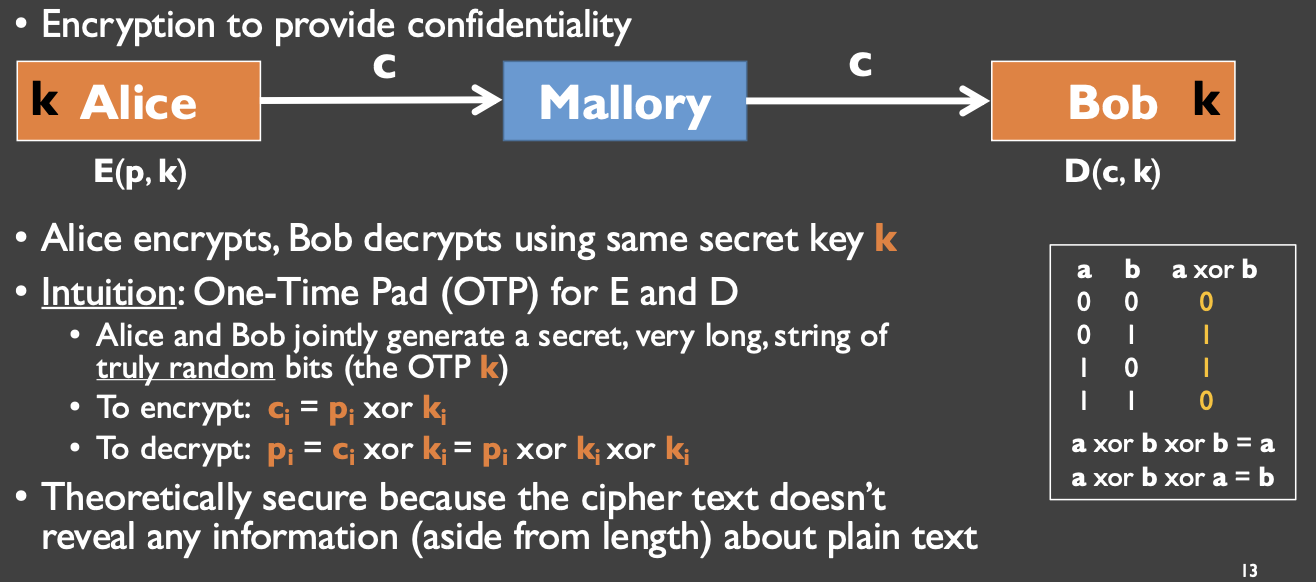
Alice encrypts, and Bob decrypts using the same key k and uses OTP for E and D
both generate a secret, long string of truly random bits (the OTP k)
to encrypt: c = p XOR k
to decrypt: p = c xor k = p xor k xor k
theoretically secure since cipher text doesn’t reveal any info (besides length) about plain text
One-Time Pad (OTP) Reuse Problem
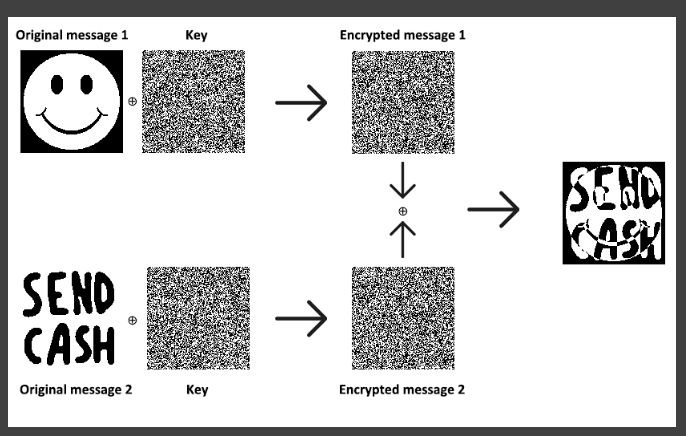
should never reuse any part of the pad
adversary can learn (a xor k) and (b for k)
adversary xors those to get (a xor b) which is useful
Stream Cipher
using pseudorandom generator
inputs seed k
outputs stream that is indistinguishable from true randomness unless know k
start with shared secret key truly random number k
Alice and Bob use k to seed the PRG
to encrypt, Alice XORs next bit of her output with next bit of plaintext
to decrypt, Bob XORs next bit of his output with next bit of ciphertext
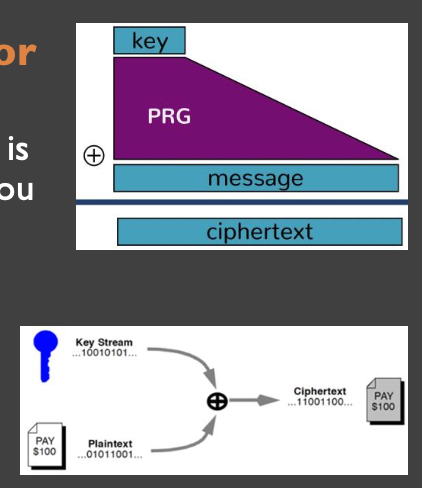
Stream Cipher: Questions
what happens if you reuse the key?
Mallory can save sequences and look for repeats (like Vigenère cipher)
what happens if you reuse the output of the PRG?
Mallory can save sequences and look for repeats (like Vigenère cipher)
what is the tradeoff between OTP and Stream Cipher?
OTP: true randomness and random key = len(m)
Stream Cipher: pseudorandomness and random key = 256 bits
what are some examples of Stream Cipher?
Salsa20, RC2 (broken), RC4 (broken)
should I roll my own Stream Cipher instead?
NO
Block Cipher
functions that encrypt fixed-size blocks with a reusable key
inverse function decrypts when used with same key
most commonly used approach to encrypting for confidentiality
Block Cipher is a Pseudorandom Permutation (PRP)
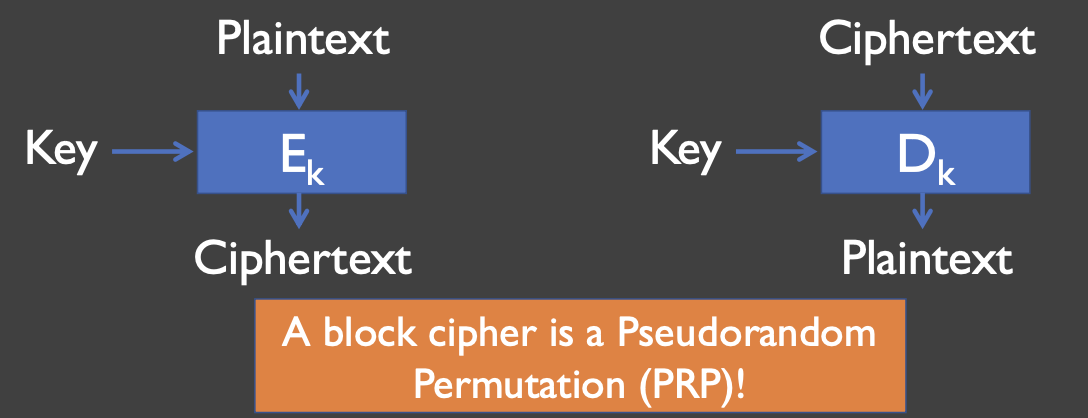
Pseudorandom Permutation
input: n-bit string (or block)
output: n-bit block
confusion
each bit of the cipher text should depend on several parts of the key
destroy features of the plaintext
diffusion
changing a single bit of plaintext, statistically changes 50% of the cipher text bits,
and similarly changing one bit of the cipher text causes 50% of the plaintext bits to change
hides features of the plaintext
Data Encryption Standard (DES)
key: 64-bit quantity = 8-but parity + 56-bit key
input/output: 46 bits
brute force key search
trying 1 key/microsecond would take 1000+ yrs (256)
no longer secure since 56-bit key vulnerable toe exhaustive search
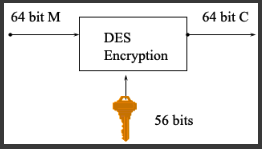
Alternatives to DES
Triple DES (3DES)
168-bit key
no brute force attacks
encryption is slower than DES
Advanced Encryption Standard (
AES)
Advanced Encryption Standard (AES)
most common block cipher
128-bit block size
variable key size (128, 192, or 256)
AES-128, AES-192, AES-256
designed to run fast in SW
How to encrypt longer message?
can only encrypt in units of cipher block size
cut message into multiple chunks
message might not be multiple of block size
add padding to end of message
add n bytes that have value n
must be able to recognize and remove padding after decryption
how to properly encrypt multi-block messages? (cipher modes)
ECB, CBC, CTR
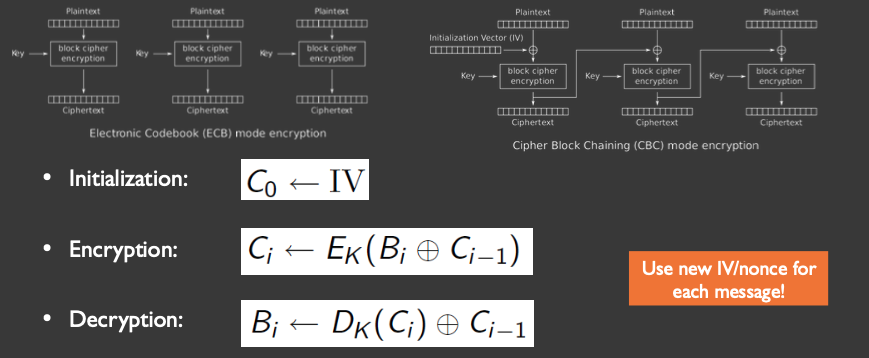
Electronic Codebook (ECB) Mode
just encrypt each block individually
DON’T USE ECB
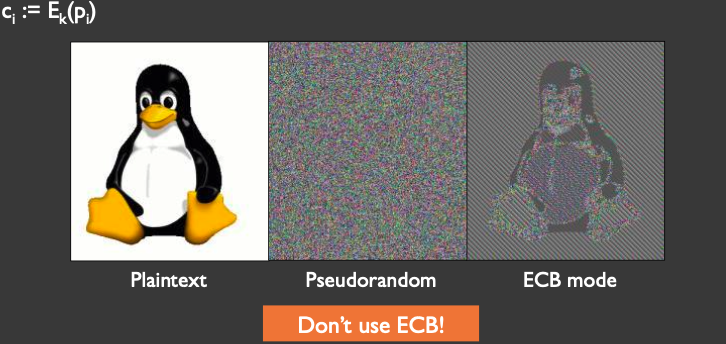
Cipher-Block Chaining (CBC) Mode
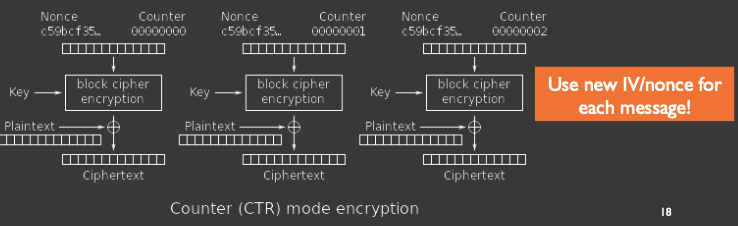
Counter (CTR) Mode
XOR ith block of message with Ek(nonce || ctr)
effectively a stream cipher
blocks can be decrypted independently
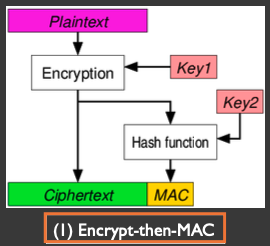
How to enforce confidentiality AND integrity?
Encrypt-then-MAC
“E then M” in the alphabet
Questions
we need two shared keys, but only have one?
use a PRG
we have a reverse channel (Bob to Alice), do we use the same key?
no, use separate keys
in networking applications, we cannot encrypt header. what do we do?
use authentication encryption with associated data (AEAD)
Secret Key (Symmetric) Cryptography
assumptions we’ve made so far: Alice and Bob shared a secret key in advance
limitation: sender/receiver must share the same key
needs secure channel of key distribution
impossible for two parties having no prior relationship
needs many keys for N partiers to communicate
Alice and Bob can have public conversation to derive a shared key
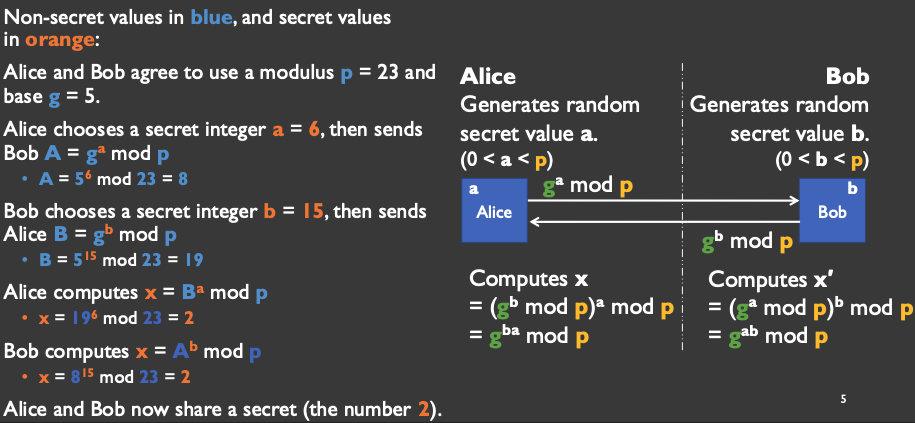
How to derive a shred secret key?: Diffie-Hellman (DH) Key Exchange
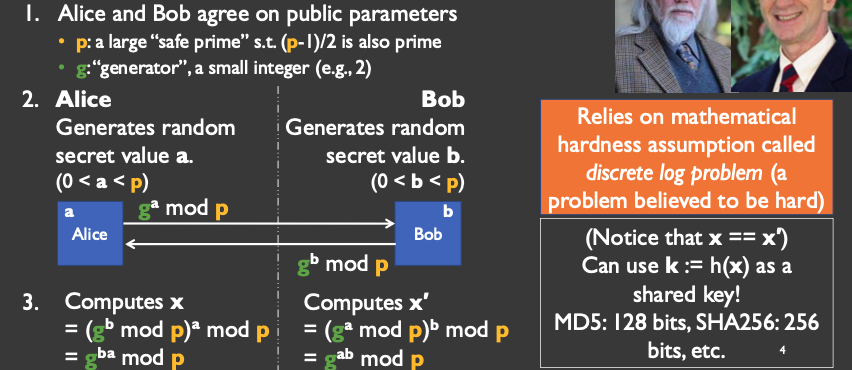
Diffie-Hellman (DH) Example
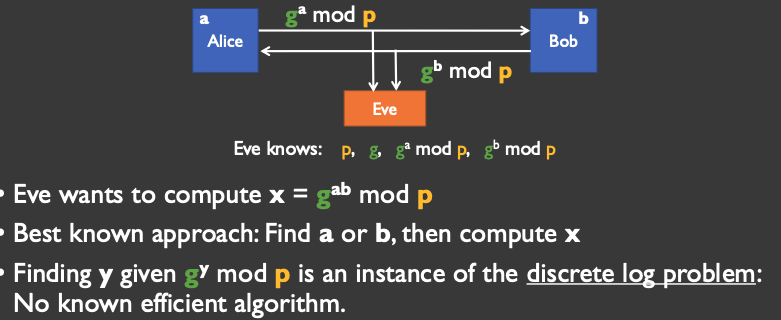
Diffie-Hellman (DH): Passive Eavesdropping Attack
DH secure against passive eavesdropping attacks since no known efficient algorithm
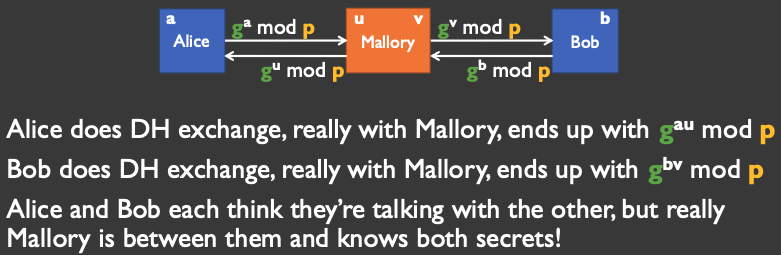
Diffie-Hellman (DH): Man-in-the-middle (MITM) Attack
DH not secure against MITM attack
DH gives shared secret, but you don’t know who's on the other end
Defending against MITM Attacks
rely on out-of-band communication between users (2FA)
rely on physical contact (smartcards)
use digital signuature
Key Management
key management is hard (protecting keys, communicating keys, etc)
each key should have 1 purpose
vulnerability of a ket increases:
the more you use
the more places you store it
the longer you have it
Forward Secrecy
protestation against old keys that have been compromised
learning old keys shouldn’t help adversary learn new keys
compromising an individual session should not compromise future sessions
compromising a long-term key should not enable decryption of recorded cypher text
use short-lived ephemeral keys or sessions keys
Secret Key (Symmetric) Cryptography
assumptions we’ve made so far: Alice and Bob shared a secret key in advance
limitation: sender/receiver must share the same key
needs secure channel of key distribution
impossible for two parties having no prior relationship
use Diffie-Hellman (DH) to determine shared secret key
problem: Scaling
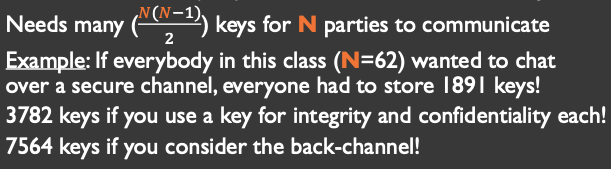
Scaling Problem
suppose Alice publishes data to lots of people, and they all want to verify integrity
can’t share integrity let with everyone, or else anybody could forge messages
suppose Bob wants to receive data from lots of people confidentially
schemes we’ve discusses would need separate encryption key shared with each person
Solution: Public-Key Crypto
Public-key (Asymmetric) Cryptography
so far: encryption key EK = Decryption key Dk
Symmetric-Key Cryptography
require a separate key shared with each person
new idea: each party has a pair (K, K-1) of keys
K is the public key (can be shared with any other party)
K-1 is the private key (kept secret)
private key K-1 to pubic key K (impossible)
pubic key K to private key K-1 (possible)
Rivest-Shamir-Adleman (RSA)
best known public-key cryptosystem
secure based on difficulty of factoring large numbers
uses for encryption AND asymmetric cryptography
drawback: factor of +1000 slower than AES
How Rivest-Shamir-Adleman (RSA) Works
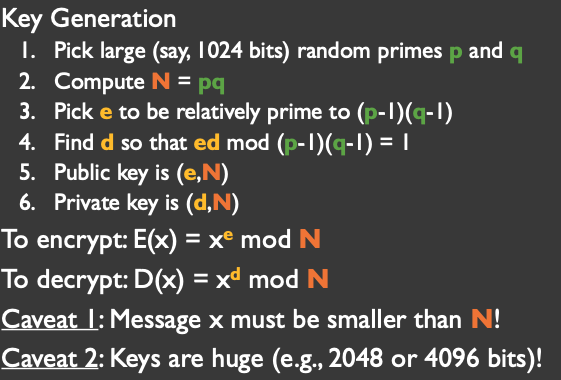
Asymmetric Encryption
Alice wants to send encrypted message to Bob
they know each other’s public keys
Alice encrypts with KB, now only Bob can decrypt with KB-1
D(E(m, KB), KB-1) = m
many can encrypt a message for Bob, but only Bob can decrypt
solves message confidentiality

Digital Signiture
Bob needs to know if the message is coming from Alice
they know each other’s public key
Alice encrypts (signs) with KA-1, Bob decypts (verifies) decrypts with KA
only Alice has her own private key (so message must be from her)
Bob receives Alices’s digital signature d
solves message integrity AND sender authenticity

Question
since RSA encryption is much slower than AES and message lengths are constrained, why bother?
AES requires symmetric key, needs to be derived first
DH fails under the presence of Mallory (MITM attack), so RSA needs to be used to distribute the symmetric (secret) key
how do we distribute the symmetric key using RSA?
RSA with DH
RSA without DH
RSA with Diffie-Hellman (DH)
establish shared secret k using DH (even with Mallory is there)
make sure they’re really talking to each other by exchanging/verifying RSA signatures on k (if Mallory were there, this would fail)
split k into four distinct keys (integrity and confidentiality in both ways)
to encrypt: encrypt with symmetric cipher, then add MACs for integrity (Encrypt-then-MAC)
RSA without Diffie-Hellman (DH)
Alice generates secret key k and encrypts with Bob’s public key KB. Cipher text is sent to Bob who decrypts with his private key KB-1
Use RSA signatures on ciphertext to avoid Mallory from tampering
with the message
Decrypted plaintext is k, now both Alice and Bob can use k for symmetric encryption ( AES).
Split k into four distinct keys (integrity and confidentiality in both ways)
To encrypt: Encrypt with symmetric cipher, then add MACs for integrity (Encrypt-then-MAC)