AP Physics 1 Equations Kinematics, Dynamics, Energy
 Call Kai
 Learn
Learn Practice Test
 Spaced Repetition
 Match
Match Flashcards
 Knowt Play
1/23

There's no tags or description
Looks like no tags are added yet.
Name | Mastery | Learn | Test | Matching | Spaced | Call with Kai | Chat |
|---|
No analytics yet
Send a link to your students to track their progress
24 Terms
Definition of Average Velocity
∆x = Change in Distance [m]
t = Elapsed Time [s]
![<p>∆x = Change in Distance [m]</p><p>t = Elapsed Time [s]</p>](https://assets.knowt.com/user-attachments/9a2da7cb-e866-4c04-8da7-25147e6ca9e9.png)
Definition of Acceleration
∆v = Change in Velocity [m/s]
t = Time [s]
![<p>∆v = Change in Velocity [m/s]</p><p>t = Time [s]</p>](https://assets.knowt.com/user-attachments/9add8b68-dede-4f8c-b0d4-b87bbd780aea.png)
Velocity of an Object as a Function of Time (1 star)
∆x = displacement [m]
v₀ = Initial Velocity [m/s]
t = Time [s]
a = Acceleration [m/s^2]
![<p>∆x = displacement [m] </p><p>v₀ = Initial Velocity [m/s]</p><p>t = Time [s]</p><p>a = Acceleration [m/s^2]</p>](https://assets.knowt.com/user-attachments/653a24dd-bb35-468d-b3df-7a03d505fd87.png)
Displacement of an Object as a Function of Time (2 star)
v₀ = Initial Velocity [m/s]
t = Time [s]
a = Acceleration [m/s^2]
![<p>v₀ = Initial Velocity [m/s]</p><p>t = Time [s]</p><p>a = Acceleration [m/s^2]</p>](https://assets.knowt.com/user-attachments/409f937d-532b-4461-b5fc-466d79bbbcc7.png)
Velocity as a Function Without Time (3 star)
v₀ = Initial Velocity
a = Acceleration
∆x = Distance

Newton's 2nd Law
The net force on a system is equal to the product of its mass and acceleration

Force of Friction
μ = Coefficient of Friction [unitless]
Fn = Normal Force
![<p>μ = Coefficient of Friction [unitless]</p><p>Fn = Normal Force</p>](https://assets.knowt.com/user-attachments/49914a8f-bdab-4faf-b410-0a6f7979631b.png)
Newton's Universal Law of Gravitation (force of gravity between objects in
G = Universal Gravity Constant (6.67 x10^-11)
m1&m2 = Masses [kg]
r = separation between centers of mass [m]
![<p>G = Universal Gravity Constant (6.67 x10^-11)</p><p>m1&m2 = Masses [kg]</p><p>r = separation between centers of mass [m]</p>](https://assets.knowt.com/user-attachments/5de66d50-067f-4bdd-9a02-33251997b4e4.png)
Centripetal Acceleration
v = Velocity [m/s]
r = Radius [m]
![<p>v = Velocity [m/s]</p><p>r = Radius [m]</p>](https://assets.knowt.com/user-attachments/83ef78f9-91d3-4ac2-af97-36937835201e.png)
Kinetic Energy
m = Mass [kg]
v = Velocity [m/s]
![<p>m = Mass [kg]</p><p>v = Velocity [m/s]</p>](https://assets.knowt.com/user-attachments/9b35ba24-cd08-44f8-afc2-3bb7423643c0.png)
Gravitational Potential Energy
m = Mass [kg]
g = Acceleration Due to Gravity [m/s^2]
h = Height [m]
![<p>m = Mass [kg]</p><p>g = Acceleration Due to Gravity [m/s^2]</p><p>h = Height [m]</p>](https://assets.knowt.com/user-attachments/a792d0e7-c04f-4dfd-9977-15921533518b.png)
Definition of Work
F = force doing the work [N]
d = Distance [m]
θ - angle bewteen F & d
![<p>F = force doing the work [N]</p><p>d = Distance [m]</p><p>θ - angle bewteen F & d</p>](https://assets.knowt.com/user-attachments/d30ea869-66e0-4bd8-be9f-8abf6dc1726b.png)
Average Power
w = Work [J]
∆t = Elapsed Time [s]
![<p>w = Work [J]</p><p>∆t = Elapsed Time [s]</p>](https://assets.knowt.com/user-attachments/746d78e6-7037-4eca-b325-2a1408e106cb.png)
Power as a Function of Force
v = Velocity [m/s]
![<p>v = Velocity [m/s]</p>](https://assets.knowt.com/user-attachments/3b181009-e0a1-4bbf-8682-26cffe32b76e.png)
Hooke's Law
Fs = Force on Spring [N]
k = Spring Constant [ N/m]
x = stretch or compression from natural length of Spring [m]
![<p>Fs = Force on Spring [N]</p><p>k = Spring Constant [ N/m]</p><p>x = stretch or compression from natural length of Spring [m]</p>](https://assets.knowt.com/user-attachments/3a37b467-ce50-4b8e-8636-16a5d89ee8d7.png)
Elastic Potential Energy
k = Spring Constant
x = Position of Spring

Period/Frequency Relationship
T = period [s]
f = Frequency [Hz]
![<p>T = period [s]</p><p>f = Frequency [Hz]</p>](https://assets.knowt.com/user-attachments/ef942aca-da3e-4c1e-a9d9-4f385babfda2.png)
Newton's 1st Law
∑F = 0
When the net force on an object is zero, no acceleration will occur.
Force of Gravity
Fg = mg
Fg - force of gravity [N]
m - mass [kg]
g - gravitational field strength [N/kg] (9.8N/kg on Earth)
Newton's 2nd for Circular Motion
∑Fc=mv^2/r
in circular motion, centripetal force causes an inward centripetal acceleration
Work - Energy Theorem
W = ∆E
In an open system,
the change in energy is equal to the work done.
Conservation of Energy
MEi=MEf
In a closed system,
the total mechanical energy does not change
Newton's 3rd Law
Every force has a "force pair" that is equal in magnitude and opposite in direction
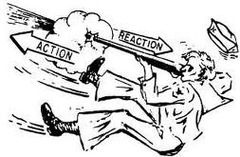
Velocity - Period Relation
For objects in circular motion
V = tangential velocity [m/s]
r = radius of circular path [m]
T = Period (time of 1 rotation) [s]
![<p>For objects in circular motion</p><p>V = tangential velocity [m/s]</p><p>r = radius of circular path [m]</p><p>T = Period (time of 1 rotation) [s]</p>](https://assets.knowt.com/user-attachments/c0710d4e-3fee-4208-a9e6-ce3d4d8fa63b.png)