2) Ocular Analgesics and Pain Management
 Call Kai
 Learn
 Practice Test
 Spaced Repetition
 Match
 Flashcards
 Knowt Play
1/41

There's no tags or description
Looks like no tags are added yet.
42 Terms
What are the characteristics of acute ocular pain?
→ involves recent trauma or surgery
limited duration
resolves when the source of pain is detected and treated
responds effectively to pharmacologic intervention
What are nociceptors? Give their common locations.
→ nerve endings where pain signals are initiated
Viscera
Musculoskeletal system
Structures making up the eye and orbit
What are the stimuli and chemicals activating nociceptors?
Stimuli - strong mechanical stimulation (trauma)
Chemical - serotonin, bradykinin & histamine (released in response to injury)
What is the role of prostaglandins and leukotrienes in pain?
→ DON’T directly stimulate nociceptors
sensitize nociceptors to inflammatory mediators (bradykinin or histamine) which then interact with substance P to stimulate nerve ending

Give the pathway of conduction of ocular pain.
Pain signals originate at ocular nociceptors
Conveyed via trigeminal nerve (CN5) → brainstem
Impinge on cells of the sensory and spinal nuclei of the trigeminal nerve
Sent to the somatosensory cortical areas of the brai
this is where the degree and location of pain are perceived
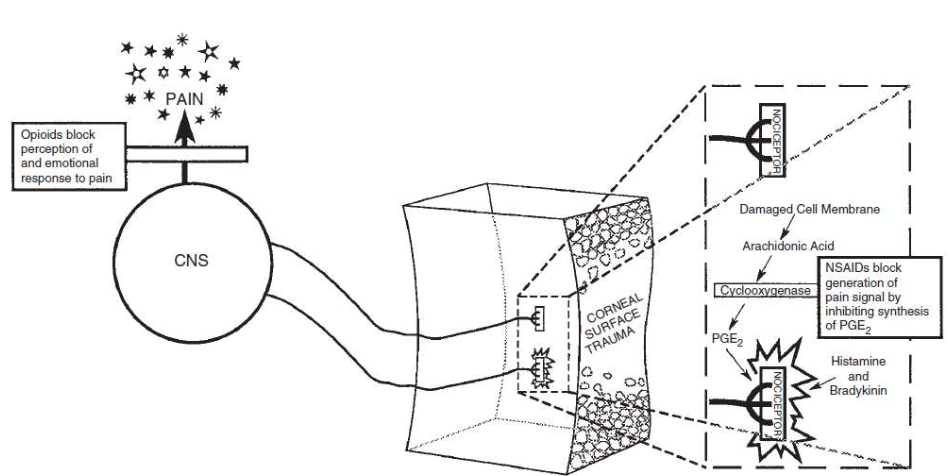
How is arachidonic acid formed? What are the 2 enzymes acting on arachidonic acid and their respective end products?
Trauma triggers conversion of membrane phospholipids → arachidonic acid via Phospholipase A₂ (inhibited by corticosteroids)
COX converts arachidonic acid → endoperoxides → Thromboxane A₂, Prostaglandins (PGE₂, PGF₂ₐ, PGD₂), Prostacyclin (PGI₂)
(inhibited by NSAIDs)
Lipoxygenase converts arachidonic acid → hydroperoxides → Leukotrienes

What are the main targets of peripherally acting agents, anesthetic agents, and centrally acting agents? Give their role.
Peripherally acting agents: Target peripheral pain receptors (nociceptors) to prevent sensitization and discharge
e.g., NSAIDs/aspirin block prostaglandin synthesis at the COX pathway
Anesthetic agents: Target and interrupt the nociceptive signal b/w its peripheral source and central target (in brain or spinal cord)
Centrally acting agents: Target specific CNS receptors to interrupt the pain message +emotional responses (e.g., opioid analgesics)
How does aspirin relieve pain? What is its influence on cyclooxygenase?
→ inhibits prostaglandin E₂ synthesis
causes irreversible acetylation & inactivation of cyclooxygenase
How does the activity of Aspirin change based on dose?
Low doses = analgesic
Higher doses = anti-inflammatory (3 to 4 g daily)
What are the advantages of adding antacids to aspirin formulation?
↓ GI irritation
↑ dissolution and absorption rate of aspirin
What are the advantages of nonacetylated salicylates over aspirin (acetylsalicylic acid)?
Minimal antiplatelet properties
Less inflammatory
Fewer GI side effects
useful for pt who can’t tolerate aspirin or other NSAIDs
What is the adult dose of aspirin?
325 to 650 mg every 4 hours (not to exceed 4 g/day)
Give some major side effects of salicylates.
GI disturbances (dyspepsia, gastric irritation, GI bleeding, gastric ulceration/erosion)
Prolonged bleeding time (12–15 days)
HA, tinnitus, dizziness, deafness
Confusion in elderly pt (>70 yrs)
Reduced renal function
Acute systemic HTN
Congestive HF
Displacement of other drugs from plasma proteins
Reye's syndrome in children/teenagers with viral infections
What are the 2 ways by which aspirin hypersensitivity can occur?
Respiratory reaction - seen in rhinitis, asthma, or nasal polyps pt
Type I hypersensitivity reaction - urticaria, wheals, angioedema, itching, rash, bronchospasm, laryngeal edema, hypotension, shock, or syncope
What are the 4 classic signs of salicylism?
HA
Tinnitus
Dizziness
Deafness
What are the major contraindications to Aspirin and nonsalicylate NSAIDs?
Active upper GI disease
Hx of heavy alcohol use
Hx of bronchial asthma, nasal polyps, or aspirin hypersensitivity
Bleeding disorders, anticoagulant therapy, or vitamin K deficiency
Pre-/postop cataract or other invasive surgery
Chronic renal or hepatic disease
HTN or congestive HF
Pregnancy
Children or teenagers with flu-like (viral) sx
Give the mechanism of action of nonsalicylate NSAIDs.
→ Inhibit cyclooxygenase in injured or inflamed tissues
↓ or eliminating sensitizers (like PGE₂) for peripheral nociceptors
Compare the analgesic efficacy of ketoprofen, ketorolac tromethamine, and Ibuprofen to that of aspirin.
Ibuprofen: Superior
Ketoprofen: Superior
Ketorolac tromethamine: Superior
Give the clinical uses of Systemic NSAIDs.
Treat mild to moderate pain assoc with:
inflammation
postoperative pain
posttraumatic pain
Give the clinical uses of Topical NSAIDs.
Corneal abrasions
Pre/post Betadine 5% treatment for EKC
Post FB removal
Post anterior stromal puncture
Post PKP or laser procedures
Post-cataract surgery care
Treating/preventing cystoid macular edema
Adapting to punctal plugs
Allergic conjunctivitis
Photophobia
Scleritis (adjunct)
Inflamed pterygia/pingueculae
What are the main clinical indications for Bromsite formulation? What is the vehicle used in the formulation and its specific advantage?

Indications
Preventing ocular pain in cataract surgery pt
Tx postoperative inflammation
Vehicle: DuraSite delivery vehicle
Advantage: Extends the drug's residence time on the ocular surface
Compare the effects of COX-1 and COX-2 isoforms of cyclooxygenase.
COX-1: COX-1 products are cytoprotective in the kidney and gastric mucosa
COX-2: makes prostaglandins in inflammatory rxns
Why is Acetaminophen not a drug of choice for inflammation?
weak inhibitor of prostaglandin synthesis
little or no anti-inflammatory properties
What are the clinical uses of Acetaminophen?
Analgesic for mild to moderate pain when aspirin/NSAIDs are contraindicated
Pt w/ upper GI disease (ulcers, gastritis), bleeding disorders (hemophilia), post-cataract surgery, pregnancy, or lactation
Adjunct to narcotics for severe pain
Who is Acetaminophen contraindicated in?
Chronic alcoholism
Preexisting liver impairment (due to risk of liver toxicity and severe liver failure)
What is the benefit of including caffeine and belladonna alkaloids in nonnarcotic combinations?
Caffeine - helps tx certain vascular HA syndromes
Belladonna Alkaloids - antispasmodic properties
What are opiates and opioids?
Opiates - agents derived from opium
Opioids - synthetic or natural compounds having morphine-like analgesic properties
How do opioid analgesics work?
produce analgesia by binding to opioid receptors in the brain, brainstem, and spinal cord → alter physical pain sensation + suffering
How are narcotic analgesics classified?
→ based on their activity at opioid receptors:
Agonists
Partial agonists
Mixed agonist–antagonists
Give the 5 major opioid receptors. What are the receptors at which the agonists mainly act?
mu (μ)
kappa (κ)
sigma (σ)
delta (δ)
epsilon (ε)
Main Agonist Targets: Most clinically useful opioid agonists act primarily at mu (μ) and kappa (κ) receptors
How do the opioids differ from nonnarcotic analgesics?
DON’T have a ceiling effect (↑ doses = ↑ analgesia)
Note: pt can develop tolerance to their analgesic effects
Where is codeine metabolized and into what compound?
metabolized in Liver into morphine via the cytochrome P-450 system
What are the main drawbacks of codeine use?
↑ sedation
↑ GI side effects
Ceiling effect
Compare the potency and side effects of hydrocodone and oxycodone to that of codeine.
Oxycodone
10-12x potent than codeine
produces more euphoria
lower incidence of side effects
has abuse potential
Hydrocodone
6x potent than codeine
less sedation
less constipation
Give the mechanism of action and application of Tramadol.
→ Centrally acting codeine analogue that binds to mu opioid receptors
inhibits NE & serotonin reuptake
Application: Tx moderate to moderately severe pain
Identify an opioid analgesic that has MAX efficacy for analgesia and ability to produce euphoria.
Oxycodone
Give major side effects of opioid analgesics on CNS, GIT, respiratory system and the eye.
CNS: Sedation, lightheadedness, confusion, dizziness, drowsiness, disorientation, euphoria, HA
GIT: Anorexia, nausea, vomiting, constipation, dry mouth
Resp System: Bronchospasm, cough suppression, respiratory depression, breathing difficulty/shortness of breath
Eye: Blurred vision, miosis, diplopia
Name the common analgesics (opioids and nonopioids) prescribed for Children.
Nonopioids
Acetaminophen
Ibuprofen
Naproxen
Tolmetin
Opioids
Codeine
Name the common analgesics (opioids and nonopioids) prescribed for Elderly.
Nonopioids
Acetaminophen
Ibuprofen
Diclofenac
Diflunisal
Fenoprofen
Naproxen sodium
COX-2 inhibitors
Opioids
Codeine + acetaminophen
Oxycodone + acetaminophen
Identify the drug name + drug concentration associated with the following trade names:
Motrin
Aleve
Celebrex
Tylenol
Excedrin migraine tablets
Anacin
Lortab
Vicodin
Motrin: Ibuprofen
Aleve: Naproxen sodium
Celebrex: Celecoxib
Tylenol: Acetaminophen
Excedrin migraine tablets: Acetaminophen (250 mg) + Aspirin (250 mg) + Caffeine (65 mg)
Anacin: Aspirin (400 mg) + Caffeine (32 mg)
Lortab: Hydrocodone + Acetaminophen
Vicodin: Hydrocodone + Acetaminophen
Identify the drug name + drug concentration associated with the following trade names:
Percocet
Darvocet
Ultram
Ultracet
Percocet: Oxycodone (5 mg) + Acetaminophen (325 mg)
Darvocet: Propoxyphene napsylate + Acetaminophen
Ultram: Tramadol (50 mg)
Ultracet: Tramadol (37.5 mg) + Acetaminophen (325 mg)
Identify the drug name + drug concentration associated with the following trade names:
Voltaren
Acular LS
Acuvail
Ilevro
Prolensa
Bromsite
Nevanac
Voltaren: Diclofenac sodium 0.1%
Acular LS: Ketorolac tromethamine 0.4%
Acuvail: Ketorolac tromethamine 0.45%
Ilevro: Nepafenac 0.3%
Prolensa: Bromfenac 0.07%
Bromsite: Bromfenac 0.075%
Nevanac: Nepafenac 0.1%