socpsych exam 3
 Call Kai
 Learn
 Practice Test
 Spaced Repetition
 Match
 Flashcards
 Knowt Play
1/36

There's no tags or description
Looks like no tags are added yet.
37 Terms
Social Facilitation
Arousal enhances the dominant response (the dominant response is something you’re good at, or it’s well-learned): if you’ve practiced something enough, the excitement will improve your performance, but if you haven’t, it will submarine you; if you’re good alone, you’ll be better in front of an audience, if you’re bad alone, you’ll be worse in front of an audience
Group Behavior: Performance Before A Group: [Social Impact Theory]
Social Impact tracks how aroused we are when we perform before a group. Our arousal is a function of (Strength immediacy number)
Strength = How much we care about other people’s evaluation of us. If I am giving a speech to 8 year olds, I probably don’t care, if it is a panel of job recruiters, I might care more.
Immediacy = How connected am I to the audience’s presence. If I am giving a zoom speech, I am pretty disconnected, but if I am in a cramped room giving a speech to people 2 feet away from me, I feel really connected.
Number = Number of audience members. It has diminishing returns, we care about an extra 4th audience member, but not an extra 1000th audience member.
Maze Study
They got subjects to do a paper cornfield type of maze, the independent variable is the difficulty of the maze: ½ of participants got an ez maze, ½ got a hard one; the second IV was if you did it alone or with an audience, the DV was how long it took you to complete the maze. For ppl doing the ez maze, ppl went faster with an audience, but for ppl w/ a hard maze, it took them longer w/ an audience. They also did the same experiment but with anagrams as a more cognitively demanding task to prove that skill/practice and performance under arousal correlate
Other Social Facilitation Studies
Lacing vs Tying shoes: ppl are not used to fully lacing their shoes, so an audience made them slower and worse at it
Basketball: this is the famous example: the psychologists observed free throw stats, and sorted people into two categories: 50% accuracy about, and 80% accuracy about; tested both with and without an audience: with an audience, the 50% group when to 40%, but the 80% group became better (90%? This I don’t think was a given stat)
This is because being in front of audience elicits the threat response in people who aren’t familiar with a task, but the challenge, and competitive response in people who are: this is why you need to practice something until it’s second nature to ensure ideal performance
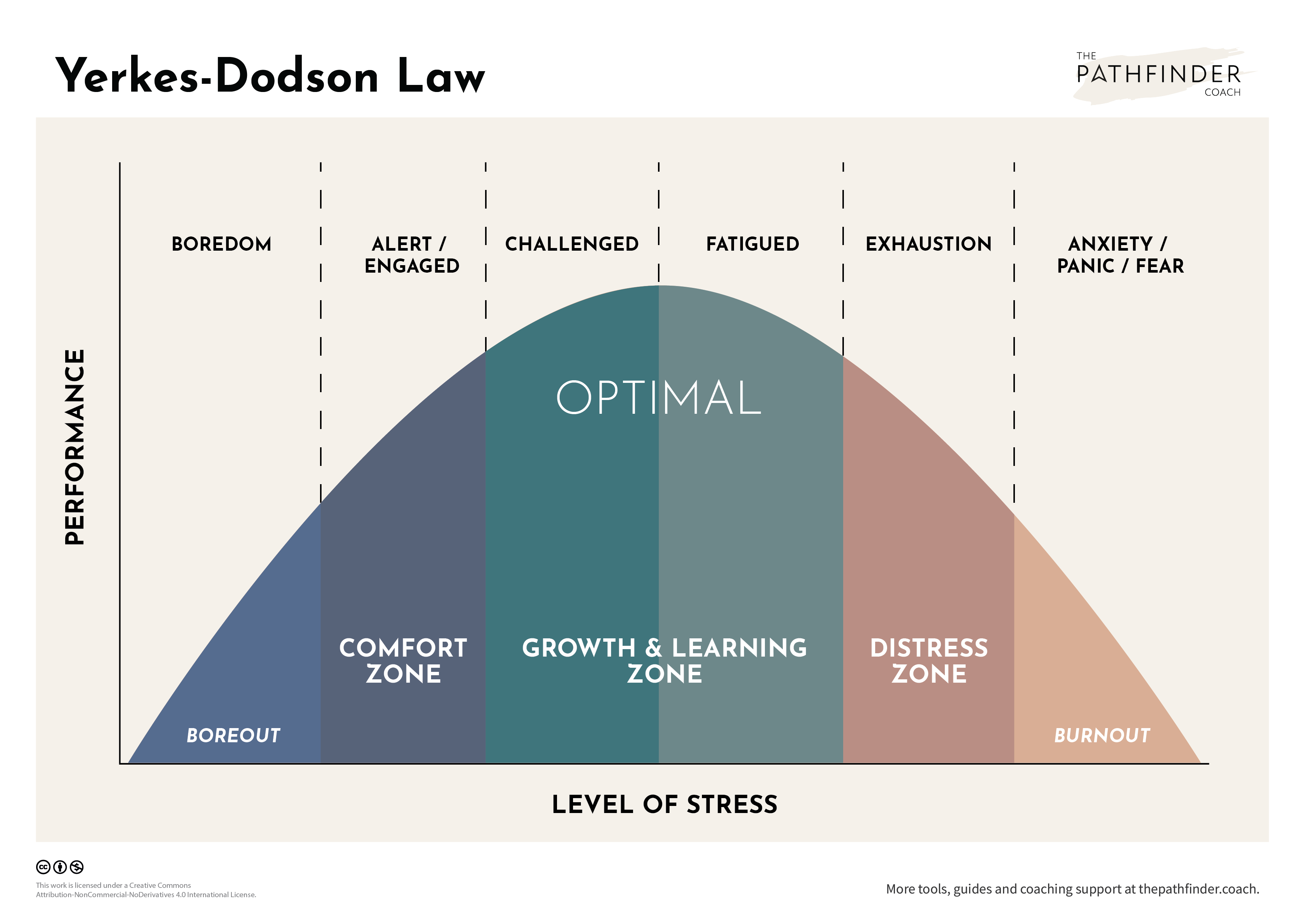
Group Behavior: Performance Before A Group: [Yerkes Dodson]
There is a curve for how arousal impacts our performance. Each person has their own curve for each activity. IE curve is both TASK and PERSON dependent (too much arousal is overstimulated or petrified, too little is bored and not dialled or locked in, low motivation, automatic processing)
-There is an optimal amount of arousal for the best performance.
-If someone is objectively really good at something, their arousal might not impact them as much. Example: Tiger woods has played so much golf that his behavior is pretty automatic, no matter how aroused he feels, he will still perform very well; if the task was ballet, both would have a similar curve because even tho Tiger Woods is the best in the world at something, there is no overall confidence or inherent talent or skill that skews the curve
Social Loafing
Intragroup behaviour: how you act as someone imbedded in a 3-4 person group
Social Loafing is when we are embedded within a group, we don’t work as hard as when doing a task alone
Why: deindividuation, free riding, and diffusion of responsibility (FDR, bc during the Great Depression under him, everyone was loafing, or js sitting around bc they were unempluzz) (all described in later cards)
Ex: to eliminate the skill component (ppl will be less confident and will perform worse in a crowd doing a skill they’re worse at compared to the others), an experiment was made such that ppl come into the lab to shout, either alone, or in groups up to 6; the loudness of shouting (in decibels) was recorded, and every individual shouted louder alone than in groups. To eliminate the social comparison and drowning out considerations, they redid the experiment, but every person was in their own cubicle, that you couldn’t see or hear them, yet js knowing others were shouting into the same collection device made them quieter together than alone.
Then, scientists did an experiment where people were motivated to do the behaviour: clapping in a cheerleading camp (and all should be good at it). They again put them all in cubicles, and despite the motivation and talent, people clapped less when they were in a group.
How to Fix Social Loafing?
Measure everyone’s contributions publically
Ex: in a swim meet, they did a 4×100 where either the total time was all that was visible, or each competitor’s stopwatched times were visible to everyone; when you couldn’t see individual leg time, the overall speed was lower, showing social loafing
Deindividuation
When behaviour is not tied to identity, people will act NON-NORMATIVELY (ie, they aren’t held responsible for their actions, examples are the veil of the internet and mob mentality). There is positive and negative deindividuation:
Ex: positive: subjects are told they’re in a study in group interactions, they go into the lab and they’re told that there’s 7 other participants in 7 other rooms, and soon, you’ll be in a common room where you guys can talk about whatever. The independent variable was whether or not the common room was lit (if it isn’t, you can’t see their others’ faces). They blindfolded everyone until they got to the common room, and on the way back, so if you weren’t meant to see the others, you never would, and you wouldn’t recognise them outside of the experiment bc they’re at the same college. The group in the dark’s conversation was judged to be more positive (more fun, the disclosed more, like their aspirations, they talked about things they love about college and more, because deindividuation frees you from impression management, so you can be chalant; also, if they see you, they could match info to a name, and your private details could go somewhere where you don’t want, so if you everyone can see you, you’re more socially cautious
Negative: a researcher had a police scanner, and whenever there was a (suicide) jumper, the would measure the crowd’s reactions (ie, how many people told the jumper to jump). People were more likely to be mean, and encourage the jumper to jump, if they were in a larger group (because in a group of 50, everyone is shouting, so nobody knows who is being mean, or non-normative, freeing you to be non-normative, ie mean). Also, the higher height of the jumper dehumanises them (because they’re so far, you don’t factor them as one of us), which deindividuates them (makes them not a person), so the crowd is more likely to tell them to jump
Halloween Study
Adult lets kids into house for trick or treating, adult says they’ll be in the kitchen, and just to take one live of candy from the bowl, then leaves them alone. There is a bowl of candy, and one of quarters, and there is also a mirror, the kids who looked in the mirror would be less greedy because they are self-aware (want to match actual self to ideal self, self-discrepancy). Importantly, scientists measured which kids’ costumes you could tell their identity vs u couldn’t (if you can’t see their identity, they’re deindividuated), and the more deindividuated kids took more (they acted non-normatively: selfish and greedy, not listening to adults)
Diffusion of Responsibility
When we are embedded in a group, each group member shares the responsibility for the outcome of a group, thus each person doesn’t feel as responsible for ensuring that the group succeeds.
Example: If I work on a company project with 1,000 other employees, if the project isn’t completed on time, the blame of that failure does not solely go on me, thus I can slack off if I want.
Free Riding
Free-riding is the phenomenon that people who social loaf have an advantage for social loafing. They benefit from the group's success without having to contribute.
-It allows me to save time and energy
Example: If I join a bunch of academic clubs and barely participate, I get to add on my resume that I was part of successful club which did XYZ which reflects well on me, even though I barely contributed.
Maximising vs Optimizing:
When a group is maximizing, they are simply trying to produce the greatest quantity of something. They are often in automatic processing and more likely to social loaf.
Example: Trying to solve as many questions as possible in a group quiz with a tight time constraint.
When a group is optimizing, they are trying to create the best version of something possible. They are often in controlled processing.
Example:Trying to solve a group test with no time constraint.
(All group task types: MO, AC, DC, I want MO AC/DC, I would work (do a task) for that, idk)
Additive vs Compensatory:
Additive is when a group needs to maximize its output and individuals all add their individual contributions together to create the group output. Individuals doing this are prone to social loafing.
Example: The task is for the group to create the most paper airplanes and each individual contributes by individually folding paper airplanes and adding it to the group total.
Compensation is when the group result is the average of each members, so each member’s accuracy matters.
Example: A group tries to estimate the temperature of a classroom and the group result is the average of all the members’ results.
Disjunctive vs Conjunctive:
Disjunctive is when the group is as good as its best member.
Example: A group is participating in group trivia. As long as one member knows the answer, it doesn’t matter how little everyone else knows.
Conjunctive is when the group is only as strong as its weakest member.
Example: Each group member has to take turns adding 2 cards to a card pyramid. If one group member is terrible at it, they will keep knocking down the pyramid.
How to combat groupthink?
Generate ideas first (either separately, or when sharing, don’t allow anyone to evaluate), and then once the well dries up, evaluate as a group. Why?: studies have shown that evaluating as u go (as soon as an idea is introduced, reacting to it) changes the tide towards the idea if the rxn is positive, and away if negative, limiting creativity (also, if someone is punished for stating an idea early doors, they might not want to contribute anything later)
Groupthink
When you have more minds collaborating, it typically leads to better ideas, but groupthink is a phenomenon where there is a deterioration of decision making that results from structural flaws and ingroup pressures, often leading to a disastrous decision.
Variables
Central Leader
-Someone with the final say and whose opinion matters the most.
Gatekeeper
-Someone who filters all the messages going to the central leader. This means they can sell all the upsides of an idea and not share any of the negatives. They can also reward or punish the regular group members due to their power of proximity to the central leader, so the gatekeeper can reward members who agree with their ideas and punish members who disagree. This creates a pressure to conform to the gatekeeper.
Pressure to uniformity:
-The group feels pressure (often from the gatekeeper) to come to a consensus because a group should agree and there shouldn’t be in-fighting.
Pluralist Ignorance
-People sometimes drop their doubts because they assume other more intelligent people already accounted for them
Self-censorship
-People with doubts often self-censor themselves because they don’t want pressure from the gatekeeper and because of pluralist ignorance
Example: The JFK administration executed the Bay of Pigs Invasion which was a terrible plan to sent ex-Cubans to infiltrate Cuba and start a revolution
Example: The challenger spaceship exploded after launch. There was a central leader (flight commander) and there was a gatekeeper. A lot of engineers had doubts about the weather that day, but there was pressure to launch that day because the entire US population was looking forward to seeing the launch, so the engineers self-censored their doubts and assumed that other people already accounted for the weather conditions.
Minority Influence
The idealised idea that one hold-out can flip the majority’s opinions
Ex: 12 Angry Men/jury duty
Also Johnny Rocco Study! 85% gave in to majority, and the vast majority of the 15% who didn’t, only held just their ground, didn’t go onto to change the others’ opinions
How to do it tho?:
Consistency: (don’t agree with them an inch, if you do, the majority will take a mile and hound you to follow the path)
Confidence
Objectivity: don’t become emotional, make it clear that your attitudinal position is influenced by only the facts
Independence: if you have a relation to the topic or stakes in it, it’s harder to be taken seriously and objectively (bc correspondent inference theory: the glaring difference among similarities would explain to them why you chose your action, ie, a personal or emotional connection is not a good reason for having an attitudinal position, so the majority will smell blood)
(Remember COCI bc you have to be cocky to succeed in this)
Contingency Model:
No Big 5 trait makes you a better leader, instead, two abilities do (like social-monitoring, ppl who can do both, and know when to do each (be positive vs productive), are the best single leaders, but a leadership group of both is equally as effective); they are:
Task leadership; good at keeping team members locked in on task, they put the hammer down to make them drill the important stuff (they know when to lay down the law, crack the whip, etc)
Socio-emotional leadership: feel vibe of group, listen to group members and make them feel like they have a say, improve morale, make them feel valued and heard, like they’re part of the team really, do team-building, and pick the pieces up when they’re chastised by the task leader
A lot of the research comes from military promotions
Public Goods Dilemma
Everyone has to contribute to a resource to keep it alive, however if everyone is doing it, you can afford to not (free ride)
Ex: NPR (public radio stations rely on donations for survival, but everyone could js listen in w/o donating, but when ppl do that, the station goes under, so everyone, even those who paid, lose, so the solution is everyone do the minimum (equitable, not necessarily equal ig)
Ex2: recycling can be a hassle, but not doing it kills the planet we live on, ppl think they’re js a drop in the bucket, but if everyone thinks like that (and logically, they would), then nobody would recycle, and we’d not have a world to enjoy with all the free time you saved not recycling
Social Dilemmas:
The conflict between wanting to maximize self-interest versus the interest of the group as a whole. (This is specifically for LARGE GROUPS)
Commons Dilemma:
When people are taking from a common resource (oftentimes a natural resource), if they act selfishly, they will benefit, but eventually they will use up the common resource.
Example: The commons is a communal grazing area. If every farmer tries to maximize their sheep herd size, the commons cannot sustain the population and will be used up.
Example: If everyone overhunts Great Whales for their bones, they will go extinct; If everyone cuts down the rainforest for wood, there will be no more trees; if everyone overhunts lobsters, there won’t be any left.
-Sometimes, people will overuse the common resource not out of greed, but out of fear that they will miss out.
General Social Dilemmas:
Unrelated to a group resource, It is when a group might suffer if everyone acts selfishly.
Example: When single occupancy vehicles use the HOV lane, while the environmental impact is the same, it backs up the HOV lane and it will eventually be just as backed up as the regular lane.
Example: If everyone takes the grass path shortcut outside Levering, eventually the grass path will deteriorate and become an eye sore which hurts everyone.
Ways to reduce selfish-behaviour:
All factors: Normative issues; smaller groups; deindividuation; operant conditioning (DONS, bc real DONS aren’t selfish)
Normative Issues:
Normative and informative social influence. If you can establish a norm that you restrain yourself in a social dilemma, people are pretty strong norm followers, so they won’t act selfishly.
Example: During the San Antonio Water Shortage, an NBA player was called out for still watering his lawn which broke the norm of conserving water, so the NBA player felt pressure to defend himself and tell the public that there was a water leak. (example of normative social influence)
Informative social influence example: During the OPEC oil crisis, lightswitches were labeled with a sign that said to turn off when not in use to save electricity and oil. Thus you followed the norm to do the correct thing: save oil.
Descriptive and injunctive norms.
Descriptive norms, information about what most people do. If I distribute signs that say 85% of Hopkins students recycle, I feel compelled to recycle.
Injunctive norms are what people ought to do. This is like the subjective norm from the reasoned action model. They are most powerful when it comes from people close to us. If I am in a neighborhood that cares about recycling, I am more likely to recycle, because the pressure around me says that I ought to recycle.
Smaller Groups:
In a smaller group people show more restraint because they feel like their behavior makes a bigger impact.
Example: Being 1 of 8 people who selected 10 points, has a smaller impact than being 1 of 2 people who selected 10 points.
Deindividuation: Identifiability.
When someone can be identified, their actions can be tied back to them, so they are forced to clean up their act. If the extra credit poll was public, people would respond less selfishly.
Operant Conditioning (rewards/punishments): If people are rewarded for showing restraint, there are more likely to act that way in the future.
Example: You can set a recycling goal and if your group makes the goal, you have a pizza party.
-If people are punished for being selfish, they are less likely to act selfishly
Example: If there is a fine for not recycling properly, you will start recycling properly.
-When it comes to punishments, people also weigh the odds of getting caught. For example, Maine established lobster fishing limits but people did not follow them until they started getting enforced through many police boats.
Group Behavior: Intragroup Behavior: [Discontinuity effect]
-When you compare intergroup behaviour and inter-individual behaviour, intergroup behaviour is much more competitive.
Ex: in double tennis vs singles, players are more likely to be aggressive and challenge calls
Prisoner’s Dilemma Game (PDG):
You can either act selfishly and increase your own outcome or you can cooperate. The best strategy is for both parties to cooperate, but you take on the risk that the other person can screw you over.
-In interindividual interactions, individuals cooperate about 95% of the time. They put their trust in the other individual. With groups, they cooperate only 50% of the time.
-Sometimes people act selfishly not out of greed/sadism, but out of fear that the other party will act selfishly, so there is also the Prisoner’s Dilemma Game Alternative PDGalt. There is a 3rd option, Z. If you choose Z, you will get Z regardless of what the other person chooses.
-for PDGalt, groups cooperate 50% of the time, act selfishly 25% of the time, and choose Z 25% of the time showing that not everyone acts greedily, sometimes they just act out of fear.
X is a cooperative response, Y is competitive, Z is fear

Large Intragroup Issues: Crowd Behaviour: Destructive Events:
Destructive events are purposeful negative behaviour (like property destruction, violence, looting, etc)
Ex1!: “I’m js here for the riot): Bruins beating Vancouver team in Vancouver to win Stanley Cup
Ex2: Knicks winning chip
Ex3: Celebrations after PSG won UCL (twopeat), js France in generally rlly
Ex4: BLM protests
Social Rage Approach
A theory for why crowd behaviour leads to destructive events: there must be some system issue (racism, police brutality), and as the straw that breaks the camel’s back, an unpopular verdict (legal, assassination, sports defeat)
The problem with that idea is that most protests are bc of a system issue, and are organised, sparked by an event, however they’re mostly peaceful; also, this happens in the face of good news (PSG winning UCL, UNC reaching NCAA final)
How destructive events develop:
Unifying event: (ppl need to be massed together, it can be spontaneous or planned, it can be open, closed, or mixed: open = u can come and go as u please, closed = must be part of a group to participate (show membership), mixed = start closed (usually), then ppl join cause and pour in
Convergent Norm: enough people in the group must be inherently down for destruction if it were brought up/permitted (most ppl doing crazy stuff have no past, they js get caught up in the atmosphere)
Instigator: ppl can be in the mood, and would technically be down to do it, but until one brave soul decides to open the door to this being a possible outlet (most ppl need social support for this action), people will typically weigh that the benefit, whatever it may be, is not as big as the consequence of being caught, and worse, it not catching on (aura loss)
Ex: Spike Lee’s movie “Do The Right Thing”, there was alr civil unrest (police brutality), but throwing a thrash can thru a window set riot off
(ICU, bc destructive events may leave u in the ICU)
What happens after the instigating action?
Contagion (Le Bon’s 1895 Psychology of Crowds): the crowd mentality and adrenaline and excitement spreads, and ppl get swept up by it (intoxicated basically?), so people end up doing crazy stuff as an outlet for that energy (their frontal cortex is inhibited)
Emergent Norm: a new, counter-culture norm that arises from a scenario (here, the norm is against destructive behaviour, but post-instigation, it becomes normalised, so people do it because normative social influence and social comparison theory(?)
Deindividuation: crowds inherently create crazier action bc when your actions are swallowed up, and responsibility is diffused by the mob (nobody will know what YOU did), you are freed to act non-normatively (break stuff)
(DEC, bc I was taught that declamations were normal, therefore the emergent norm is for me to memorise shit I don’t have to)
Ex: in Dr. Drigotas’ Co-Ed frat thing, ppl were hanging out in the house after finals, and one kid thinks he bombed his Orgo final, so an instigator suggests they burn the book for catharsis; when they do it, the emergent norm is to burn things, and this contagion spreads, escalating things till firemen had to come, and then the responsibility hit them, so leader dipped
Reasons for intergroup competition:
-Schemas of Fear and Greed
-Social Support for Greed
-Diffusion of Responsibility
-Deindividuation
-Reciprocity Effects
-Ingroup-outgroup bias
-Social identity theory
(DDSSRIS, bc DD and SSRIs are a cure for depression, which can be an effect of intergroup competition, but also you could think Double Duty SSRIS, bc we’re gonna need extra strong anti-depressants after having to memorise all this)
Schemas of Fear and Greed:
As children, we develop schemas that competitiveness and greed is okay for group activities, but not okay for one on one interactions. You first develop the schema for greed, but once you realize that other people can act out of greed, you develop the schema for fear.
Social Support for Greed:
Within groups, there can be social support for the greedy behavior and this can’t happen when you are by yourself.
Experiment: A confederate would be planted in the PDG group. Groups have 30 seconds to make their decision, in that 30 seconds, the confederate is either neutral or floats a greedy response. When you have a confederate supporting a group response, it ramped up competitiveness to 70% of the time.
Diffusion: When you are by yourself, your greed reflects back on you 100% of the time. It is all on you for screwing the other participant over. In groups, the responsibility of the group behavior is diffused. Oftentimes the PDG spokesperson will blame their group members for choosing the selfish option.
Deindividuation: When the decision to choose the selfish option cannot be tied to your own identity, this frees you up to behave competitively and greedily. In one study, the PDG participants had a nametime which individuated the players. Because their identity got tied to their behavior, group competitiveness went down. Groups chose the selfish option only 30% of the time instead of 50%.
Reciprocity: While individuals can regret screwing each other over and apologize and willingly take a loss so they can thereafter cooperate, groups really want to screw each other over if they get screwed over. When one group acts selfishly, it breaks down the trust between the two groups and it makes the other group want to reciprocate by also acting selfishly. While individuals can rebuild trust, groups struggle to.
Ingroup-outgroup bias. You have more positive attributions about your own group and you make more negative attributions about the other group. This leads to competitive behavior. If my group is better, we deserve to win, we deserve more.
Social Identity Theory: Part of our self-esteem comes from group membership, therefore, you want your group to do better than the other group because that will reflect back onto you. Even with a minimal group paradigm
Example: Subjects are put in either a blue or green group and they compete against each other. If a subject from blue is pulled out and asked to distribute $100 among the subjects, they will distribute the money among the blue group even though they have no real attachment nor reason to be part of the group.
Minimal Group Paradigm
Being assigned to a group arbitrarily (there is no real reason or connection that you’re part of the group, eg, there is no reason why you would be team green vs team blue, but even if you’re arbitrarily labelled that, you will defend your team stronger, and make strong positive internal attributions about your team and its members, and the opposite team)
Reduction of intergroup competition:
Simple Contact Effects: if you get people together on equal footing, when they talk, their similarities will be more evident, and differences will seem smaller (doesn’t work, as seen in Brown v Board of Education (desegregation), and Robber’s Cave Study)
Higher Level Goals: unite the two groups pitted against each other against a common enemy
Ex: Robber’s Cave Study
Having a good interaction with opposite side
Ex: 2 Groups made by minimal group paradigm in study, the two groups participate in the PDG and trivia and stuff to make competition, then, one representative from both teams has to work with the other in a creative task, it goes well and is fun, and when they go back to their group, they share that, so not only is that individual’s perception changed, but coming from an in-group member, that perception is believable, and so it changes the dynamics
Robber’s Cave Study
-random 11/12 year old boys from a homogenous background (midwestern, Protestant, middle-class; same number of siblings etc) go to a summer camp and get assigned to groups
Ways to increase competition:
-The groups pick their own names: Eagles and Rattlers. Naming the group ties the boys to the group. The groups have their own housing.
-The group will win a trophy for a day if they win at an activity
-Soon the groups are fight: Food fights, dorm raids; etc, so the researchers want to reduce competition
Ways to reduce competition:
The researchers try to reduce competition through simple contact (force the boys to mingle during lunch) but it doesn’t work.
-What worked was the creation of high level goals. When the water truck got stuck in a ditch, the two groups had to work together to get it out of the ditch, one group had a winch, the other group had a chain.
-They had a camp olympics with another camp which also reduced competition because the boys were united and instead of the Eagles vs the Rattler, it was the Robber’s Cave vs the other camp.
Interpersonal Attraction: Impact of First Impressions:
First Impressions have an enormous impact this is due to Primacy effect; Confirmation Bias; Overconfidence
Primacy Effect: When we first learn something about someone, we weigh in on that information more heavily and remember it better.
Confirmation Bias: We build our schemas about someone based off our first impressions and then commit confirmation bias as we pay attention to things that strengthen our existing schema and ignore information that contradicts our schemas.
Overconfidence: People tend to be more confident that their first impressions of someone is accurate than it really is. This is seen even in relationships.
(COP, bc cops use first impressions to choose their actions)
Physiological Arousal as a Cue for Attraction
When you’re in the presence of someone you fancy, you experience physiological arousal (adrenaline, excitement, sweating, increased heart rate, flushed skin, butterflies in the stomach, cotton mouth, etc). Ergo, if you hypothetically felt arousal not caused by a person, and associated it to a person, your brain, which is used to the causal effect, might take physiological arousal as a cue for attraction
Ex: in a park, there’s a scary bridge, and a non-scary bridge (scary bridge is scary bc it’s rickety, a rope bridge, and it overhangs a massive chasm, the non-scary bridge is concrete and covers a small pit); in the study, they got an attractive female research assistant to randomly stop guys and ask them about their experience, like the helpfulness of the signage, the amenities, etc. After the guys cross the bridge, a different person stops them, and asks them to rate how the research assistant (posed as a trainee) did (how well she did her job, her looks, and also if they wanted her number to “follow up and ask any questions”). People who had js immediately went over the scary bridge (been aroused), were more likely to take her number, and call her (used as a metric of defining how attractive she was to the guys), than the ppl who took the non-scary bridge.
This was a quasi experiment, bc they didn’t choose who went thru which bridge, so perhaps guys with more testosterone, and ergo, are higher risk takers, would take the rickety bridge bc they enjoy the rush, and are also more likely to take the number and call bc of that hormonal reason; to address this concern, they did another study:
They got straight ppl to sign up for a learning theory; they were then put into a waiting room with a research assistant and confederate. The research assistant then showed them a shock machine, and said, like the Milgram Shock Experiment, if you get a question that they will ask wrong, you will either receive a small shock, or big shock (some people were told small shock, some told big, these were the two IV groups). After hearing this news, they’re returned to the waiting room, and asked, while they’re waiting, to do a survey rating the room (demand characteristic), and also the confederate. The group who was told they were gonna get a big shock, ie, they’re aroused, found the confederate more attractive in average than the small shock group did. This was seen in both genders
Operant Conditioning as a factor of the learning theory of attraction
We are attracted to people who reward us (if spending time around them is rewarding, we have a positive attitude shift towards them), and people who punish us for being around them (draining to be around, high neuroticism, mentally costly and taxing), we don’t like
Ex: Flattering someone will increase their attraction to you (even if they can tell it’s not genuine or there’s an ulterior motive); bc it makes you feel good to be rewarded with positive words, it does operant conditioning
Ex2: Reciprocity Effect: When someone likes you, they’re doing you a favour, so you feel motivated to like them back (there are limits to this, ie, you won’t reciprocate to a completely ridiculous level, or you won’t like someone you are actively repulsed by probably, but you feel an obligation to like those who like you because they’re good to you)
(FR, bc these can be easily observed in real life)
Social Exchange Thoery