Chem Final Flashcards- Reactions
 Call Kai
 Learn
 Practice Test
 Spaced Repetition
 Match
 Flashcards
 Knowt Play
1/40

There's no tags or description
Looks like no tags are added yet.
41 Terms
Methyl substrate
SN2
Primary substrate without bulky base
SN2
Primary Substrate with Bulky Base
E2
Methyl substrate and primary substrate with strong base
SN2
Sterically hindered substrate with strong or bulky base
E2
Aprotic- DMF, Acetone, DMSO
SN2
Protic
SN1 and E1
Tertiary Substrate
SN1 and E1
Secondary Substrate and protic
SN1 and E1
Secondary Substrate and aprotic
SN2
Secondary Substrate and Strong or Bulky Base
E2
Special thing that happens in SN2
inversion
Special thing that happens in SN1
racemic mixture
Zaitsev Product
elimination
more substituted alkene
Hoffman Product
elimination
less substituted alkene
Markovnikov Product
addition
nucleophile attracted to more substituted carbon
Anti-Markovnikov Product
addition
nucleophile attracted to less substituted carbon
Alkyne to Cis Alkenes

Alkyne to Trans Alkene

Markovnikov Hydrohalogenation

Anti-Markovnikov Hydrohalogenation

Acid Catalyzed Hydration
Markovnikov

Oxymercuration-demercuration
Markovnikov for OH and Anti

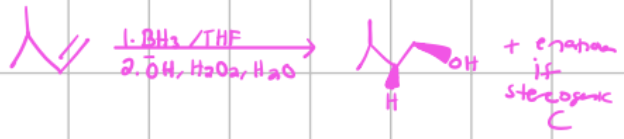
Hydroboration
Anti-Markovnikov, Syn
Halogenation
Anti

Halohydrin
Anti and Markovnikov

Ozonlysis

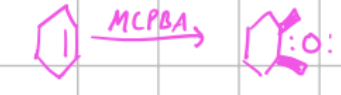
Expodiation
Syn
Anti-Dihydroxylation


Syn-Dihydroxylation

Cycloproponation
instead of hv can be heat

Hoffman

Vicinal Dihalides Dehydrohalgogenation

Vicinal Dihalides Dehalogenation

Cyclopronation with chcl3

Br2 hv or ROOR
Markovnikov

Oxymerucuration with Alkynes

Syn Dihydroxylation ( Meso or Racemis)
Cis Alkene →Meso
Trans Alkene →Racemic
Anti Dihydroxylation ( Meso or Racemis)
Cis Alkene →Racemic
Trans Alkene →Meso
Chromic Acid Reactions
Primary Alcohols to Carboxylic Acids: Chromic acid oxidizes primary alcohols first into aldehydes and then straight through to carboxylic acids.
Secondary Alcohols to Ketones: Secondary alcohols are oxidized cleanly into ketones.
Aldehydes to Carboxylic Acids: Aldehydes are rapidly oxidized to carboxylic acids (via a gem-diol intermediate in aqueous acid).
Tertiary Alcohols: Do not react because they lack an alpha-hydrogen atom. [1, 2, 3, 4]
