Learn: Introduction to Physiology, Homeostasis, and Body Tissues
 Call Kai
 Learn
 Practice Test
 Spaced Repetition
 Match
 Flashcards
 Knowt Play
1/27

There's no tags or description
Looks like no tags are added yet.
Name | Mastery | Learn | Test | Matching | Spaced | Call with Kai | Chat |
|---|
No analytics yet
Send a link to your students to track their progress
28 Terms
What is physiology?
The study of how the human body works, emphasizing cause-and-effect mechanisms.
What does pathophysiology study?
How physiological processes are altered during disease or injury.
What are key elements of physiological research?
Quantitative measurements, control groups, and statistical analysis.
What is homeostasis?
The state of relative constancy of the body's internal environment, crucial for health.

Who pioneered the concept of homeostasis?
Claude Bernard, named by Walter Cannon.
What is dynamic constancy in homeostasis?
Physiological variables fluctuate within a normal range around a 'set point'.
What is the primary mechanism for maintaining homeostasis?
Negative feedback loops.

What are the components of a negative feedback loop?
Sensor, integrating center, and effector.
How does the body regulate temperature?
Using antagonistic effectors that have opposite effects.

What happens when body temperature rises?
Sensors detect high temperature, and the integrating center stimulates sweat glands.
What is positive feedback?
A mechanism where the action of effectors amplifies changes, moving the body further from its starting state.
Give an example of positive feedback.
Blood clotting and childbirth.
What are the two main regulatory systems for homeostasis?
Nervous system and endocrine system.

What is the role of the nervous system in homeostasis?
Regulates organs by sending electrochemical impulses via nerve fibers.
What are the four primary types of tissues in the body?
Muscle tissue, nervous tissue, epithelial tissue, and connective tissue.

What characterizes muscle tissue?
Specialized for contraction and movement.
What are the types of muscle tissue?
Skeletal muscle, cardiac muscle, and smooth muscle.
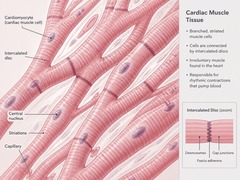
What is the function of neurons?
To generate and conduct electrical impulses.

What distinguishes epithelial tissue?
It forms membranes that cover surfaces and line cavities.
What is connective tissue primarily composed of?
An extensive extracellular matrix of protein fibers and ground substance.

What are the major functions of the integumentary system?
Protection and thermoregulation.
What are adult stem cells?
Undifferentiated cells that can become various cell types for repair and renewal.
What is the difference between totipotent and pluripotent stem cells?
Totipotent can become any cell type, while pluripotent can become any body cell except placental cells.
What is the extracellular compartment (ECF)?
The fluid outside the cells, divided into blood plasma and interstitial fluid.

What is the primary function of the circulatory system?
Movement of blood and lymph.
What is the largest organ of the body?
The skin.

What is the role of the basement membrane in epithelial tissue?
Anchors epithelial tissues to underlying connective tissue.
What is the significance of homeostasis in health?
Illness can be seen as a failure of homeostasis.